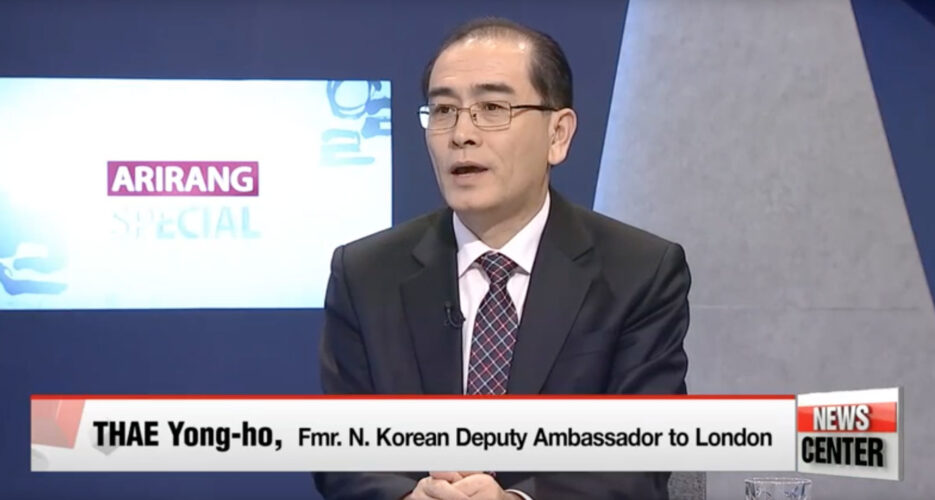

Thae Yong Ho, the high-profile North Korean diplomat who defected to Seoul in mid-2016, conducted his first extended English-language interview on South Korea’s Arirang TV on Tuesday evening.
During the interview, Thae spoke at length on subjects including the prospects for reunification, sanctions, and Kim Jong Un’s actions after succeeding his father in 2011.
He even offered advice to the newly established Trump administration in dealing with North Korea’s nuclear developments.

Thae talks to Arirang presenter | Picture: Arirang
Trump, America and denuclearization
It’s no secret that many feel President Trump could soon face a looming crisis related to North Korea’s commitment to advancing its nuclear capabilities.
“If the American and South Korean government accept this kind of compromise deal then it only serves to justify so far the stance of North Korean regime”
But Thae, who previously spoke on behalf of North Korea’s right to nuclear weapons during his tenure at the country’s embassy in London, strongly recommended the United States and South Korea against making any potential deals with Kim.
“Kim Jong Un wants to make a kind of deal on temporary ban on nuclear tests and ICBM tests in return for the cancellation of joint military drills and easing of sanctions against North Korea,” Thae said.
“It seems very fine his offer – and even some American experts agreed on this kind of approach – but if the American and South Korean government accept this kind of compromise deal then it only serves to justify so far the stance of North Korean regime.”
Thae warned against legitimizing the argument constantly presented by the North: that their weapons are a necessary deterrent to what it deems a hostile U.S. policy embodied by annual joint U.S.-ROK military exercises on the peninsula.
He also said that any deal involving a potential freeze or recognition that North Korea is a nuclear state would help Kim achieve a primary goal.
“If this kind of deal or compromise is reached then… it accepts the present North Korean nuclear address so it may also justify legally the present current state of North Korea, which is what Kim really wants to do,” Thae said.
“They should not compromise on North Korea nuclear issues… the American and South Korean governments should not be deceived by these kind of tactics.”
It seems Thae’s recommendations could likely be adopted if his assessment of previous Republican administrations holds true in 2017, describing the negative history between North Korea and the U.S. under previous Republican administrations.
“So far American Republicans have been very negative. They are very hard-line and to my impression these days most of the president-elect Trump’s security and diplomatic lines are consisted of these kinds of hard-liners,” he said.
“I can feel that the future Trumps’ policy would be more near hard-line rather than the soft.”
In contrast, he referred to key visits by then former President Bill Clinton as well as Secretary of State Madeleine Albright during Democrat administrations.
On the topic of denuclearization, Thae also touched upon Chinese foreign policy, saying that North Korea obtaining nuclear weapons is not in Beijing’s long-term interests. Pyongyang’s possession of nuclear weapons, he warned, could lead to proliferation in South Korea, Japan and potentially Taiwan.
“I think we have to tell and persuade Chinese… that North Korea’s nuclear weapons can one day even threaten the Chinese interests,” he said.

United Nations Secretariat in NYC | Picture: NK News
Sanctions and the domestic economy
One of the key developments in policy towards North Korea since the beginning of 2016 has been the expansion of sanctions.
Thae was consequently asked to address questions regarding their effectiveness, considering North Korea’s advancement of its nuclear and ballistic missile programs continues despite them.
“The effectiveness of the current sanctions should not be measured by economic numbers or the level of the management of the market of the North Korean society,” he said.
“The effectiveness…should be measured by the change of people’s mentality and the failure of Kim Jong Un’s regime.”
The reasoning behind this, he said, is because North Koreans are increasingly aware that to develop the economy – and improve the lives of residents – foreign investment in the country is needed. And as it stands, such investment is limited and dwindling.
“The effectiveness of the current sanctions should be measured by the change of people’s mentality and the failure of Kim Jong Un’s regime”
“When Kim Jong Un came to power, he introduced a policy of expanding Special Economic Zones (SEZs) throughout the country,” Thae explained, adding that Pyongyang also established two key government ministries to fulfill this expansion.
“But last year (Kim) dissolved these two important ministries because it is very obvious that he can’t maintain hundreds of civil servants when there is no foreign investment,” Thae continued. “So we have to measure the effectiveness of the sanctions in this way.”
He also said that unlike in the 1990’s, the North Korean people’s adaptation towards market-oriented activities has left them less susceptible to negative impacts of sanctions – a fear that sanctions opponents and proponents share.
Sanctions – he suggested – may even accelerate the positive aspects of marketization of the domestic black market economy.
“If the North Korean society is more pushed to that market-oriented economy by these sorts of sanctions I think one day… this kind of economic freedom and the competition would change the senses of ordinary people,” he said.
But like many other foreign analysts, Thae said that if China was “really serious” about sanctions against North Korea then the regime would “easily collapse.”
In order to deliver on the promises of economic prosperity for the country, Thae said that Kim must enact reforms outsiders were initially hopeful of when Kim ascended to power.
“The present North Korean economy is not a socialist-planned economy, it is a kind of hybrid of a socialist-planned economy and a very primitive capitalist market economy,” Thae said.
“To solve this issue, Kim Jong Un should deliver a new policy to solve the current economic situation.”

North Korean reunification propaganda near the DMZ | Picture: NK News
Appealing to the populace and prospects for reunification
On the subject of the North Korean regime’s stability, Thae said he believes that when Kim is no longer leader, due to the lack of a family successor, North Korea will fall and the onset of reunification will begin.
Thae told Arirang he believes this will happen within a five year period.
He pointed especially to problems related to Kim’s balancing efforts between delivering on development promises and maintaining absolute control.
One problem area relates to the losses Kim experienced by actively pursuing what Thae called a “reign of terror” over the North Korean elites under him.
“The North Korean society is more than 70 years old and if a society can only be maintained, not by ideology or law, but (only) by the reign of terror, then the people do not trust the society,” he said.
As a result of high-level purges, Kim’s own elites feel a lack of solidarity with their leader, Thae continued.
He also said that beyond the elites, the general populace is also increasingly dissatisfied and that this is something very apparent to the leader.
“He is well aware that people complain and the North Korean economy is not improving. The complaints from the people are rising,” Thae said.
“In his New Year’s address, he said that he will bring back the period of his grandfather, Kim Il Sung. In other words, he made a pledge that he will reset the time of North Korea 50 years back,” Thae added.
“That is really a clear admission of the present reality of North Korea and also of the mistakes made by his father.”
“In his New Year’s address he said that he will bring back the period of his grandfather, Kim Il Sung…That is really a clear admission of the present reality of North Korea and also of the mistakes made by his father”
Attempting to turn the clocks back to North Korea’s relative heyday under Kim Il Sung, while maintaining absolute power over his people, clashes with the results of potential reforms.
Kim “knows well that if he introduces a market-oriented economic policy, then there is no place for him to lead the society as a God,” Thae said.
“A market-oriented economy is very simple because everything is run on the principle of demand and supply and there is no place for the leader to instruct do this or that,” he said.
This may explain Kim’s self-criticism in his New Year’s address, Thae believes.
“He is now trying to create kind of a new image – so far, he tried to create a kind of image of a god – now, he is trying to create a kind of image of a god who actually cares about the ordinary lives of the people and the improvement of the lives of the people.”

Kim Jong Un delivers his New Year’s speech | Picture: Rodong Sinmun
While some may likely see his five-year reunification timeline as optimistic, Thae reiterated his intention to work ardently towards achieving this aim.
“The past 50 years of my life have been an opportunistic time. I pretended to be loyal to the North Korean regime,” he said.
But now in his life in South Korea, Thae said he wants “to be remembered by the North Korean people as a hero who did everything possible for the country’s reunification.”
Arirang TV says it broadcasts to 138 million homes around the world and during Tuesday’s interview, Thae made an appeal to the international community to end his interview.
“I would like to tell all Arirang viewers, not only overseas Koreans, (but) all foreigners, that Korean reunification is not only a matter for Korean people but this is a matter for common prosperity for the whole of North East Asia,” he said.
“Please join us together to reunify the country as soon as possible.”
The interview itself marked a step towards media appearances accessible for international audiences following Thae’s repeated appearances on Korean language media programming and in newspapers since his resettlement.
The interview precedes Thae’s appearance on Wednesday at a press conference to be held at Seoul Foreign Correspondents’ Club (SFCC).
Main picture: Arirang TV
Join the influential community of members who rely on NK News original news and in-depth reporting.
Subscribe to read the remaining 1732 words of this article.
EXISTING MEMBER?


');
newWindow.document.write('
');
newWindow.document.write('