
|
News North Korea’s “byungjin line” will succeed: NK Pro expert pollResults contradict line from Seoul that parallel development of nukes and economy is impossible
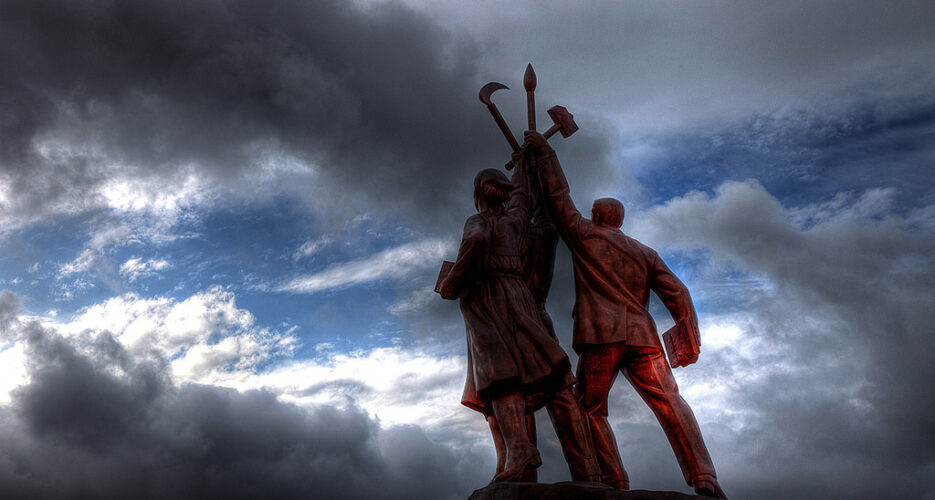 A major poll of North Korea experts and individuals working in the DPRK has revealed the vast majority of respondents believe that Kim Jong Un’s controversial policy to pursue the parallel development of the economy and nuclear weapons capabilities will in some way succeed. The survey, conducted by the NK News-affiliated NK Pro service, was sent out to 200 North Korea-focused professionals around the world, of which 49 responded. The first question asked “If international policy doesn’t change, the DPRK will in 2021…”, and respondents were asked to choose between three potential scenarios North Korea could find itself in in five years – the end of the next U.S. Presidential term – or were given the option of suggesting their own. The first scenario hypothesized that, by 2021, the DPRK would have improved its nuclear weapons and economy, and that as a result, the North Korean leadership would feel stable and free to experiment with mild reforms. The second suggested North Korea would have improved its nuclear weapons and achieved slow but steady economic growth, but that the leadership would be threatened by growing internal economic independence and more likely to respond with external belligerence and / or internal repression. The third, alternatively, suggested byungjin would fail, with Kim Jong Un facing a major political or economic crisis and therefore more willing to make concessions on the nuclear front in return for sanctions relief. The scenarios, for the sake of argument, all rested on the assumption that international policy towards the DPRK will not dramatically change over the next five years. BYUNGJIN SUCCEEDS: BUT AT WHAT COST? Overall, 86% of respondents agreed with the first two scenarios as being most likely, that byungjin in some way succeeds, with only one agreeing with the third option and 12% not agreeing with any of those scenarios offered. On the second question, which asked, for those that believed byungjin will succeed: “With a larger economy and nuclear capability, the DPRK will in 2021…”, respondents were more divided as to Pyongyang’s likely response. IS BYUNGJIN POSSIBLE? READ THE FULL SURVEYOf the 42 who believed parallel development of nuclear weapons and the economy would succeed, 50% believed North Korea’s leadership would feel secure and have room to experiment with economic reform, while the other half thought the regime would respond to the rise of the gray economy with internal repression or belligerent external activity. These results make it, potentially, the largest survey of DPRK-watchers this year, said Tristan Webb, a Senior Analyst for NK Pro and the researcher behind the project. “I was surprised to see that so many respondents (86%) thought that on the current trajectory, the DPRK would have a larger economy and a more powerful nuclear capability by 2021,” he told NK News. The view directly contradicts the position of South Korea’s President, Park Geun-hye, who told the United States Congress in 2013 that Pyongyang’s byungjin line could not succeed. The two objectives were “incompatible,” she said at the time. “Only 1 respondent (2%) shared President Park Geun-hye’s assessment that this would not be possible (the others generally thought there would be some sort of muddling-through),” said Webb. “This is really significant because the assumption that the DPRK’s byungjin line is unachievable has been a foundation stone of the ROK’s policy towards the DPRK, and also to some extent the U.S.’s as well.” The survey was a straw poll of expert opinion, Webb argued, so cannot be said to be definitive: researchers could not determine exactly how many would respond or guarantee regional balance. HOW WILL NORTH KOREA REACT? READ THE FULL SURVEY“Nonetheless it is one of the best indicators of expert opinion we’ve seen this year,” he said. “The most important caveat to note, and it really must be emphasized, is that this survey only considers where experts think the DPRK is heading on its current trajectory, assuming that foreign policies toward the DPRK do not change.” Professor Andrei Lankov of Kookmin University, a regular NK News contributor, said he was “not surprised” at the unanimity of the results, but that he thought that economic and nuclear success would lead to a more belligerent Pyongyang. “North Korea will feel insecure as long as it will face much richer and freer South Korea,” he said. “The North Korean populace can easily fell under the spell of a neighbor which is also officially considered a part of the same nation.” Such a scenario, Lankov said, might lead to an East Germany-type scenario, where the leadership is justified in worrying about its position. Pyongyang may respond, he continued, with “fake” bellicosity, as the government will not want to trigger a war it cannot win. “They will just need a measure of tensions which would help them to maintain internal coercion on a sufficiently high level,” he said. “So we are not talking about ‘genuine bellicosity’, but rather about ‘fake bellicosity’, simulated for domestic political purposes.” The survey is the first part of a two-part series, the second of which hopes to gauge opinion about the appropriate policy response from Washington D.C. and Seoul. The results are due in the coming weeks. Featured image: Roman Harak This article was updated on December 1 to improve clarity. © Korea Risk Group. All rights reserved. |

October 22, 2026Oct 22, 2026


 SHARE
SHARE COPY LINK
 X
X MASTODON