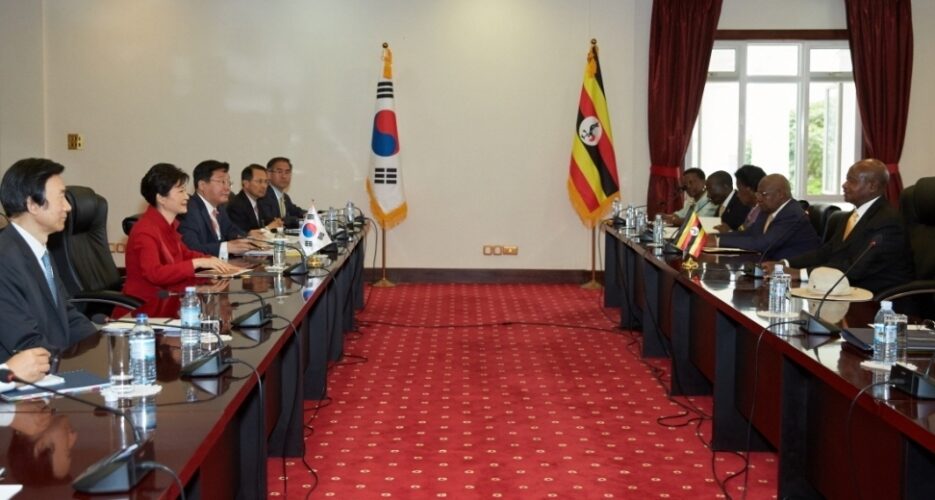
Uganda, a long-time ally of North Korea, announced that it will halt military and security exchanges with Pyongyang following a summit with the South Korean president on Sunday.
This decision, however, became clear after a diplomatic dispute between two countries.
South Korean President Park Geun-hye has been in Africa since last Wednesday to push shared growth opportunities in the region, however she also asserted the need for the denuclearization of North Korea. Foreign Minister Yun Byung-se accompanied her.
The spokesperson for the Presidential Office, Jung Yeon-guk, quoted President of Uganda Yoweri Museveni as saying: “We instructed officials to faithfully enforce the UN Security Council resolutions, including the halt of cooperation with North Korea in the security, military and police sectors.”
However, the Ugandan government at first denied this.
“That is not true. It is propaganda,” Ugandan government spokesperson Shaban Bantariza said in remarks carried by the AFP.
The spokesperson criticized the South Korean government for revealing this remark in public.
“Even if (such an order) was made by the president, it cannot be public … This is international politics at play,” he said.
But later the South Korean Ministry of Foreign Affairs (MoFA) distributed a video clip to journalists, which included the Ugandan minister of foreign affairs’ remark, apparently confirming Seoul’s statement.
“The latest information coming from the cabinet (is that) we are disengaging from the cooperation we’ve been having with North Korea as a result of UN sanctions,” Ugandan Foreign Minister Sam Kuteesa told a local broadcaster without revealing the specifics.
According to the most recent UN resolution against North Korea, UN member states are not permitted to provide the DPRK with technical training, advice, services or assistance, as well as the hosting of trainers, advisors or other officials for the purpose of military or police-related training.
After the AFP’s report, Jung on Monday said Uganda’s position is “not disputable” during the press conference in Kampala.
“The (Ugandan) government spokesperson’s remark seems wrong,” Jung said.
Later, the Ugandan Foreign Ministry reaffirmed Jung’s comment.
According to the Facebook post from the State House of Uganda, 10 areas of the MOU between Uganda and South Korea include policy consultation, health care and medical science, information and communication technology, energy, science and technology, community credit cooperatives, social welfare, defense, agriculture and rural development.
The South Korean MoFA declined to comment further regarding whether the MOU includes Uganda’s diplomatic status with North Korea.
During the visit, President Park also discussed economic and cultural exchanges with Uganda.
Diplomatic ties between Uganda and North Korea have long been tight, particularly in military and security. In 1987, a year after Museveni’s inauguration, the North agreed to provide a military loan worth almost $4 million, and then dispatched 40 military advisors to Kampala.
North Korean officials, including Vice Minister Ri Song Chol and other security officials, met President Museveni in June 2013. Ri met with Inspector General Kale Kayihura to learn about Uganda’s appreciation of North Korean domestic security initiatives.
“We have a lot of respect for the people of (the) DPRK. We admire your steadfast resilience towards the pressure put on your country for years,” Kayihura said in remarks carried by the Ugandan newspaper Daily Monitor.

DPRK Ambassador Choe Thae Rae (front row, second from left) and Vice Minister Ri Song Chol (front row, center) pose for photos with Ugandan police officials and taekwondo students in 2013. | Picture: Andrew Bagala for NK News
The relationship continued in 2014. In November, North Korea’s official head of state Kim Yong Nam met President Museveni. Ugandan media reported that the two parties negotiated on sending more North Korean personnel to train Ugandan tank crews and Special Forces, including marine police.
Pyongyang’s Vice Minister of Foreign Affairs Kung Sok Ung in 2014 requested that the Ugandan president oppose a UN resolution condemning North Korea’s human rights abuses. A UN Commission of Inquiry published a report about North Korean human rights abuses in March 2014, which recommended (among other things) prosecuting North Korean leader Kim Jong Un at the International Criminal Court.
The non-binding measure passed the General Assembly that year – as did another measure condemning the North’s human rights record the following year – but Uganda has typically abstained.
North Korea has long emphasized its diplomatic relationship with African countries. Kim Yong Nam recently met nine African countries’ leaders during his trip to Equatorial Guinea.
Featured Image: The Blue House
Join the influential community of members who rely on NK News original news and in-depth reporting.
Subscribe to read the remaining 745 words of this article.
EXISTING MEMBER?


');
newWindow.document.write('
');
newWindow.document.write('