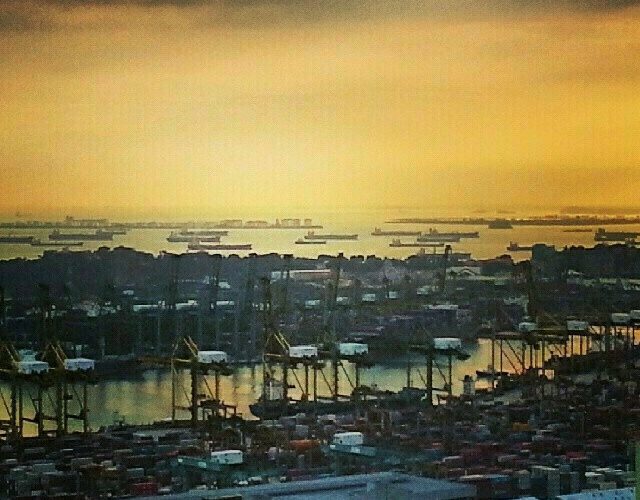

The ongoing trial in Singapore of Chinpo Shipping and its director Tan Cheng Hoe for making payments to a now sanctioned North Korean shipping company currently awaits a verdict after a two-month, often-delayed court battle.
The court proceedings have shed a little light on North Korea’s usually shaded dealings, and how the DPRK makes use of trusted foreign intermediaries.
Singapore-based Chinpo is currently accused of making a payment of $72,000 to Panama shipping agent C. B. Fenton and Co. in July 2013, on behalf of the Chon Chong Gang, a ship caught smuggling arms through the Panama Canal.
The North Korean ship is controlled by Ocean Maritime Management (OMM), a company now sanctioned by the UN and U.S. Department of Treasury for its involvement in the case.
Disassembled fighter jets, Soviet-era radar systems and various munitions were among the contraband. The illicit cargo was concealed under 10,000 tons of sugar.
If Chinpo is found guilty of breaking UN sanctions in aiding North Korea smuggle weaponry, it could face a fine of up to SGD $1 million (U.S.D. $700,000).
The business is also threatened with a supplementary fine of up to SGD $100,000 for running a remittances business without a license, a charge related to a total of 605 payments made to DPRK entities between April 2009 and July 2013, for sums totaling more than $40 million.
NUCLEAR ISSUE
The majority of the evidence relating to the Chong Chon Gang was dealt with quickly and covered on August 3, the opening day of the trial.
The charges were laid out by Deputy Prosecutor Sandy Baggett, of the Economic Crimes and Governance Division and formerly of the New York Attorney General’s office.
Baggett began proceedings by drawing the court’s attention to the potential use of some of the components aboard the Chong Chon Gang in North Korea’s nuclear weapons programs.
While the weapons in the Chong Chon Gang’s hold were not nuclear, prosecution witness Graham Ong-Webb, research fellow at the S. Rajaratnam School of International Studies, argued the arms could be used as part of “an air defense system to protect nuclear weapons on the ground.”
“It is impossible to construe a MiG-21 as anything but arms-related”
Defense attorney Edmond Pereira countered by arguing the two MiG-21 fighters were “obsolete” and could not possibly help to advance North Korean military knowledge. In addition, the aircraft were intended for training rather than battlefield use.
The distinction however would likely do little to appease the UN, whose sanctions also prevent providing the DPRK with lethal arms for training purposes.
“The efforts of the defense to argue that the fighter jets were for training rather than combat may have offered new insights into the nature of the Cuban-North Korean contract, but they will have convinced few of Tan’s innocence. It is impossible to construe a MiG-21 as anything but arms-related – the metric in UN resolutions,” Andrea Berger, deputy director of proliferation and nuclear policy at RUSI told NK News.
ASK THE AMERICANS
The majority of the trial focused on the second charge, with Chinpo accused of over reaching its duties as a shipping chandler (a dealer specializing in ship equipment), running a remittance business without a license and determining the precise extent to which Tan was aware of the illegality of Chinpo’s activities.
During questioning from his own legal team, Tan revealed his connections to North Korea stretched back to the 1970s.
Tan argued the Singaporean authorities had long been aware of their interactions with the DPRK, and would often point to this apparent transparency and openness as a sign of innocence.
In response, the prosecution attempted to show how Chinpo and co-located company Tonghae had attempted to obfuscate their dealings with North Korea.
The prosecution revealed Tan’s companies had a habit of not mentioning ship names or providing shipping documentation when moving money from Chinpo’s accounts with numerous banks including UOB, ICB and the Bank of China, among others.
When pressed on the issue, Tan claimed omitting ship names was relatively standard practice, suggested by the banks to speed up money transfer times. Ship names would necessitate ship documents, which in turn would slow up the whole process.
Tan did not elaborate on why this was the case, other than to say “ask the Americans,” a remark he would return to several times during the proceedings.
The defense also presented a former employee as a witness, who gave evidence to Chinpo and Tonghae being different companies only nominally. The two entities are run from the same address, with the same staff, under the same direction.
The blurry distinction made it difficult to maintain how Chinpo shipping was acting within its normal bounds as a ship’s chandler.
The prosecution added that while ships might well need emergency funds, the large number of payments to unknown OMM vessels over the years were excessive, and remained on the company’s books for too long.
DIVERSIFIED INTERESTS
The ongoing trial also brought to light how the Tan family had sought to provide numerous services for the DPRK extending far beyond OMM.
Since the 1970s Tan became the point of contact for businesses already entangled with North Korea, and also those looking to set up new connections.
Their numerous business interactions extended to facilitating North Korean employment in Singapore (an enterprise later shut down by the Singaporean Ministry of Manpower), to having discretion in using DPRK money to dabble in silver and resources markets.
The Tan family also acted as intermediaries and partners for North Korea on a more informal basis. When local telecoms company Singtel – a subsidiary of the Singaporean sovereign wealth fund Temasek Holdings – was having trouble with a North Korean client’s unpaid bills, it was to Chinpo Shipping they turned to for assistance.
These personal contacts with the North Korean elite proved to be a valuable business asset for the Tan family companies.
In around 2009, Chinpo Shipping was approached by a Chinese company wishing to conduct exploratory oil drilling activities on North Korean territory.
They hoped Tan would be able to put them in touch with another DPRK contact, Kim Ha Jae, a high ranking OMM executive who worked with the company since the 1970s and left three years prior.
“Singapore was always their way of handling this kind of thing”
Chinpo shipping even created a joint venture called Global Resources, in the hope of transporting the necessary equipment for oil and gas exploration equipment to North Korea.
Over the years North Korea has made headlines with foreign companies looking to develop its non-existent oil and gas sector.
Most recently Mongolian company HBOil was hopeful it may be made to start some exploration, and even went as far as opening a data room to analyse geophysical data in Pyongyang’s Yanggakdo Hotel.
Previous attempts however have usually been accompanied by some public fanfare, according to Dr Paek, DPRK energy expert at Chatham House. In contrast the Global Resources deal was kept very quiet.
“Singapore was always their way of handling this kind of thing,” Paek told NK News.
Global enterprises however soon ran into problems when they found the current sanctions regime against North Korea prevented the easy transfer of necessary technical equipment to the DPRK. Wiring and steel tubes were particularly affected, and the enterprise was swiftly wound up.
TROUBLED WATERS
The court proceedings also revealed how in recent years the relationship between Tan and the DPRK began to sour.
In 2005 all North Korean accounts with the Singapore based UOB were closed at the request of then Treasury Under Secretary for Terrorism and Financial Intelligence Stuart Levey.
Levey informed UOB the accounts could be related to proliferation related activities. An account belonging to Tonghae was caught in crossfire, leading the prosecution to ask why this should be.
Once again, Tan’s reply was “ask the Americans!”
Chinpo’s relationship with OMM also began to show signs of strain. Throughout the beginning of the last decade it appears Tan and OMM were on good enough terms for Chinpo to extend the North Koreans a substantial line of credit.
At one point during the trial the prosecution claimed there were large sums of OMM money resting in bank accounts belonging to Chinpo and Tonghae.
However by 2009 Chinpo had been loss making for eight years, and it became difficult to continually extend OMM credit. By that time the North Korean shipping company owed Chinpo nearly SGD 1 million.
Some of the money owed was eventually paid, but Chinpo nevertheless made a loss of SGD 200,000. In 2012 the company was forced to restructure and lay off staff. Tan’s daughters were obliged to take on more work.
“Regardless of the case’s outcome, the proceedings reveal how deeply Tan became involved with North Korea”
Chinpo’s own debts were also mounting up, with several hundred thousand owed to its own suppliers.
Tan argued he wished to close the loss making company down, but could not due to longstanding debts. Eventually he decided to take SGD 300,000 from an OMM account with which he was entrusted, to pay off the remaining obligations.
Despite the recent problems, Tan claimed he still on good terms with his OMM contacts and kept open accounts which could help him do business with them in the future.
Regardless of the case’s outcome, the proceedings reveal how deeply Tan became involved with North Korean business, across numerous sectors.
“This case highlights the importance to North Korean trade and proliferation networks of long-standing, trusted foreign partners and intermediaries. Other recent examples of this trend include Alex Tsai in Taiwan and Leonard Lai in Singapore,” Berger added.
“Bringing these key nodes into compliance with UN regulations, or eroding their ability to operate, can be a particularly effective way to disrupt North Korea’s broader proliferation network,” she continued.
Originally due to conclude on August 28, the trial was adjourned due to a scheduling problem. The verdict will be made on November 23. All parties involved have declined to comment.
Join the influential community of members who rely on NK News original news and in-depth reporting.
Subscribe to read the remaining 1660 words of this article.
EXISTING MEMBER?

Featured Image: North and South Korean navies exchange fire by Eric Lafforgue on 2009-05-17 05:24:11


');
newWindow.document.write('
');
newWindow.document.write('