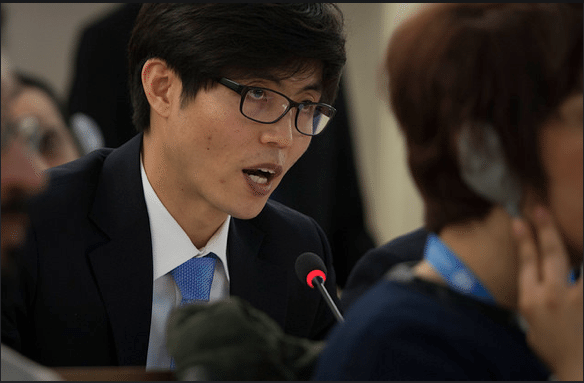
A prominent North Korean defector and human rights campaigner has said he may end his involvement in activism after admitting he changed parts of his story.
Shin Dong-hyuk, famed defector and subject of the book Escape from Camp 14 by Blaine Harden, had also testified in front of the U.N. Commission of Inquiry (COI) on Human Rights in the DPRK. Harden told the Washington Post on Saturday that Shin admitted he changed key parts of his story.
Shin has maintained that he was born in Camp 14, a gulag to the north of Pyongyang, and that he watched his mother and brother’s execution because they tried to escape the camp. Shin, born Shin In Geun, has admittedly changed his story before; originally stating that he had no knowledge of his mother and brother’s escape attempt, since the publication of Harden’s book he has admitted to betraying them to the authorities, thus resulting in their execution.
He said he fled the camp in 2005, accompanied by a fellow inmate who died while attempting to escape.
However, Shin has now told Harden that he was relocated, along with his mother and brother, to Camp 18, another gulag when he was about 6. While he had recounted betraying his mother and brother and watching their execution in Camp 14, he now states that this all happened in Camp 18.
Shin now also claims he made two attempts to escape, which failed, before he finally succeeded in 2005. After he was caught by local police and sent back to North Korea in 2001, he was transferred to Camp 14. He was tortured as punishment for this, he said, though in the book he claims he was tortured by authorities following the escape attempt by his mother and brother, as the guard he reported their escape attempt to claimed all credit for discovering their plan.
“When I agreed to share my experience for the book, I found it was too painful to think about some of the things that happened,” Harden quoted him as saying. “I didn’t want to tell exactly what happened in order not to relive these painful moments all over again.”
Shin, unable to be reached for this report, said publicly that he may no longer participate in human rights activism.
“At this point, I may or may not be able to continue in my work and efforts,” he said in his Facebook post with a link to the Washington Post story.
“But instead of me, you can still fight. … The world still needs to know of the horrendous and unspeakable horrors that are taking place. These will be my final words and this will likely be my final post,” he said.
North Korea watchers, including those in the human rights field, have acknowledged Shin’s revelations as a blow to his credibility.
“He changed the very place where all his ordeals took place. Now it is doubtful to take his other words at face value,” said Kim, Hyung-deok, who defected two decades ago and now runs the Corea Peace & Prosperity Center.
“North Korea’s human rights is in a very poor condition but it gives no excuse to exaggerate or even make up a story. It’s not only insulting to the international community but also detrimental to North Korean defector community,” he said.
Others have noted the propensity of defectors, encouraged and sometimes even paid by an audience eager for outlandish stories out of the North, to exaggerate.
“There has always been a lot of storytelling and embellishing in the defector-turned-activist community, to be honest,” said Matthew Reichel, co-founder of Pyongyang Project. “It’s been a well-marketed and financed group at that.”
Reichel said that some, but not necessarily all defectors may now suffer from greater skepticism.
“This does not really do any good for defectors whose voices may be more quiet but have honest stories to tell,” he said.
Sanctions expert and outspoken North Korea critic Joshua Stanton said he was “very disappointed” in Shin but emphasized the volume of testimony that exists regarding human rights abuses in the North.
“Shin is one of thousands of witnesses to come out of North Korea,” Stanton, author of the One Free Korea blog, said.
“The U.N. Commission of Inquiry did not base its conclusions on the account of one man, but on the testimony of 80 witnesses and experts. … (This) doesn’t get Shin off the hook for lying to us, but it doesn’t get Kim Jong Un off the hook, either,” he said.
The credibility of defector testimony, which is exceedingly difficult to verify due to the reclusive nature of North Korea, has recently come under scrutiny. Another prominent defector, Yeonmi Park, has had inconsistencies in her story called into question.
“When we interview defectors, we try to fact-check their words with other defectors,” Bada Nam, director of People for Successful Corean Reunification (PSCORE) said. “As we are working with many defectors in an education program, we know how to fact check between defectors. We’ve been taking care of this issue and will do (so) as long as we gather testimonies,” he said.
In the face of mounting international attention following last year’s UN COI report, North Korea sought to discredit Shin, accusing him of being a rapist who escaped North Korea to avoid punishment. Uriminzokkiri, one of the regime’s propaganda channels, uploaded videos to YouTube last October in which Shin’s father appears.
His father claimed his family lived in Ponchang-ri – unintentionally admitting they were inside Camp 18 – not Oedong-ri inside Camp 14 as Shin claimed, and his injury was due to mining accidents.
Picture: UN Mission Geneva, Flickr Creative Commons
Rob York contributed to this report.
Join the influential community of members who rely on NK News original news and in-depth reporting.
Subscribe to read the remaining 946 words of this article.
EXISTING MEMBER?


');
newWindow.document.write('
');
newWindow.document.write('