  News North Korean ships visit Chinese coal and iron ports, possibly for illegal salesAt least five North Korea-linked ships took turns at Longkou Port for possible sales between March 29 and April 13 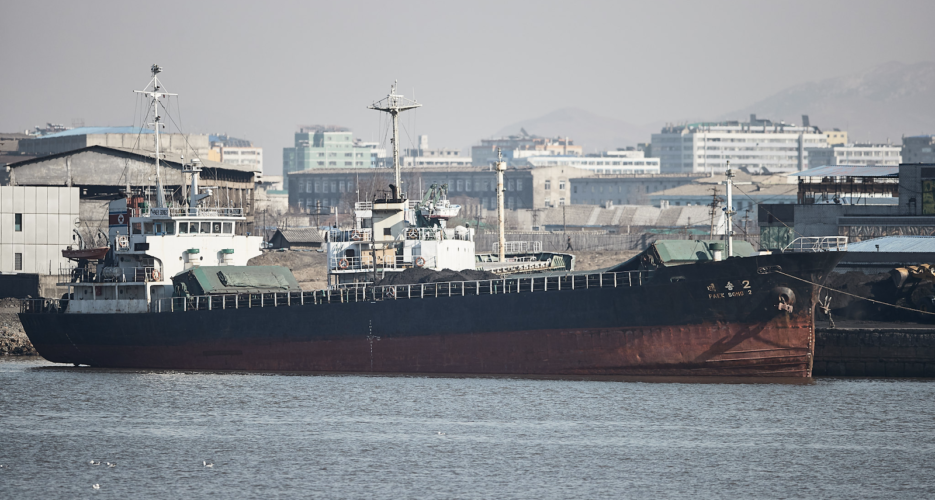 North Korean shipping operations have returned to pre-pandemic lows as of early April after months of cargo vessels idling at sea last year, according to NK Pro analysis of ship tracking data. Both North Korean-flagged and foreign-flagged ships appeared to have engaged in trade, with 20 ships in total detected making active voyages between March 29 and April 13 on the Automatic Identification System — a tool used to help ships avoid collisions. North Korean shipping activity started to pick up in February of this year after a slowdown that coincided with waves of COVID-19-related travel restrictions in 2020. Throughout last year, reports surfaced that North Korea had enacted a flexible “border blockade measure” that selectively restricted the volume of imports in 2020, according to the Korea Institute for National Unification. According to a recent United Nations Panel of Experts report, maritime smuggling of strategic goods like North Korean coal exports or oil imports continued throughout 2020, with ships often successfully using false AIS identities or avoiding transmitting AIS signals. Of the 20 ships observed between March 29 and April 13, five docked at the coal yards of Longgang, China. Those ships — the Rina, Ryon Hwa 3, Hwang Gum Phyong 2, Tu Ru Bong, and the Yon Moo — have all recently resurfaced on AIS after dropping off during the summer of 2020. However, these ships — all North Korean-flagged vessels — may have had their AIS identities taken and fraudulently used by other vessels in North Korea’s fleet in order to conceal the sale of sanctioned coal. 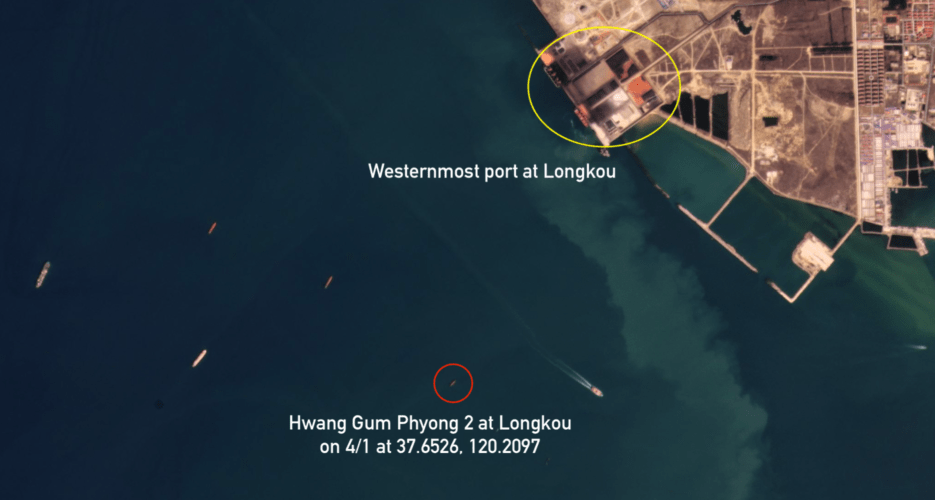 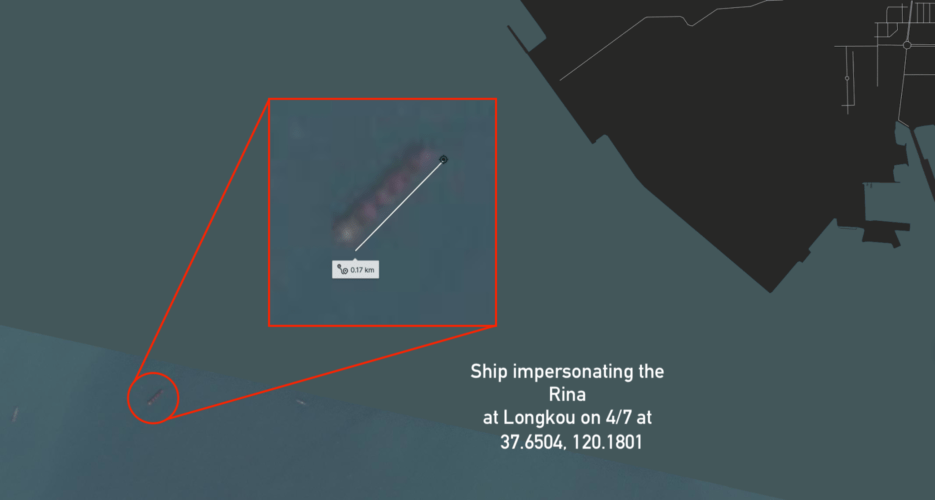 In an April 7 satellite image, the mystery ship had its four holds open to the sky, which were dark in color and looked like coal cargo from outer space. According to AIS data, the Rina later traveled and docked at one of Longkou’s multiple coal yards from April 9 to 12 before heading eastward in the direction of North Korea on April 13. After years off AIS, two North Korea-flagged tankers also made rare appearances in the month of April. The An San 1 — which has not appeared on AIS since Aug. 2019 — traveled westward through the Korea Strait on April 7 and was detected approaching the North Korean port city of Chongjin on April 11. The Sam Jong 2, which was last detected via land-based AIS station in Dec. 2019, was seen via satellite-based AIS exiting the Korea Strait on April 12 with an unknown starting point and final destination. Between March 29 and April 13, only one ship was detected making a voyage to one of North Korea’s most popular and profitable commercial routes before COVID-19. The Nampho-Dalian route was a key path for both regular and COVID 19-related aid, but NGOs reported in Aug. 2020 that it was closed due to the global pandemic. The Ja Song 2 left Nampho port for the Chinese city of Dalian on March 30 and has loitered outside the port since. Edited by Kelly Kasulis © Korea Risk Group. All rights reserved. |

October 08, 2026Oct 08, 2026

The ultimate resources for professionals working on North Korea
 SHARE
SHARE COPY LINK
 X
X MASTODON