  Analysis What the US charges against Sue Mi Terry mean for North Korea policymakersIndictment of DPRK expert spotlights extent of influence ops in Washington, but it may just be the tip of the iceberg 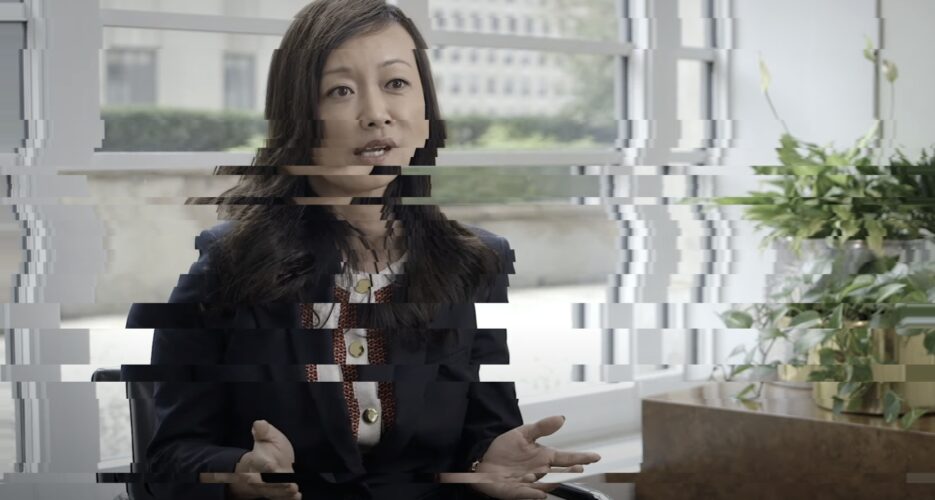 The recent indictment of Sue Mi Terry, a former CIA employee and White House official on charges of acting as an unregistered agent for South Korea’s National Intelligence Service (NIS), has sent shockwaves through the Korea-watching community. For over a decade, Terry allegedly followed instructions from the NIS, including advocating for Seoul’s policy positions, disclosing nonpublic U.S. government information and facilitating access for ROK officials to key U.S. counterparts. In return, she allegedly received luxury goods, high-priced dinners and tens of thousands of dollars in covert funding for a public policy program she controlled. Despite her extensive involvement with ROK intelligence officials, Terry never registered as a foreign agent, as is required by U.S. law. The extent of South Korea’s influence-peddling and intelligence collection documented by the indictment reveals important issues for policymakers, researchers and others who work on North and South Korea issues:
The indictment could chill cooperation and meetings between researchers in the two countries, while forcing Washington to confront the extent of influence operations that shape policies on North Korea and beyond. COVERT FUNDING AND THINK TANK PARTNERS One of the most notable revelations from the FBI’s indictment of Sue Mi Terry is the NIS’ use of covert funding mechanisms to support influence activities in the U.S. The indictment details multiple instances where the NIS allegedly funneled money to Terry’s programs at various think tanks through circuitous routes, including payments potentially laundered by the NIS through South Korean think tanks and the ROK Embassy in Washington. For example, during a Jan 2023 dinner between Terry and an NIS officer, the pair “discussed potential ROK think tanks that could serve as the intermediary for ROK NIS funds.” The purpose of using a South Korean think tank to funnel such funds was to enable the NIS to “covertly send money” to the think tank Terry was working at the time — apparently referring to the Wilson Center, where Terry worked from 2021 to 2023, according to her LinkedIn profile. It’s not clear whether this particular transaction was ever completed or which think tanks were involved. But the NIS agent allegedly indicated that the purpose of the discussion was to find a way to “do it directly without the complicated process of involving a third party which we’ve been doing so far,” suggesting ROK think tanks have provided funding to outside parties at the direction of the NIS on other occasions too. Two months later, Terry allegedly followed an “urgent” ROK foreign ministry request to find space to hold an “event celebrating ROK-U.S. alliance.” The event was eventually hosted by the Wilson Center, ahead of a major summit between Joe Biden and Yoon Suk-yeol, and featured high-level government and non-government speakers. A $26,035 payment for the event was “nominally issued by the ROK Embassy but … provided by the ROK NIS,” with another $25,418.70 coming from an unspecified South Korean think tank. Such orchestration and payment methods raise concerns about the due diligence and auditing processes of think tanks and other institutions working on Korea-related issues. In this case, the allegations suggest that NIS funds could be disguised as legitimate think-tank or diplomatic contributions, bypassing scrutiny from a receiving institution, to fund high-level discussions immediately prior to leader-to-leader summits on directly related issues. Combined with separate allegations of ROK embassy funding for a happy hour event with U.S. Congressional staff in July 2022 for intelligence purposes, these cases leave open the possibility that Terry is not the only individual in the Korea-watching community that is or has been involved in similar campaigns.  NORMAL AND ABNORMAL ACTIVITIES It’s important to acknowledge that it is common practice for intelligence officers from many countries, not just South Korea, to operate under diplomatic cover in embassies worldwide. Part of the job of such officials is to cultivate relationships with local influencers, opinion leaders and subject matter experts in their host countries, activities that are largely in line with what diplomats do on a daily basis. These interactions can take many forms, such as invitations to embassy events, dinners at restaurants and the occasional exchange of gifts. For example, the indictment details multiple instances of Terry dining with NIS handlers at high-end establishments, including “an upscale Greek restaurant in Manhattan” and a “high-end sushi restaurant” in late 2022. This in itself is not unusual, as many Korea watchers will have had meals with ROK embassy officials (NIS or otherwise) in similar circumstances. Embassies worldwide also regularly organize and fund dinners and events that bring together local experts and foreign counterparts, taking partial or complete control over the guest list. This is seen as a legitimate way to promote dialogue and understanding between countries, even if guests may unwittingly engage with intelligence officials at the same events. It’s also not unusual for foreign policy experts to have ongoing relationships with foreign diplomats and officials that span multiple administrations, some of which may not be known to be intelligence officials. For example, Terry’s alleged relationship with multiple NIS officers allegedly began in 2013 and spanned at least three ROK presidential administrations. However, the allegations against her point to activities that go beyond normal diplomatic engagement and cross the line into improper influence. One of the most significant allegations is that Terry received cash payments from the NIS in exchange for sensitive information. The indictment states that in return ROK intelligence officers provided Terry with “luxury goods, high-priced dinners, and more than $37,000 in covert funding for a public policy program focusing on Korean affairs” that she controlled. This quid pro quo relationship, in which Terry allegedly acted as a paid but undeclared South Korean agent, is a far cry from routine expert-diplomat interactions. Another red flag is the allegation that Terry used her position and connections to arrange a private high-level meeting in early 2019 between then-NIS director Suh Hoon, “other NIS officials” and “several current and former senior U.S. national security officials.” A former U.S. intelligence official who attended the meeting later told the FBI that he considered it “highly abnormal” and unprecedented in his experience, according to the indictment.  The lavish gifts that Terry allegedly received from her NIS handlers also go well beyond typical exchanges in diplomatic settings. The indictment details luxury handbags and coats worth thousands of dollars, and photos apparently show that the NIS officers sometimes accompanied her to stores to buy the items in person — a highly unusual level of cooperation. Perhaps most concerningly, the indictment alleges that Terry shared sensitive information from private meetings with her NIS handlers. In June 2022, after attending a private, off-record meeting with U.S. Secretary of State Antony Blinken, Terry allegedly met with an NIS officer and provided him with “detailed handwritten notes from that meeting.” Finally, the indictment suggests that Terry took steps to conceal her relationship with the NIS, such as using an encrypted messaging app to communicate with her handler and self-deleting messages to obfuscate communications. LONG-TERM INVESTIGATION One of the most striking aspects is the depth, breadth and sophistication of the FBI’s counterintelligence investigation into Sue Mi Terry. The indictment reveals a decade-long effort by the FBI to monitor and document Terry’s alleged activities. It was much longer than the one to four-year investigation periods of other high-profile FARA cases into people like Paul Manaford, Senator Robert Menendez, Michael Flynn and W. Samuel Patten and incorporated much more sophisticated intelligence collection techniques. The investigation appears to have begun as early as early 2014, with FBI agents interviewing Terry in November that year about her contacts with ROK intelligence officers. The indictment states that Terry admitted to meeting with an individual she understood to work for the NIS, but “became visibly nervous, changed her speech pattern and began to stutter and shift in her seat” when questioned about her interactions. One of the most remarkable aspects is the level of detail the FBI was able to collect about Terry’s private conversations with her alleged NIS handlers, often held in restaurants and bars. The indictment includes verbatim quotes from several of these meetings, suggesting that the FBI was able to reliably obtain audio recordings of these meetings. For example, it cites a Jan. 2023 dinner between Terry and “NIS Handler-3” at a Washington restaurant, during which Handler-3 allegedly provided Terry with talking points on North Korea policy that she subsequently incorporated into her public writings and statements. 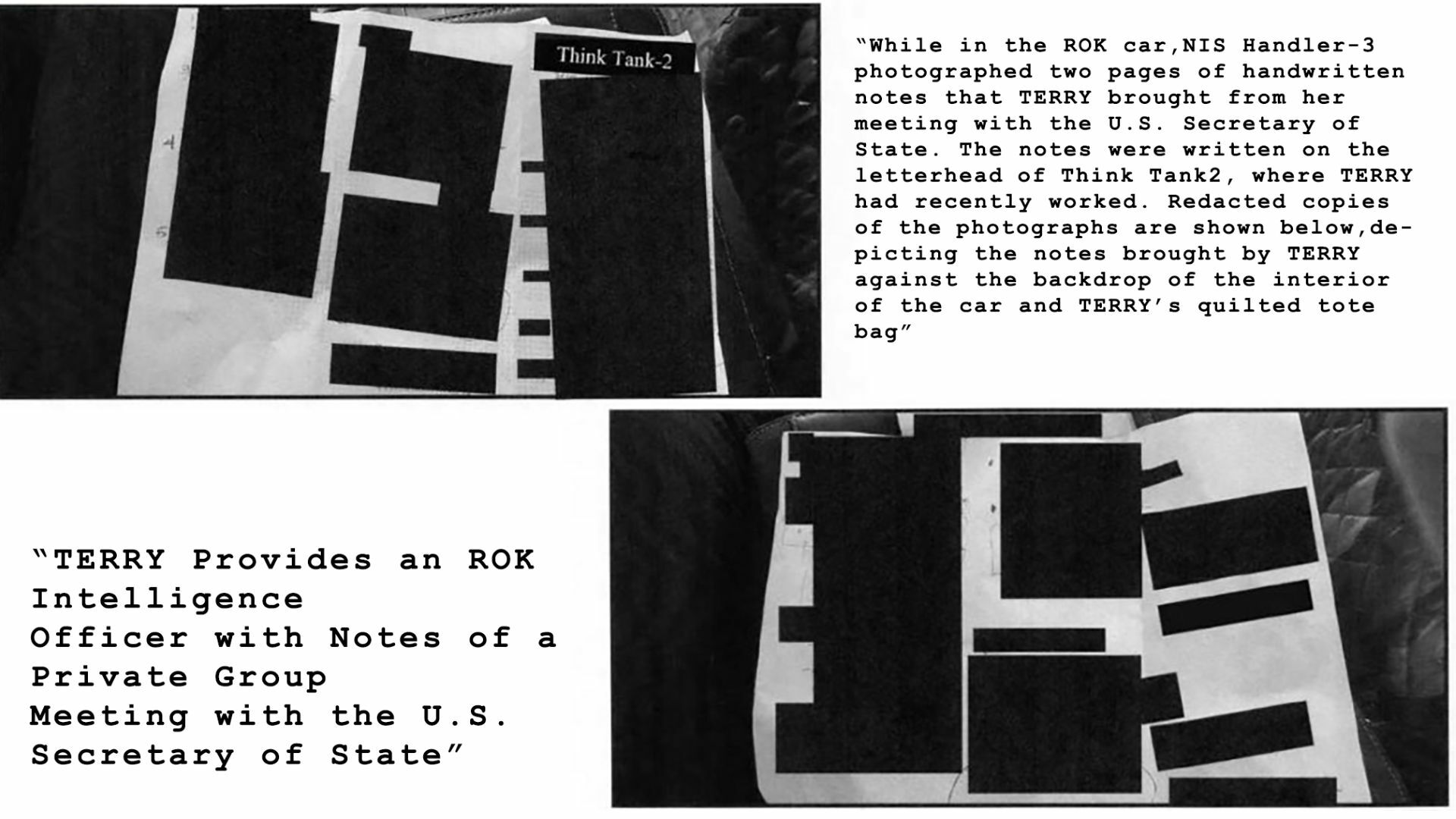 The FBI also appears to have conducted extensive physical surveillance of Terry and her NIS contacts. The indictment includes detailed accounts of Terry’s movements, such as a June 2022 incident in which she met with an NIS handler in a ROK embassy car immediately after the private meeting with Secretary of State Blinken. The handler allegedly photographed Terry’s handwritten notes from the meeting while in the car, and the FBI was able to obtain copies of these photographs, which are included in the indictment. The indictment also includes a photo of Terry at the Greek restaurant with the two ROK NIS officials, implying the FBI was able to stake out the venue and take photos at relatively close range. 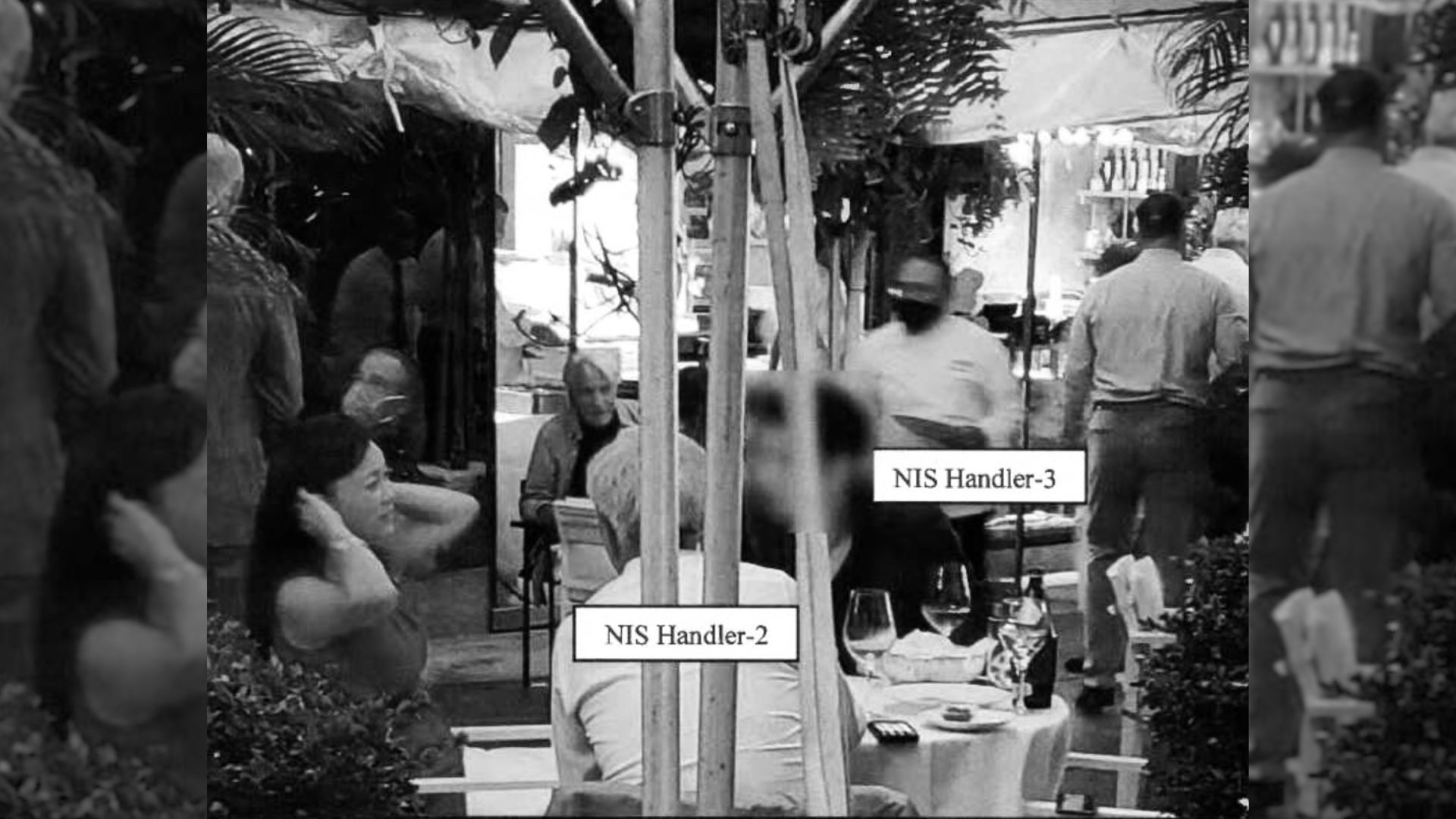 Similarly, the FBI appears to have had access to Terry’s electronic communications with NIS officers. The indictment quotes from numerous text and encrypted message exchanges between Terry and NIS handlers dating back to 2016, in which they allegedly discussed efforts to facilitate ROK government access to incoming Trump administration officials. This level of sustained, multi-faceted intelligence collection raises questions about the FBI’s underlying motivations and the potential scope of Terry’s alleged misconduct. The charges ultimately brought against Terry — conspiracy to act as an unregistered foreign agent and acting as an unregistered foreign agent — are serious but relatively narrow in scope, focusing on her failure to register under FARA. The intensity and duration of the FBI’s investigation suggest there may be more to the story. One possibility is that the FBI uncovered evidence of more serious offenses, but is unable to include these allegations in the public indictment for national security reasons. Alternatively, the FBI may view the Terry case as a high-priority counterintelligence matter, given the sensitive nature of U.S.-ROK relations and the potential for NIS influence efforts to undermine U.S. foreign policy interests. WHAT HAPPENS NEXT While the case has brought renewed attention to South Korean influence efforts in the U.S., the reality is that many nations, including its closest allies, have engaged in similar efforts to shape policy discourse and decision-making in Washington. The UAE, Qatar, Saudi Arabia and Israel have all been accused of similar efforts, from think tank influence-peddling to much more serious examples. It’s possible that similar Korea-related investigations could be ongoing and that there might be more significant evidence of undue efforts to influence policy-making in Washington. “Washington is a swamp,” said Van Jackson, a senior lecturer in International Relations and an East Asia specialist at Victory University of Wellington. “The normal way that everyone operates, and the heavy hand the ROK government (and Japanese government, and Saudi government, and of course Israeli government) exercises over policy, is seemingly legal but it’s also corrupt by any normal person’s standard of the common good.” He added that U.S. policies are resistant to change due to “alliance managers and intellectuals — usually former government officials — who are no more accountable to politics than to reason,” he continued. “It would be great if this changed how Washington operated; I bet there are a lot of think tankers right now who are freaking out.” A researcher at a Korean think tank, who requested anonymity due to the sensitivity of the issue, said the case could have ramifications for a range of legitimate work areas. “This situation could complicate the lives of Korean think tankers trying to arrange interviews with key figures abroad,” they said. “Potential interviewees contacted by Korean think tankers may hesitate before agreeing to meetings, at least in the short term.” “This is unfortunate, especially considering that the current period calls for active discussion and collaboration among like-minded countries.” Moving forward, it will be important to watch for any additional details that emerge about the scope and nature of Terry’s alleged activities, as well as discussion on implications for the broader Korea expert community. The case will likely prompt a wider reckoning within the U.S. foreign policy establishment about the need for greater transparency and accountability in interactions with foreign entities. Edited by Arius Derr and Bryan Betts © Korea Risk Group. All rights reserved. |

October 27, 2026Oct 27, 2026

The ultimate resources for professionals working on North Korea
 SHARE
SHARE COPY LINK
 X
X MASTODON