


Analysis of North Korea's construction indicates steep decline since the 1980s
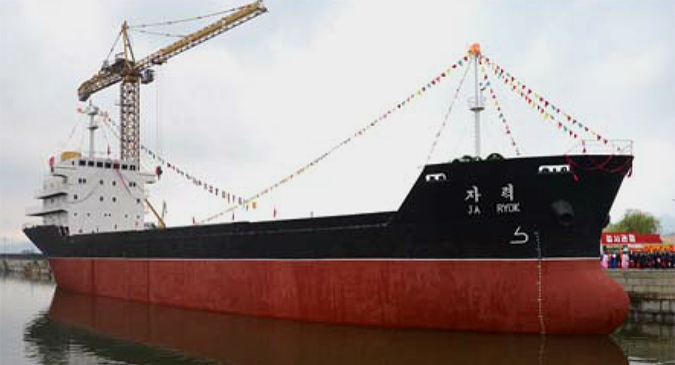
North Korea launched a new cargo ship over the weekend, an increasingly uncommon event which warranted its own ceremony held at the Ryongnam Dockyard on the DPRK’s west coast.
The launch was covered by the Korean Central News Agency (KCNA), which according to the NK News KCNA Watch data tool, has never before written a story about a ship launch in English.
The vessel was reportedly named by Kim Jong Un himself, who designated the ship Jaryok, meaning “self-reliance,” and the ceremony was presided over by two senior North Korean officials.
‘They called for attaining the high goal for the development of maritime industry by displaying the revolutionary spirit and mettle of heroic Kim Il Sung-Kim Jong Il working class in close unity around Kim Jong Un’
Both O Su Yong, vice-chairman of the Central Committee of the WPK and Kang Jong Gwan, minister of Land and Maritime Transport, said the vessel represented the North’s flourishing socialist industry.
“They called for attaining the high goal for the development of maritime industry by displaying the revolutionary spirit and mettle of heroic Kim Il Sung-Kim Jong Il working class in close unity around Kim Jong Un and dynamically fighting for the final victory of building a thriving socialist country,” the article reads.
But analysis of North Korean ships built over the last 40 years indicates that DPRK commercial ship launches appear to be increasingly rare, with construction following lengthy declines, and commercial fleets comprised mainly of aging Japanese built vessels.
A SPECIAL OCCASION?
The ceremony around the Jaryok’s launch itself indicates the event was remarkable. DPRK media coverage and accompanying photos and video from the Korean Central Television Footage show hundreds gathered at the dockyard, 10 km from the center of Nampho.
The two visiting officials added further heft to the proceedings. “There are not many vice chairs of the Central Committee. That’s a pretty high post … O Su Yong’s role in the WPK CC puts him in charge of light industry,” NK News director of intelligence John Grisafi said.
The pomp around the proceedings seems well deserved. Information on the North Korean ship construction dates collated from various maritime databases, indicates the Jaryok is the only commercial cargo vessel produced by North Korea this decade, and one of only a handful sailing in international waters built since the year 2000.
GOLDEN AGE
Analysis of North Korea’s currently active fleet shows the majority of its vessels were originally built by Japan in the eighties. This is not surprising given the prominence of the Japanese shipbuilding industry at the time, though it’s unlikely North Korean directly bought many of the vessels brand new.
But around 10 percent of the vessels currently sailing as part of North Korea’s current commercial fleet were assembled in various shipyards around the DPRK. This number does not include any North Korean made vessels that have sunk or been decommissioned (of which there may have been several), or the smaller shipping boats that infrequently sail very far from home.
The 28 ships – not including the Jaryok – are in general a relatively rickety bunch, on average approaching 20 years average and generally fairing poorly when inspected in foreign ports.
The oldest member of the fleet sailed from Chongjin port 43 years ago, while the last was in 2009, though analysis shows the steady decline in production since the 1980s.
The numbers show that nearly 50 percent of the North’s domestic shipping capacity was assembled between 1980 and 1989, when 11 vessels were built.
The total dropped to six vessels in the nineties and just four in the last decade. The Jaryok appears to be the only domestically produced cargo vessel to have joined the ranks since 2010.
The figures indicate there was never one port which consistently produced cargo vessels over the years, with the majority of production moving from Nampo to Chongjin, before dropping off to just or two vessels per shipyard in recent decades.
But the declining numbers of domestically produced commercial vessels do not mean the North Koreans have rested on their laurels. The primacy of the military in the DPRK’s economy has likely funneled significant resources to the Korean People’s Navy (KPN).
Globalfirepower.com estimates the KPN to have more than 900 vessels, including over 70 subs
While many of the KPN’s vessels are small, North Korea maintains a very large number of military ships and submarines. Globalfirepower.com estimates the KPN to have more than 900 vessels, including over 70 subs.
“Since the seventies, North Korea’s priority was producing submarines, as there would be no other way to catch up with the production level of the ROK or U.S. navy ships,” Moon Keun-sik, the director at the Korea Defense and Security Forum told NK News.
“So since then, 30 years before South Korea, in 1963 the North started the construction of submarines.”
Whereas South Korea is the industry leader in terms of commercial ship building, North Korea’s efforts have focused more on its navy, opting for a quantity over quality approach.
“Their ships are mostly focused on coastal defense, while they are many in number – almost two to three times compared to the South’s navy – they are very outdated,” Moon added.
OPEN WATERS
The newly constructed 5000-tonne Jaryok is a minnow by international standards, but also small when compared to many of the DPRK’s domestically produced ships. Other members of the fleet constructed in previous decades have two to three times the Jaryok’s capacity.
The KCNA article on the vessel’s launch did not indicate which North Korean companies would be operating the vessel, or what she would be transporting. According to the International Maritime Organisation’s (IMO) website, the ship has not yet been registered, with North Korea providing the last update in November last year.
Nonetheless when the ship enters service, there will be likely be a number of routes to fill. The recent designation of 27 North Korean vessels means those ships should only be able to sail between North Korea ports, though recent reports have indicated the designated vessels are once again testing the waters.
Additional reporting by JH Ahn
Featured image: KCNA
Leo Byrne
Leo Byrne is the Data and Analytic Director at NK News and is based in Seoul, South Korea.
Follow him on twitter @LeoPByrne
');
newWindow.document.write('Directing your request...
'); newWindow.document.write('
');
newWindow.document.write('Try clicking another headline while you\'re waiting
'); newWindow.document.write('Please click here if the article does not load
'); newWindow.document.write('