  Analysis Major construction springs up in shadow of infamous Pyongyang hotel: ImageryLack of fanfare in North Korean state media suggests ‘bottom-up’ investment is behind ambitious project, expert says 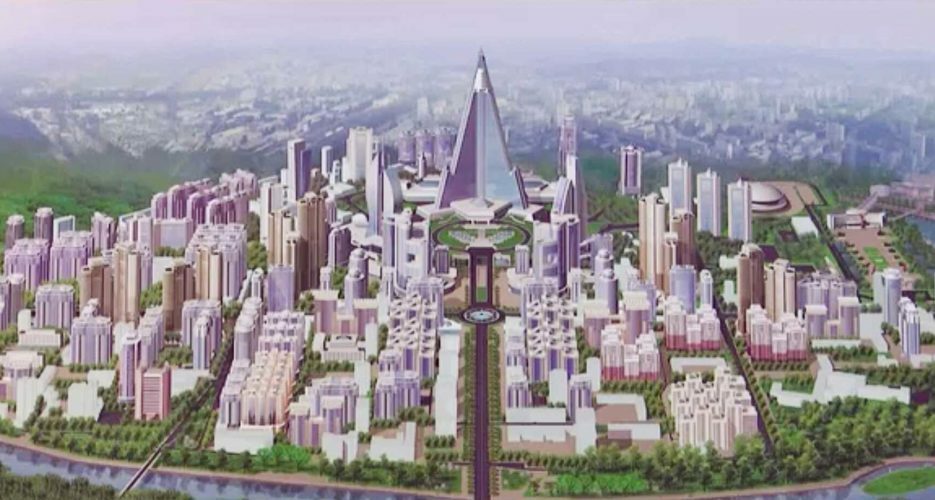 Dozens of new and ornate apartment towers have sprung up without fanfare in central Pyongyang, covering two entire city blocks around North Korea’s infamous Ryugyong Hotel, satellite imagery shows. Despite their unusually intricate and ambitious designs — similar to two major “10,000-home” skyscraper projects pushed since early last year — the buildings have yet to be featured or promoted in state media. The projects appear to be part of “bottom-up” efforts and investments, one expert told NK Pro, as opposed to top-down projects state media typically promotes for propaganda purposes. Peter Ward, an expert on the DPRK economy, said such large-scale yet low-key projects exist in North Korea due to concepts in the country’s economy called “sang-ui-ha-dal” ( 상의하달) and “ha-ui-sang-dal” (하의상달), meaning “some things are done on the initiative of those above and other things are done on the initiative of those down below.”   Most construction projects in North Korea “are going to include an element — potentially a very large element — of lower-down financing,” Ward said. “But what we’re talking about here is whether it’s the central government or Kim Jong Un’s idea or if it’s an idea of someone else further down in the system which is then proposed and approved from on high.” Workers started demolishing old apartment buildings on these blocks in 2018 and 2019, but the new towers did not appear to sprout up until mid-2021, according to Planet Labs satellite imagery. The imagery shows that the construction sites remained active but that progress slowed in the first half of 2022. Slow progress at the site may be due to general economic hardships stemming from a COVID-19-related border closure. Kim Jong Un also placed the capital under lockdown for just over two weeks in May, but he ordered construction on major projects to continue during that time, and satellite imagery shows it remained active throughout the lockdown period. In 2019, state TV revealed design plans by the prestigious Paektusan Institute of Architecture that would see dozens of apartment towers and twin rounded skyscrapers go up around the 105-story Ryugyong Hotel. It is unclear if the current construction in the area is part of the same or updated designs due to limited information about those plans, but both the original designs and actual construction sites feature buildings with half moon-shaped footprints. Workers also dug out a deep foundation indicative of a super-tall structure directly next to the still-unopened Ryugyong Hotel from February to March this year, matching the planned location for one of the rounded skyscrapers envisioned for the spot but with a seemingly smaller footprint potentially for a different design. The latest imagery of the spot taken this week suggests work has yet to begin on the actual building foundations.  HOW TO BUILD AN APARTMENT IN PYONGYANG North Korea has enjoyed a construction boom in recent years, seeing apartment towers sprout up all across Pyongyang and even in smaller cities, often without being mentioned in national news outlets. In this sense, the new projects around the Ryugyong Hotel do not present a new concept of construction in the country, and the primary factors that set them apart are their central location, larger size and relatively more intricate design layout. A North Korean defector named Ku Tae-myeong recently wrote about his experiences as an entrepreneur leading similar bottom-up projects, bribing officials and allocating free apartments in exchange for permissions and a labor force of the country’s soldiers. According to Ku, entrepreneurial builders lack legal protections in the country’s gray real estate market where home ownership and sales are illegal in most places, and disruptions can frequently occur and lead to construction delays. However, state-led projects that state media frequently boosts and North Korean leader Kim Jong Un himself sometimes even visits are also prone to delays due to material shortages or changing priorities. For example, a new neighborhood of “luxury” apartments for elites (also in the Ryugyong Hotel area) and last year’s top-priority 10,000-home skyscraper project opened in April 2022, almost four months past deadline. The much larger Wonsan-Kalma beach resort project and modern Pyongyang General Hospital project promoted by Kim in previous years were never finished and are now rarely mentioned in state media. Kim Jong Un’s current top-priority, large-scale housing project is another 10,000-home cluster of skyscrapers in northeast Pyongyang, scheduled for completion by the end of this year.  Construction on a similarly large and ornately designed housing project started last summer in the “Taephyong area” of west Pyongyang. Top official Kim Tok Hun visited the site at least twice to promise the ruling party’s direct support, but recent satellite imagery suggests its progress has slowed and state media has not revealed the party’s deadline for the project. New small apartment buildings and duplex homes have also appeared throughout the country in recent years, both for displaced storm victims and as part of “rural development” plans pushed by central authorities. The Komdok mining town project is the largest of these currently ongoing, but state media has recently promoted a general push across the country for rural home construction. Edited by Bryan Betts © Korea Risk Group. All rights reserved. |

October 21, 2026Oct 21, 2026

The ultimate resources for professionals working on North Korea
 SHARE
SHARE COPY LINK
 X
X MASTODON