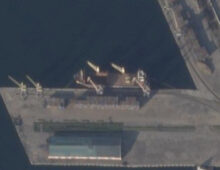
  Analysis Chinese crane vessel engages in likely illicit transfer with North Korean shipSatellite imagery shows three ships side by side outside Nampho, amid suspicious surge in activity around port 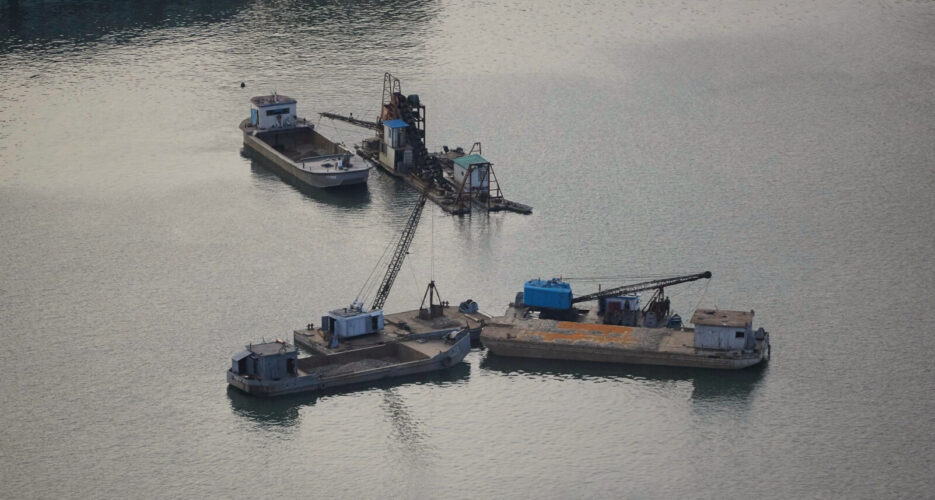 A small Chinese floating crane participated in a likely ship-to-ship transfer involving a recently christened North Korean cargo ship last week, according to NK Pro analysis, as ship activity surges outside the DPRK’s largest port. Geolocation data from Fleetmon and Beijing’s Maritime Safety Administration (CMSA) shows that at least four China-flagged vessels congregated near North Korean ships west of Nampho from June 13, a pattern suggestive of illicit ship-to-ship transfers to circumvent international sanctions on Pyongyang. In the most flagrant case, satellite imagery captured what appeared to be the China-flagged Jiang Shen Fu 6988 right next to the 12,000-ton cargo ship Jang Su San, one of the newest additions to the North Korean fleet. On June 14, the Jang Su San reappeared in Fleetmon ship-tracking data for the first time since last March, anchored within 250 meters of the Jiang Shen Fu 6988 some 17.2 miles (27.8 km) west of Nampho. 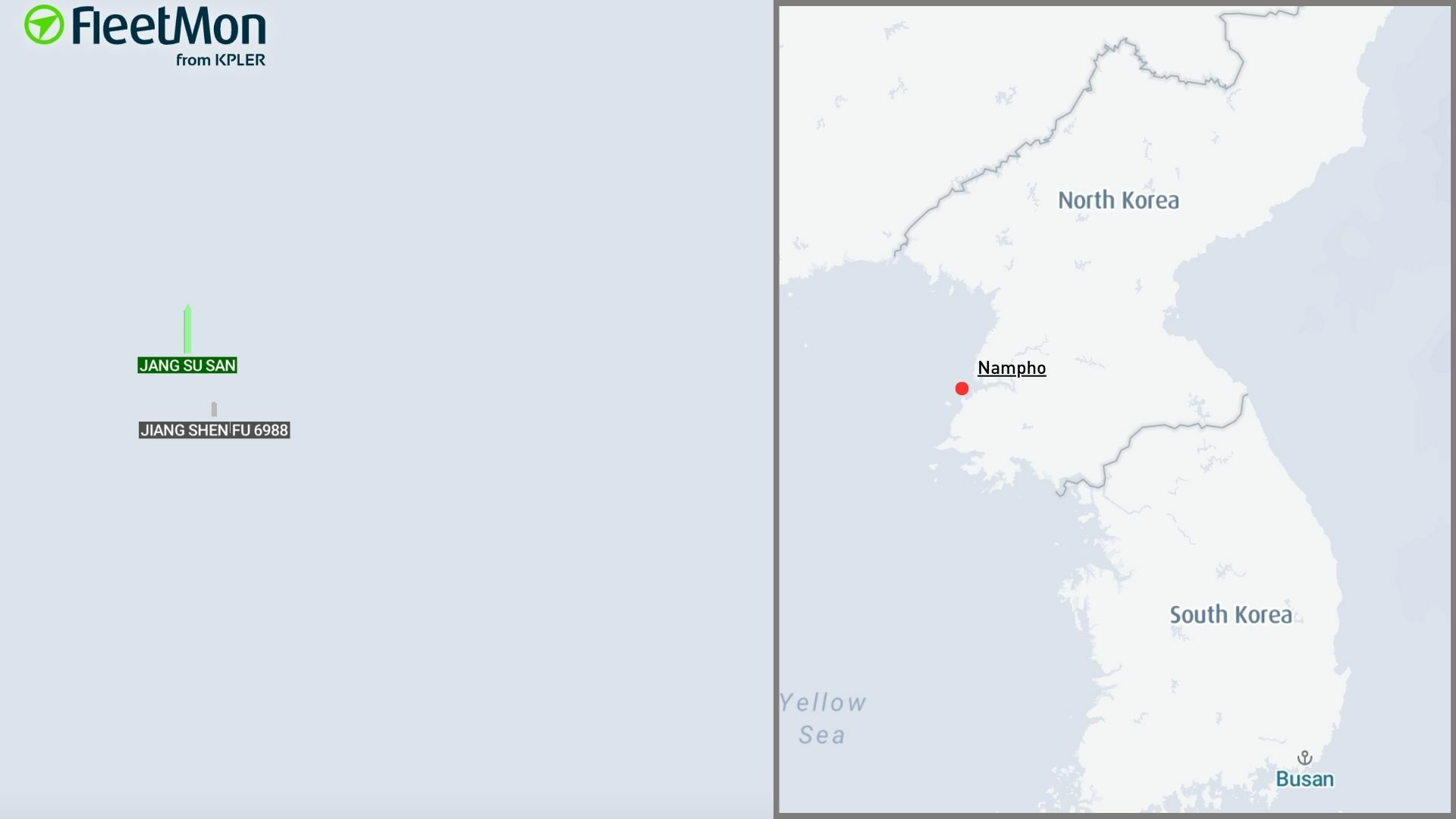 Planet Labs satellite imagery corresponding to the vessels’ coordinates shows three ships berthed together: two larger ships with a smaller vessel between them. The size of one of the larger ships approximately coincides with the dimensions of the Jang Su San, while the smaller vessel’s hull size corresponds to that of the Jiang Shen Fu 6988. The identification of the second larger ship is difficult to determine due to a lack of AIS transmissions from other ships at the given coordinates and the low resolution of satellite imagery available for that specific day. 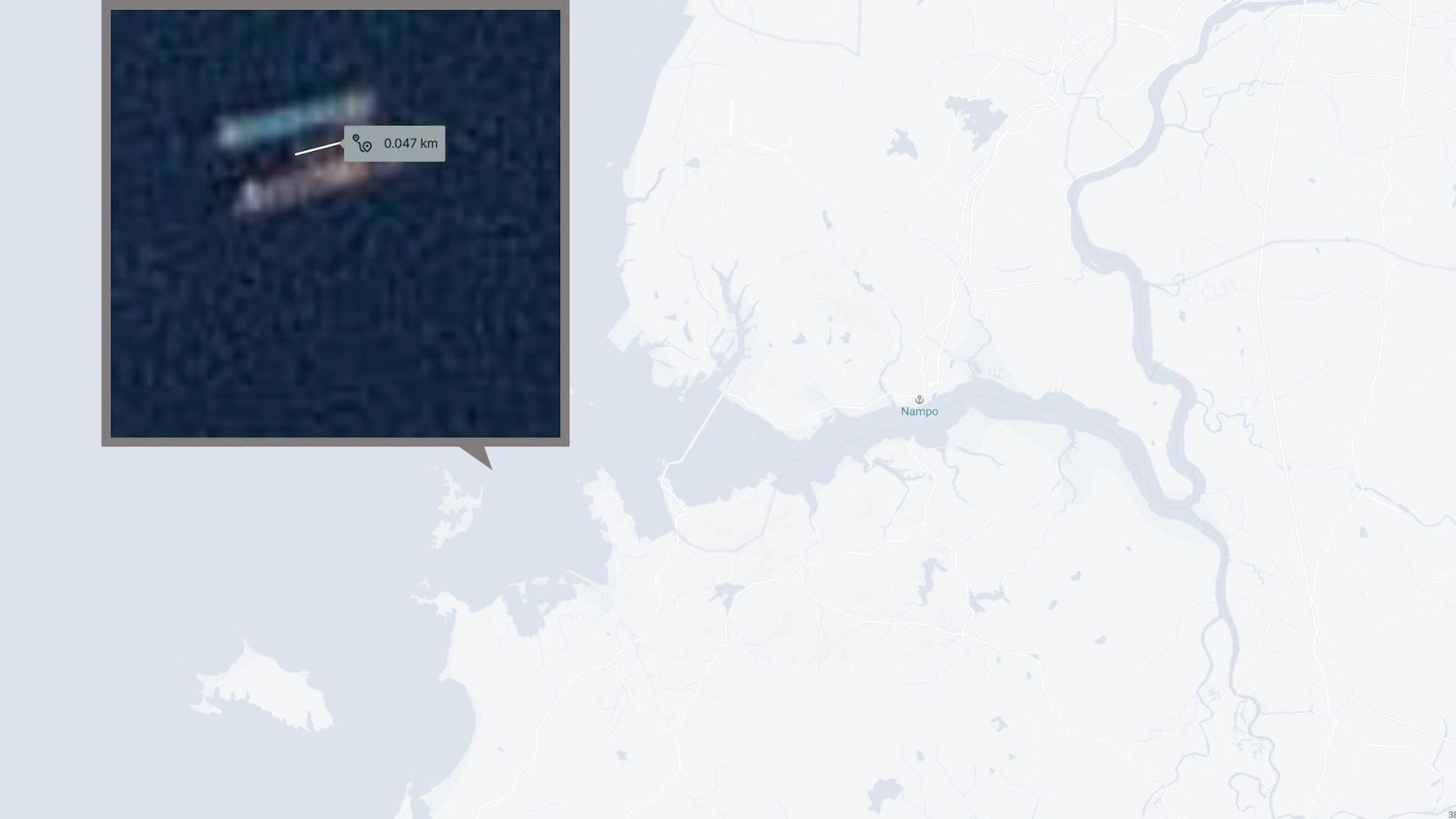 The Jiang Shen Fu 6988, a relatively small boat of 43 meters in length, does not have a known International Maritime Organization (IMO) number and has visited Nampho in the past, specifically last June. Moreover, the U.N. Panel of Experts previously identified the Jiang Shen Fu 6988 as a floating crane used to facilitate ship-to-ship transfers between Chinese and North Korean vessels. It is likely that the vessel was involved in moving cargo between the Jang Su San and the other unidentified ship. Experts have also underscored that North Korean smugglers use boats of different sizes, in particular smaller vessels, to help conceal illegal transactions and ships’ identities. The Jiang Shen Fu 6988 deactivated its (automatic identification system) AIS transponder shortly after the meeting and reappeared 6.9 miles (11.1 km) north of Cho Island on June 18. MORE CHINESE BOATS In addition to the Jiang Shen Fu 6988, three other China-flagged vessels also appeared in the Taedong River estuary west of Nampho on June 13-14 — the Ciyan 178, the Kai Xua Gong 888 and Qing An 9048. The IMO database does not provide any ownership information about the suspicious Ciyan 178, while Fleetmon records reveal that the vessel appears to use an invalid IMO number, suggestive of an attempt to spoof its identity. NK Pro previously spotted the Ciyan 178 using an illegitimate MMSI number, a unique radio identifier, from a different ship. On June 14, the Ciyan 178 also alternated its AIS transmissions with a signal belonging to the passenger vessel Shibokedu22, currently located near Shanghai, in another apparent identity-concealing tactic. The two other Chinese cargo vessels — the Kai Xua Gong 888 and Qing An 9048 — anchored a few miles south in the Nampho harbor on June 14. North Korean cargo ships began congregating west of Nampho around the same time as the Chinese vessels, forming two small groups of ships around June 13. The first group included the Madusan 1, Kumgang 1 and Sang Un 1, while the second was comprised of the Kanghung, Man Dok San, Pusong and Mo Ran Bong 5. Fleetmon records indicate that most of these vessels traveled from various locations in China, such as Longkou, Dalian and Lianyungang, reaching Nampho in the first weeks of June. Notably, the Kanghung is owned and operated by Myohyang Shipping Company, a North Korean entity sanctioned by the U.N. Security Council, U.S. and E.U. The appearance of these vessels aligns with a trend of heightened ship activity near Nampho since early May, according to NK Pro analysis of satellite imagery. Most of these ships refrained from transmitting over AIS until mid-June, when they began to appear in ship-tracking databases. A comparison of satellite imagery from May 15 (left) and June 14 (right) showing an increase in vessels west of Nampho | Images: Planet Labs Some notable vessels that came out of hiding are the U.N. and U.S.-sanctioned oil tanker SAMJONG1, which broadcast for the first time in over a year a few miles north of Seokdo Island, lying some 20 miles (32 km) west of Nampho. The Chong Am freighter, previously subject to U.N. sanctions, also broadcast an AIS signal near the west coast port. 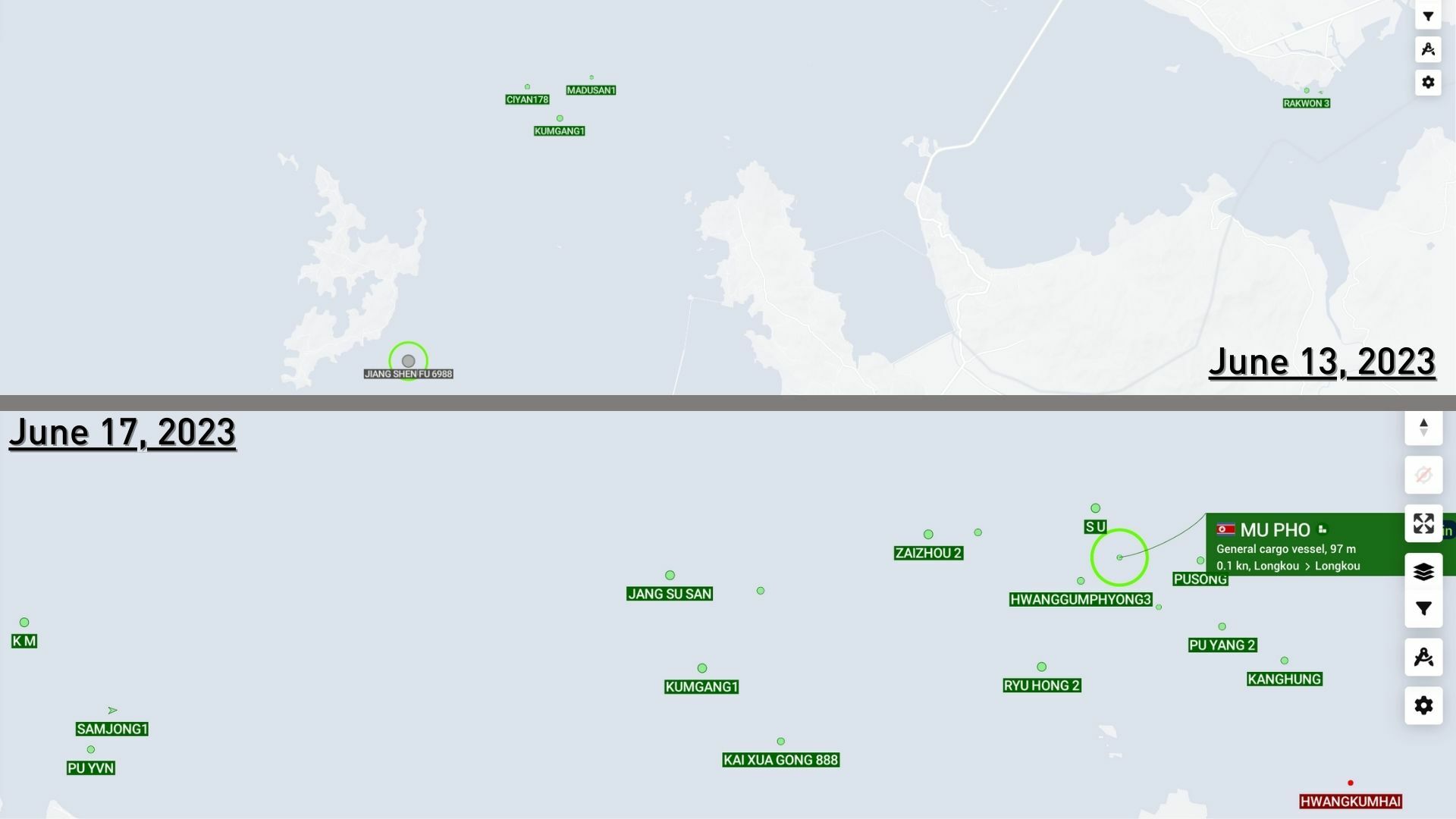 Other North Korean ships that have been actively broadcasting over AIS in the area are the Mu Pho, Zaizhou 2, HWANGGUMPHYONG 3, Hong Dae 1, Tae Dong Gang 9, Kumsanbong 3, the Happy 01 freighter, as well as the oil products tanker Hwangkumhai and the Thae Ja Bong, which flew Chinese colors until joining the DPRK fleet in Feb. 2023. In line with the increase in Chinese vessels loitering around Nampho, the China-flagged M V AM 88 and E P cargo vessels also visited the harbor on June 18, with the latter sailing directly to the port. Edited by Bryan Betts © Korea Risk Group. All rights reserved. |

October 15, 2026Oct 15, 2026

The ultimate resources for professionals working on North Korea
 SHARE
SHARE COPY LINK
 X
X MASTODON