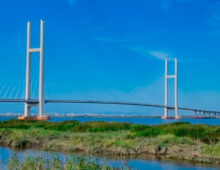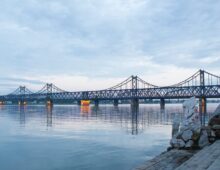
  News Work continues on DPRK side to connect long-stalled cross-border bridge with ChinaFollowing demolition of homes in road’s path, clearing continues toward DPRK highway 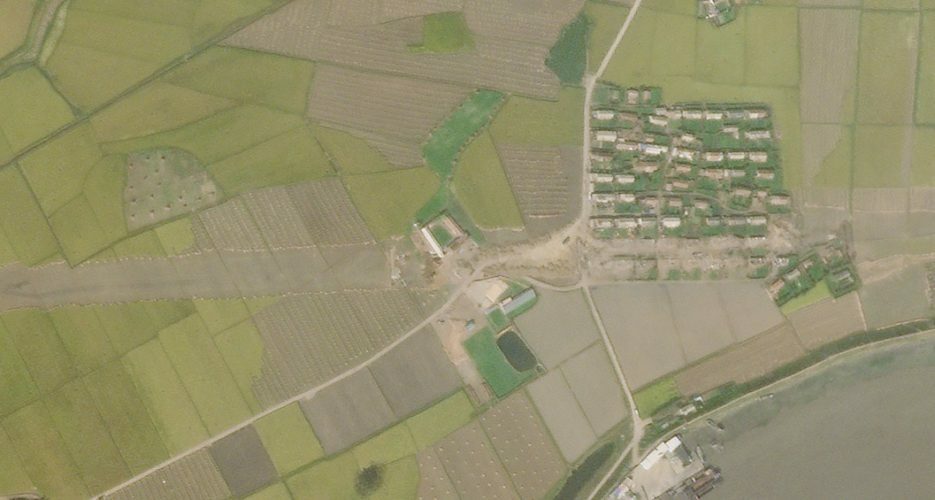 After signs began to emerge in mid-September that construction had started on a road to finally complete the multi-million dollar Sino-DPRK ‘bridge to nowhere,’ further evidence this week suggests the project is picking up speed. Additional satellite imagery provided by Planet Labs reveals details of the initial road clearing and home demolition in the road’s path, as well as further road clearing towards a North Korean highway since late last month. On September 26, NK Pro was first to break the story that work on the DPRK side to complete the road connecting to the New Yalu River/Korea-China Amnokgang Bridge began between September 15-21. The demolition of two rows of small homes in an isolated neighborhood in the path of the connecting road was the first sign that work had restarted since halting in 2014. Land clearing for the road itself then appeared in medium-resolution satellite imagery the following day on September 22 between the cluster of homes and the bridge terminus.  Now, as of October 3, medium-resolution imagery reveals this clearing in the shape and size of the planned highway began to grow in the area of land to the east of the home cluster towards the end of the highway to the northeast as well. Both areas where road clearing appears to be underway line up with the projected 4.5km-long path of the connecting road, which was drawn over the land in early 2014 shortly before the bridge’s final paving was completed. These lines soon disappeared, however, and only an initial 1.3km stretch of land parallel to a small inlet from the adjacent river was cleared in preparation for paving — remaining as a bare dirt road ever since.  High-resolution satellite imagery from Planet Labs taken on October 2 also reveals details of the home demolition and road clearing near the bridge terminus. At least 17 small homes were bulldozed in the direct path of the road, while it appears more structures still lying in the path will need to be demolished. But just as similar clearing was started in 2014 in preparation to pave the new road before halting for five years, it is unclear if the current activities will this time lead to a prompt completion and opening of the bridge to traffic. If this activity is indeed the beginning of the end of the long-languishing project, however, following reports that Chinese President Xi Jinping promised to aid in the construction costs, then its opening will raise questions over Beijing’s commitment to enforcing international sanctions.  The bridge was originally envisioned to boost trade between the countries by providing more lanes and more efficient customs procedures — a situation which China can only allow if current UN sanctions are withdrawn or if the country unilaterally decides to abandon its present level of enforcement. With the breakdown in U.S.-DPRK talks once again last weekend failing to inspire optimism in the prospects for a deal and subsequent sanctions relief, the completion of the cross-border bridge project now appears to depend on how Kim Jong Un and Xi Jinping will plan out the next phase of relations under UN sanctions. Edited by James Fretwell Featured image: Planet Labs © Korea Risk Group. All rights reserved. |

October 05, 2026Oct 05, 2026

The ultimate resources for professionals working on North Korea
 SHARE
SHARE COPY LINK
 X
X MASTODON