  News Ships openly admit to buying illegal fishing permits from North KoreaChinese and South Korean-flagged ships said they’re involved in potential sanctions-violating acts, new documents show 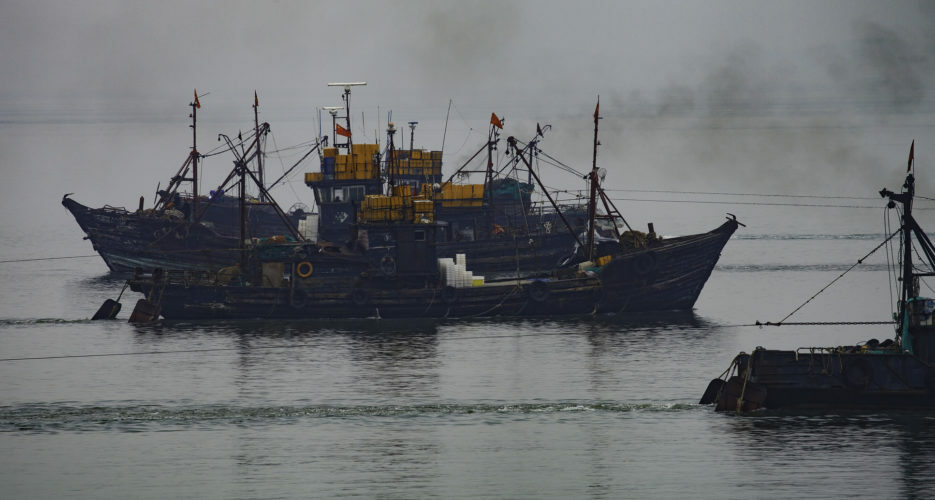 Under rare and mysterious circumstances, a ship flying the South Korean flag was spotted trying to enter North Korean waters in late 2020, according to exclusive government photos and documents obtained by NK Pro. The vessel, along with several other Chinese-flagged ships, openly admitted to being involved in potential sanctions-violating activities. Since 2017, sanctions have barred North Korea from selling seafood or fishing rights to its own waters. Now, government evidence shows that five Chinese-flagged ships — including one that also used a South Korean flag — outright told Japanese authorities that they were on a trip to buy or use North Korean fishing permits this year, or to pick up seafood sourced from the DPRK. The incidents, documented by Japan’s Fisheries Agency (JFA), show that North Korea is continuing to find ways to make money and circumvent rules designed to squeeze the country’s economy and nuclear program. The documents also relay that a South Korean-flagged vessel said it was on its way to meet a North Korean naval ship for a permit examination inside South Korea’s Exclusive Economic Zone (EEZ), which is technically international waters. “The transfer of fishing rights by a naval vessel is definitely an escalation of the relevant U.N. sanctions measures from individual fisherman to state level violations,” Neil Watts, a maritime expert and former United Nations Panel of Experts member, told NK Pro. 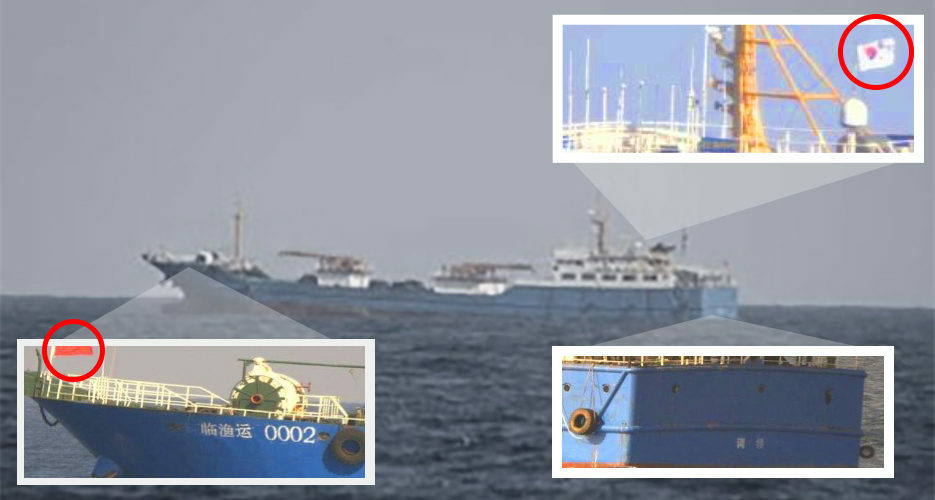 There’s already ample proof that the Chinese fishing industry illegally purchases hundreds of fishing permits from North Korea every season. But the government documents seen by NK Pro give strong evidence that North Korea continues to peddle fishing rights as recently as Oct. 2020. According to the documents, a JFA patrol questioned two Chinese-flagged fishing vessels, the Fuyuan 28 and Fuyuan 27, near the Goto Islands on Sept. 30. In an interview with the vessels, the Chinese ships said that they intended to go to DPRK waters to receive fishing permits. JFA vessels similarly questioned another pair of Chinese vessels, the Lu Rong Yu 59295 and the Lu Rong Yu 59296, after sighting them near Yamato Bank (Yamato-tai) on Sept. 21. They were traveling southwest, away from the DPRK, when they were spotted — and they explained that, while awaiting the approval process for a North Korean fishing permit, one of their crew members was injured and needed to be taken back to China for treatment. The Lu Rong Yu 59295 gave details on how North Korean fishing permits are acquired in 2020, the documents obtained by NK Pro show. After somehow communicating interest, the buying vessel would travel to North Korean waters for inspection in a designated zone, described with the coordinates “39.35N, 133.41E.” The vessel would undergo some kind of examination, make a card payment and then receive the permit. The JFA also gathered intel from a Chinese-flagged vessel called the Lin Yu Yun 0002 on Oct. 19, when the ship anchored in the Yamato Bank area. The Lin Yu Yun 0002 had a crew of 18 Chinese nationals and intended to deliver fresh food and supplies to Chinese fishing vessels in North Korean waters in exchange for frozen squid. The Lin Yu Yun 0002 claimed that it planned to receive an examination and some form of unspecified “permission” — possibly a fishing permit — from a DPRK Navy ship in South Korea’s EEZ. The ship communicated that it planned to meet at a rendezvous point of 38.37N and “around” 131 E. 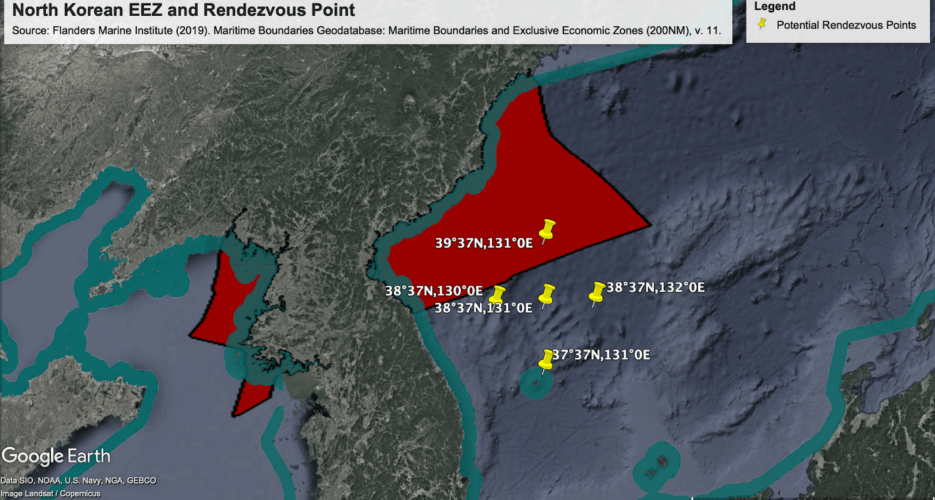 Watts, the maritime expert, said that the Lin Yu Yun 0002’s use of both a Chinese and South Korean flag is unusual. “Flying two flags is not common. It is an evasion tactic for an illegal activity, and most likely [for] vessels that do not have an IMO number,” he said. IMO numbers are an unchanging identification code that’s assigned to a ship when it’s first manufactured. “[These] vessels keep the same IMO number from build or first registry with the IMO,” he added. “If they do have an IMO number, then the second flag is a disguise and they most likely used a fake IMO number, or only a local authority registration number. NK Pro reached out to several South Korean government ministries to ask about the South Korean-flagged ship that allegedly was on its way to meet a North Korean naval vessel in international waters. A spokesperson at Seoul’s Ministry of Oceans and Fisheries, Lee Sang-hoon, said that a foreign vessel could conceivably get permission to hang a South Korean flag. Some fishing vessels that frequent South Korean ports have been photographed flying both flags, like the Russian-flagged Shans 103, for example. “According to our law, Article 5 of the Ship Act stipulates that the Korean flag cannot be hoisted unless it is a Korean vessel. But paragraph 2 states that non-Korean vessels that enter or stay in the port of Korea can have the mascot of the ship attached or hang the Korean flag on the outside where it can be easily seen,” Lee told NK Pro. Lee added that laws technically allow North Korean merchant ships — but not naval ships — to enter South Korea’s Exclusive Economic Zone (EEZ). “Internationally, there is a concept called a ‘harmless passage.’ So, if there is no harm in passing through the territorial waters, if it’s a merchant ship. Not a warship or something else,” he said. 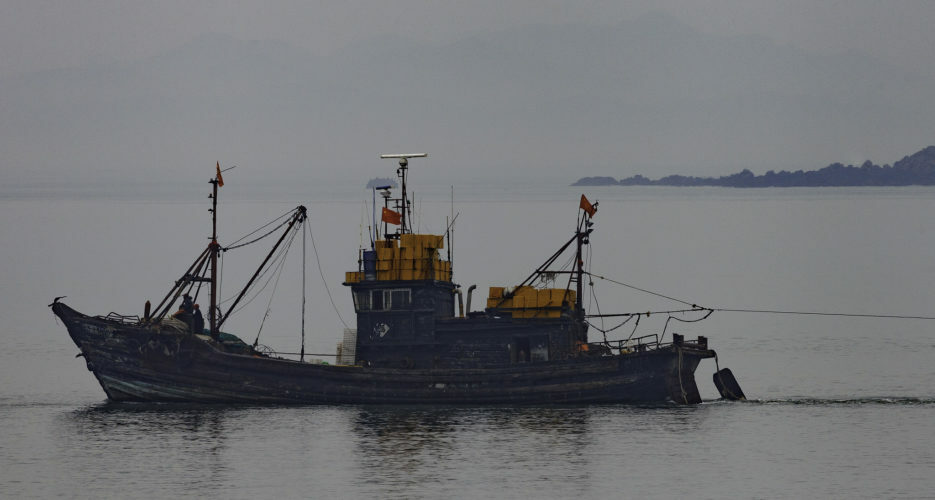 Watts said that a North Korean naval ship entering international waters to sell fishing permits is unprecedented and important. “As far as involvement of North Korean naval vessels in cases of evasion relating to fishing activity, it’s a first,” he said. “ROK territorial waters would be within 12 nautical miles of the coast, whereas the EEZ is 200 nautical miles, and therefore the high seas [or] international water … All North Korean vessels are banned from ROK territorial waters since the Cheonan incident on March 26, 2010.” NK Pro reached out to several government agencies to ask about the incident. Jenie Son, a second secretary at the South Korean Ministry of Foreign Affairs (MOFA) Spokesperson’s Office — which normally deals with sanctions violations — said that the incident currently falls under the purview of the Ministry of Oceans and Fisheries and the Ministry of Unification. “[The issue] is not about the violation of sanctions that have already taken place, but it’s about a ship that has entered the area, seemingly, that seems to have violated sanctions,” Son told NK Pro. “But we can’t confirm that it has violated sanctions yet.” However, a Ministry of Unification (MOU) representative insisted that “with regards to [a] sanctions issue, the government agency to contact is MOFA.” “If the matter is under investigation, then the Korean Coast Guard would be aware of it, and if this matter leads to sanctions violations, then of course MOFA should be looking into it,” the MOU spokesperson said. The Chinese Ministry of Foreign Affairs and the Chinese Embassy in Seoul did not respond to multiple phone and email requests for comment. Edited by Kelly Kasulis. Won-gi Jung and Chad O’Carroll contributed to this report. © Korea Risk Group. All rights reserved. |

October 08, 2026Oct 08, 2026

The ultimate resources for professionals working on North Korea
 SHARE
SHARE COPY LINK
 X
X MASTODON