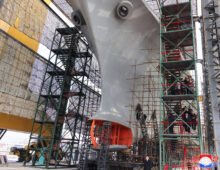
  Analysis S.Korea makes shaky claims on North Korea’s satellite launchRecent claims made by military experts in South Korea pull too much data from one fairing 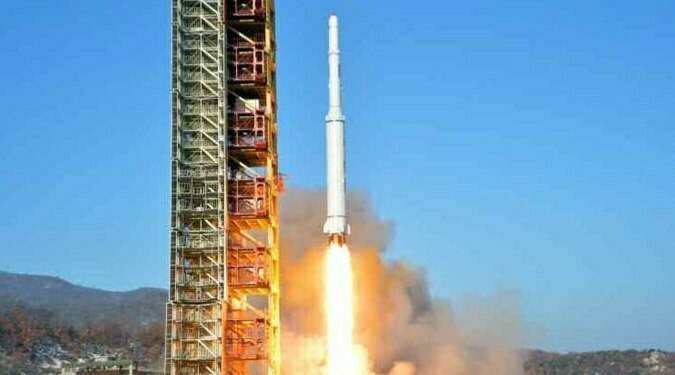 A Yonhap news agency article last week claiming that North Korea’s recent launch of Kwangmyongsong-4 (KMS-4) was “not being used to send a satellite into space as claimed by the North” is basing this claim on some pretty shaky assertions. Unnamed military experts claimed that they could tell the launch was deceptive because the recovered fairing indicated inadequate shock, acoustic, and heat shielding for the rocket’s ascent. They say that, thus, the recent space launch was “not being used to send a satellite into space,” indicating that the whole launch was exclusively a pretense for ballistic missile research. That is too much data to pull from just a fairing (let alone one that has been underwater) with no other indicated evidence. Fairings are rocket nose cones that shield the payload from the heat, drag (when in-atmosphere), and drastic changes in pressure that occur during a rocket’s ascent, as well as providing a more aerodynamic shape for the rocket. They are jettisoned once they reach a certain altitude and are no longer needed. While they are vital for the protection of a payload, they cannot be used for this sort of assertion. These claims require assumptions that the fairings recovered would contain the complete equipment required to protect the payload, which is not accurate, that the satellite was actually provided adequate protection to begin with, which is unclear, and that some degree of protection (such as the acoustic protection) was not packed in in a different or novel method.
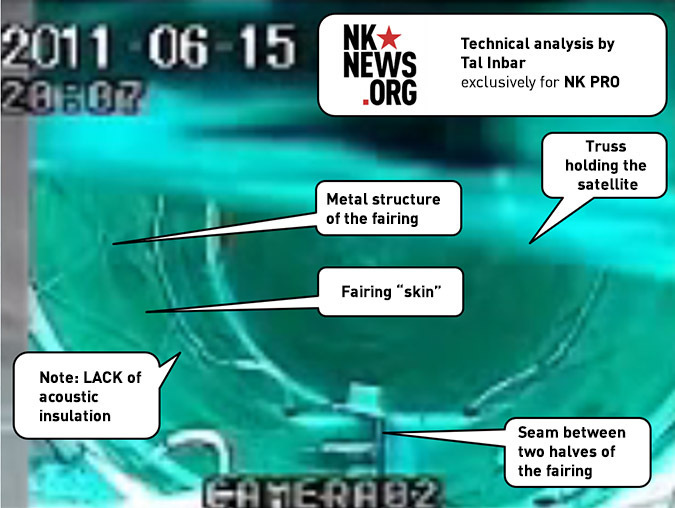
Tal Inbar of the Fisher Institute for Air & Space Strategic Studies has provided imagery from inside the fairings of Iran’s Safir B1 space launch vehicle, which successfully carried the Rasad 1 satellite to space without the acoustic blanketing that Yonhap’s military source claimed was necessary. Iran’s Safir did not seem to utilize the same level of acoustic blanketing seen in other systems, yet the Rasad 1 satellite successfully reached orbit and transmitted data. This case shows that even if the level of acoustic blanketing could be accurately determined from fairing debris, it would not necessarily be a clear indicator of a satellite launch.
Shock absorption and other protection comes in part also from whatever final stage the payload is mounted on, whether that is just the rocket’s third stage or a post-boost vehicle (PBV). Being mounted to the third stage or a PBV, the payload is still exposed to the immense shocks brought on by the first-stage motor and the drag the fairings are experiencing. Shock mitigation cannot come from the fairings alone, it comes from the way the rest of the rocket is constructed. Once the rocket has cleared the dense lower atmosphere, the fairing is usually unnecessary for aerodynamics and protecting the payload, making it dead weight. It is usually jettisoned, leaving the payload still attached to a one or more stages or a post-boost vehicle and, thus, still experiencing some (though much less) shock.  Additionally, we don’t actually know how complex the KMS-4 satellite is or how complex DPRK protection is. While there have been images that claim to be the KMS-4 satellite, we don’t know what was inside it, and there has been no analysis of previous fairings from the Unha or Taepodong launches to compare with, let alone indicate that this one was a deceptive launch. They do note that the satellite has not been transmitting data, indicating it may have either failed or be a dummy satellite. This is much more reasonable data to use for the claim, although it cannot clearly pinpoint whether or not the satellite has failed or was fake to begin with.
To say that it “wasn’t being used to send a satellite” instead of “this technology disproportionately contributes to the long-range rocket program” is unhelpful and would require significantly more proof of intent than unnamed experts extrapolating on payloads based on fairings. The lack of transmissions from the satellite is telling, but it would be difficult to assess whether that is because the satellite has failed or was fake. As the article more accurately states, “Immediately pinpointing why it was a ballistic missile instead of a satellite-launching rocket was difficult because the two kinds of launches use virtually the same technology.” The KMS-4 launch certainly contributes to the North Korea ballistic missile program, as the U.S., USSR, and Indian space programs all contributed to their respective missile programs. But they also contribute to space programs, it is a very clear dual use technology. This is not to say the unnamed sources are necessarily wrong or right or claim whether or not the DPRK is being deceptive. But the claims being made through Yonhap cannot be accurately backed up by the evidence or data they claim to be using. There are too many variables at work to assess the purpose of a rocket launch from its fairing and failure of the satellite to transmit. This claim is just an unhelpful distraction from other more important pieces of data and analyses. Featured image: KCNA © Korea Risk Group. All rights reserved. |

October 25, 2026Oct 25, 2026

The ultimate resources for professionals working on North Korea
 SHARE
SHARE COPY LINK
 X
X MASTODON