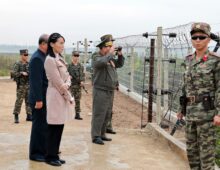
  Analysis North Korea’s coronavirus crackdown: the economic impact so farSome measures have been necessary precautions against an outbreak, but others are unnecessarily harming the market 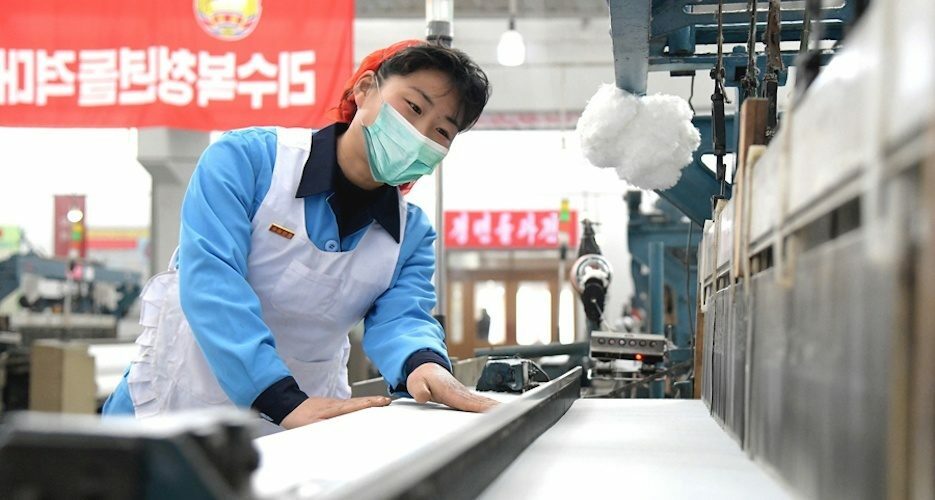 Fearing that the country’s underdeveloped public health system can’t handle a full-on coronavirus outbreak, North Korea’s leadership has largely cordoned off the country with a series of paralyzing policies that will likely exacerbate the country’s already suffering economy. In some regards, a swing towards increased isolation is in sync with plans Kim Jong Un announced at the Plenum of the 7th Central Committee in December. Pyongyang’s leadership believes the best way to ride out sanctions is to increase self-reliance. In the same speech, Kim also revealed plans to consolidate the Cabinet’s control over the economy. Now, the looming threat of coronavirus has led to the hasty adoption of policies that have ratcheted up both isolation and control. But early signs indicate that the likely result of this sudden shift will be more negative than positive, even from the government’s point of view. Squeezing too tight — the corona clampdown North Korea’s economy is already reeling. The royal economy — populated by state-owned enterprises and state trading companies — has been impacted by United Nations Security Council resolutions. These sanctions were designed to target industries utilized by the government to generate revenue, including the export of anthracite coal, textiles, and seafood. As a result, the country’s exports dropped by 32.6% in 2017 and 83.1% in 2018, according to Trade Map. And GDP shrank by 3.5% in 2017 and 4.1% in 2018, according to estimates by South Korea’s Central Bank. Decreased cross border traffic will cause a dropoff in both legal and illegal trade that could complicate the government’s efforts to ensure a continued supply of foreign currency. It will also weaken investment flows from China; these have already slowed to a trickle, according to China’s Ministry of Commerce. In many ways, the bulk of the population was largely insulated from the effects of sanctions. Per capita GNI remained stable through 2017 and 2018. Food and exchange rate prices have fluctuated within normal levels from November 2017 through January 2020. We will take a closer look at these price changes in a subsequent section. But the negative effects of corona-induced isolation and the government’s corresponding crackdown are threatening that. Upswings in rice price, gasoline price, and the dollar exchange rate hint at further strain to come, but have not yet reached unprecedented levels. Barring a restoration to cross-border flows, it is hard to see how the situation could improve. Making things worse are clampdowns by the authorities on smuggling and an attempt to re-implement oft-disregarded price controls. These moves are seen as reactions to the coronavirus, but are also complementary to a slew of new policies designed to increase the state’s control over all aspects of the economy. The effects of these policies — including increased fees for market traders — are set to put extra strain on a population that is already struggling to get by. Over 10 million people (about 40% of the population) in North Korea are food insecure, according to the UN’s latest estimate, making them highly vulnerable to infectious disease.  The current state of coronavirus (COVID-19) in North Korea Is a crisis on the horizon in North Korea? Has it already arrived? Is the state prepared? Conflicting signals obscure the current status of the virus in North Korea, but it’s possible to shift through the noise and get to a reasonable assessment. North Korea’s health minister made a public announcement on state TV declaring that “the country has no confirmed or suspected cases of the novel coronavirus.” Similarly, a spokesperson for the World Health Organization (WHO) said “there are no signals” of coronavirus in North Korea. However, a little digging suggests this might not be the whole story. Beneath this calm exterior, we see a tumult of activity that speaks to the contrary. North Korea has reached out to international health agencies in search of aid and assistance, including UNICEF, the International Federation of Red Cross and Red Crescent Societies (IFRC), and Doctors Without Borders. In addition, North Korea’s mission to Geneva set up a meeting with the World Health Organization. In this context, the North Korean health minister’s claims look more like an attempt to alleviate public concern than a statement of simple fact. The U.S. State Department issued a press statement expressing deep concern about the prospect of an outbreak and voiced support to “U.S. and international aid and health organizations to counter and contain the spread of coronavirus in the DPRK.” The two Chinese provinces adjacent to North Korea, Liaoning and Jilin, have seen nearly a three-fold increase of confirmed cases from February 1st (77 cases in the two provinces) to February 18 (200 cases), according to the World Health Organization. The Red Cross has mobilized hundreds of volunteers in the border region to assist with screening and hygiene. South Korean and U.S. media have reported on multiple suspected cases in North Korea, citing inside sources. These allegations contradict messages conveyed by North Korean state media, including a Rodong Sinmun report, insisting that the country remains corona-free. In late January, the government in the border city of Sinuiju reportedly quarantined “even those with slight symptoms.” In early February, the government reportedly “quarantined several patients with suspected coronavirus in Musan, North Hamgyong Province.” To shield the elite in Pyongyang from exposure, domestic travel restrictions have been imposed against North Koreans with recent travel overseas or to the border region, an inside source told Radio Free Asia. Indeed, whether or not Pyongyang admits any cases, it’s no secret that the government is stepping in with some rather forceful interventions. One article in the Rodong Sinmun urged people to take precautions like washing their hands, but lashed out at some residents for “not coming to their senses and facing the situation seriously.” A month-long quarantine has been imposed for those entering the country, tourism has been suspended, trains and flights connecting North Korea with the outside world have ground to a halt, a border-adjacent port has been closed, and officials stationed in China have been called back home. To top it off, Kim Jong Un was nowhere to be found as concerns began to multiply about a potential outbreak of the mysterious virus. After disappearing from state media for three weeks, he popped up again last weekend to mark the anniversary of his father’s death.  Interventions — some necessary, some counterproductive Some of the initiatives taken by the North Korean authorities to protect the country against the spread of infection make good sense. But others are counterproductive. The combination of the two is a cause for concern. A review of the economic situation suggests that — while we do see upticks across a wide array of price categories — it is still unclear how long-lasting the effects will be. Let’s start with the reasonable policies impacting the economy. Without a better health system to protect against viral spread, it may indeed be a painful necessity to close the Sinuiju Port and an array of customs offices speckled along the border. Crackdowns on illicit trade may also fit within this category. The army handed down orders in late January for border patrol units to “make the border as airtight as possible.” In addition, border patrol units were ordered by the Ministry of State Security in mid-February to crackdown against smuggling. The border guards, who supplement meager incomes by taking bribes from smugglers, are unhappy with this turn of events. But the authorities’ decision to apply military law against offenders leaves little room for debate. An atmosphere of fear — and news of border guards arrested for smuggling — has effectively tamped down activity in the smuggling routes. Less reasonable is the government’s decision to implement price controls. Responding to a surge in prices for needed items like rice, soybean oil, and fuel, People’s Committees in Hamhung (a city near the East coast) and Hyesan (a city along the northern border with China) have sent market management officials to enforce price controls in the marketplace. The government has experimented with price controls before, with mixed results. They were rolled out alongside the disastrous 2008 currency reform measures, which wiped out the cash savings of market traders. They were later recalled. Since then, attitudes and implementation levels have varied. In 2015, enforcement of the ceilings weakened, but periodically picked up in bursts of enforcement that typically lacked coordination and ignorance of market principles. Rather than take a loss by selling their wares at artificially low prices, merchants look to avoid the price ceilings and sometimes even remove their items from sale to wait out the intervention. But the state has demanded distributors to bring their product to the market. An example of this is soybean oil and sugar, two commodities that both dropped in price after the government stepped in. North Korea is a divided society, and many families are scraping to get by. Adding pressure on the leadership, the population is starting to blame Kim Jong Un for the country’s ailing economy, according to defector surveys carried out by Seoul National University. This may explain the motivation for the enactment of the price controls, which nonetheless remain misguided. So, in the short term, some of these price controls will score the regime points. However, in the long run, meddling will hurt rather than help. Under Kim Jong Un’s reign, state salaries have dropped and the importance of market income has doubled, according to defector surveys administered by Seoul National University. Over 75 percent of respondents in 2018 said they receive less than 5,000 KPW per month from the government — about the cost of a kilogram of rice. If state interventions make profitable market operations impossible, many people will have nowhere else to turn.  Prices Let’s take a look at three price categories: food, currency, and fuel. With some exceptional (and usually short-lived) cases of state intervention, these are market prices, subject to the law of supply and demand. The time parameters are May 2015 through mid-February 2020. The source is Daily NK, which employs sources in three cities to gather the data — Pyongyang, Hyesan, and Sinuiju. For simplicity’s sake, we will look at prices in Pyongyang only. The data is collected at semi-regular intervals, usually at least once per month. In addition to graphing the data points (the jagged lines), we’ve also graphed a polynomial trendline (the wavy lines) to more easily observe general shifts over time. First, let’s look at food. This year, rice prices rose sharply from January to February and are currently at a two year high. The last time prices edged above 5,800 per kilogram was November 2017. However, as the below graph illustrates, the current price remains inside the 4,000-6,000 KPW range that it has fluctuated within over the past five years. It seems that rice imported from China, typically cheaper than the domestic alternative, has now become more expensive, a consequence of diminished supply. Next, let’s turn to currency prices. Concern about the potential for prolonged isolation and a deteriorating economic situation has caused some hoarding behavior. This means people are choosing to spend more North Korean won in order to save their foreign currency for a rainy day. Both private merchants and state-owned businesses use incentives like discounts to convince their customers to use foreign currency, especially for large purchases. As the below graph indicates, exchange rates for both the dollar and the yuan are currently on an upwards trend, but neither have exceeded the range set by prices recorded over the last five years. The dollar is more volatile than the yuan, perhaps because of its scarcity. These rates are important because North Koreans tend to lack confidence in domestic banks and prefer to save in foreign currency. They also matter because runaway inflation would point to a rundown in the central bank’s foreign exchange reserves. We will have to pay close attention over the coming weeks to see how the currency rates develop.
Lastly, let’s turn to gas and diesel prices. Of all the commodities tracked by Daily NK, gas and diesel prices are the most vulnerable to supply shocks and volatility. Looking from 2015 to now, we’ve seen prices as low as 6,000 North Korean Won and as high as 23,500. Prices peaked in October 2017, shortly after the adoption of UNSCR 2375, which limited the allowable provision of oil to North Korea. But the prices fell as illicit provisions of oil continued to stream into the country through smuggling, ship to ship transfers, and underwater pipelines, as noted by the United Nations 1718 Sanctions Committee Panel of Experts. Supply shocks could cause far-ranging consequences to ripple throughout North Korean society. For example, gas prices in Pyongyang already increased over 35% from December 6 to February 11. A sustained increase in price would put the brakes on logistics, increasing shipping costs and raising prices for a wide assortment of goods affecting state factories, military units, cottage industries, and consumers.
What it means Time is not on North Korea’s side. There’s no telling how long the coronavirus will remain a threat. Some of North Korea’s policy choices are tough but necessary protections against a health crisis. But others are unnecessary barriers that stifle markets. In the short run, Kim Jong Un will succeed in increasing the state’s control over the economy, but this comes at the risk of killing the goose that laid the golden egg. Edited by James Fretwell and Oliver Hotham © Korea Risk Group. All rights reserved. |

October 26, 2026Oct 26, 2026

The ultimate resources for professionals working on North Korea
 SHARE
SHARE COPY LINK
 X
X MASTODON