
  Analysis Imagery casts doubt over North Korea’s Hwasong-17 ICBM claimsNK Pro analysis finds state TV aired footage of Hwasong-17 test likely shot on March 16 or before, not March 24 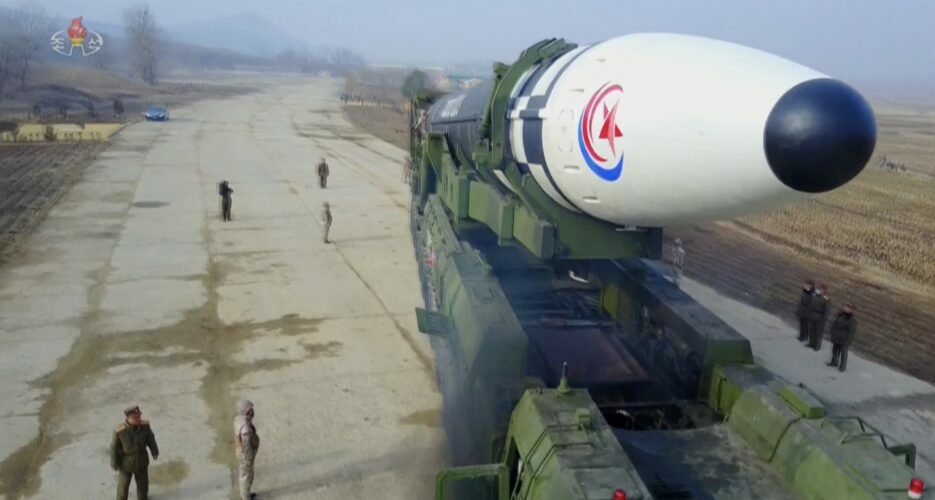 North Korean state TV aired footage on Friday of a Hwasong-17 intercontinental ballistic missile (ICBM) launch that it said took place at the Pyongyang International Airport on March 24, but NK Pro analysis of satellite imagery indicates the footage was likely filmed more than a week earlier. Available evidence raises the possibility that North Korea is trying to pass off a Hwasong-17 test launch that ended in failure in skies over Pyongyang on March 16 as the missile launched on March 24. This would mean DPRK state media is hiding footage and details of the long-range missile it fired on March 24, which landed just 150 km off the coast of northern Japan. South Korea’s Yonhap News Agency quoted a “high-level government official” saying Seoul believes it’s possible the March 24 test was of a Hwasong-15 ICBM, and that North Korea could have “enhanced the engine thrust and modified the weight of the warhead part” to achieve the extended apogee and range reported by the South Korean and Japanese militaries. Multiple pieces of visual evidence suggest North Korea’s version of events is misleading at best, and possibly a complete fabrication of a successful Hwasong-17 test at worst. First, high-resolution Planet Labs satellite imagery shows workers carried out a controlled burn of fields surrounding the south end of the airport runway between March 21 and 22, but the same fields did not appear burned in Korean Central Television (KCTV) footage of the Hwasong-17 launch, shot from a camera attached to the missile.   Second, aerial KCTV footage of the launch showed an anti-aircraft artillery (AAA) post located 200 meters to the south of the launch site that appeared in satellite images taken on March 17 and 19. However, workers appeared to dig out or cover parts of the same AAA post in satellite images taken on March 21 and 22, suggesting the KCTV footage was taken prior to, not after, the changes. Third, an apparent burn mark already showed up in satellite imagery of the road where the missile was fired on the afternoon of March 16, but no such marks appeared in the KCTV footage of the ground surrounding the parked missile transporter erector launcher (TEL) vehicle. It’s possible that the burn marks sufficiently faded by March 24, but it is clear that whatever was launched on March 16 was from the same spot as the Hwasong-17 launch depicted on KCTV. Further, a high-resolution Planet Labs image taken on March 27 appears to reveal a second burn mark up the road just meters away from the first one, suggesting the March 24 ICBM launch took place from the spot of the new burn mark and was not depicted in state media footage. 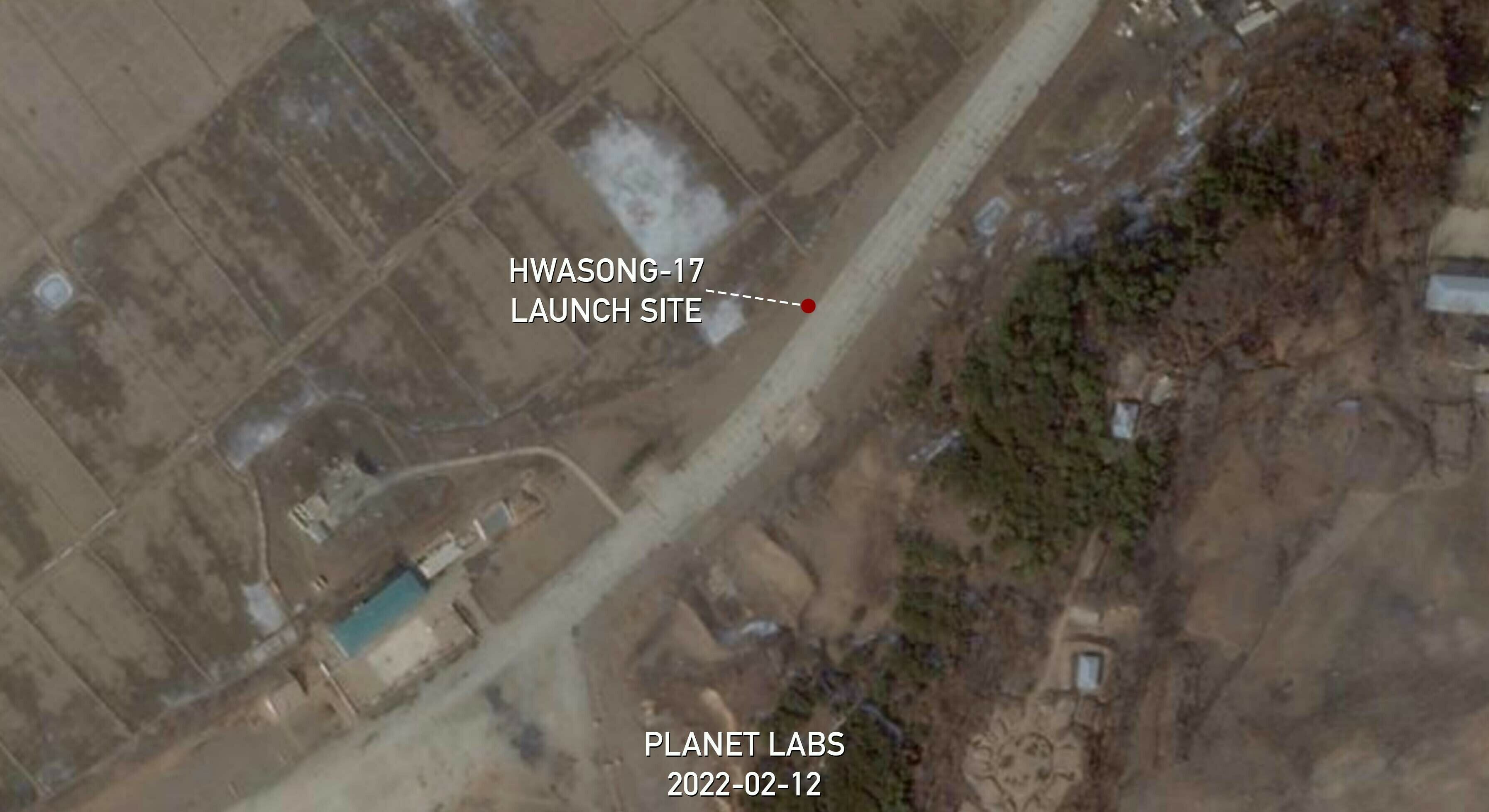 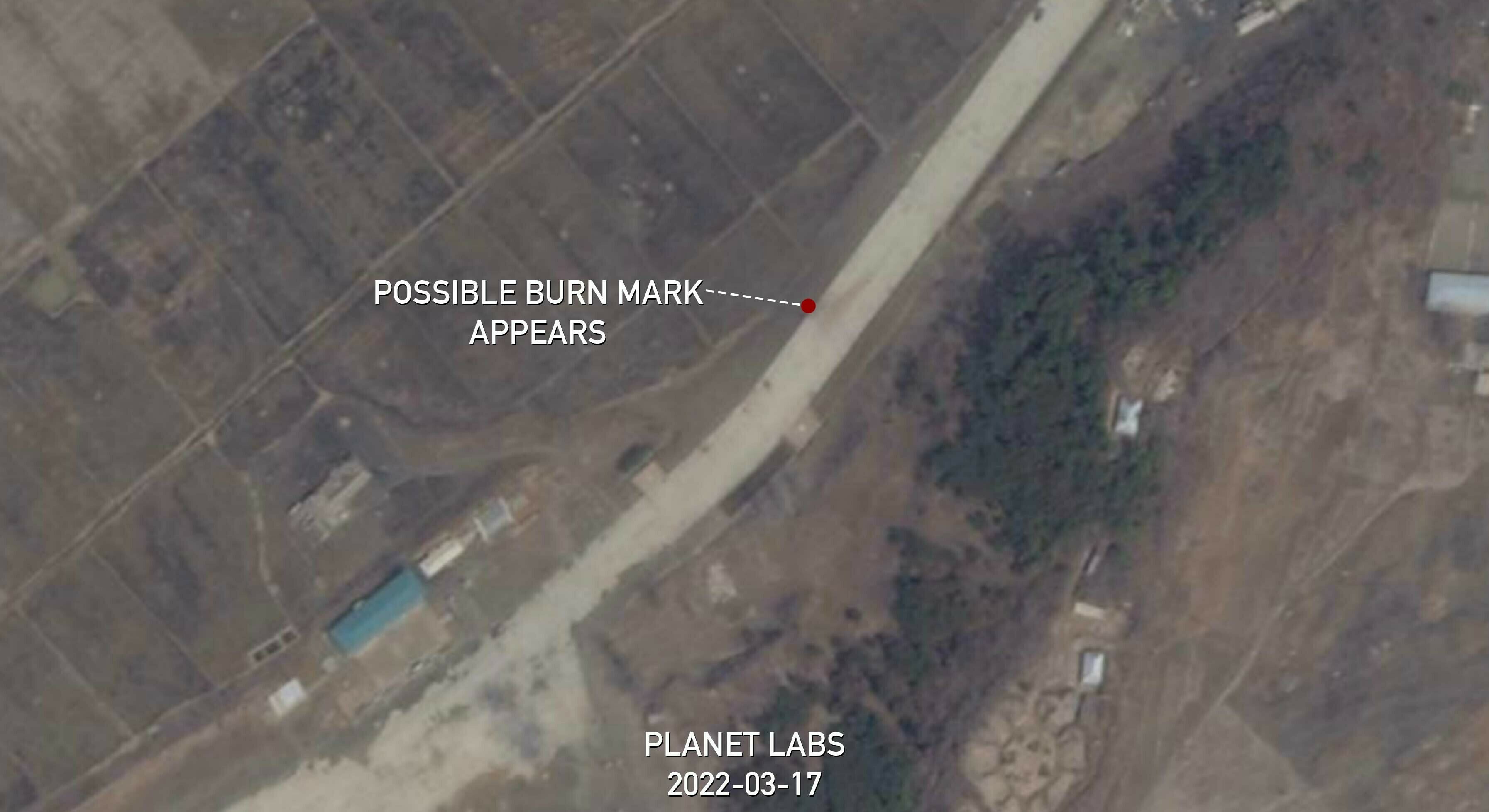 An apparent burn mark appeared between Feb. 12 and March 17 in the same spot as the Hwasong-17 test site depicted on KCTV, suggesting whatever missile North Korea fired on March 16 – which failed and which state media did not report on – was fired from this spot. | Images: Planet Labs PBH, edited by NK Pro 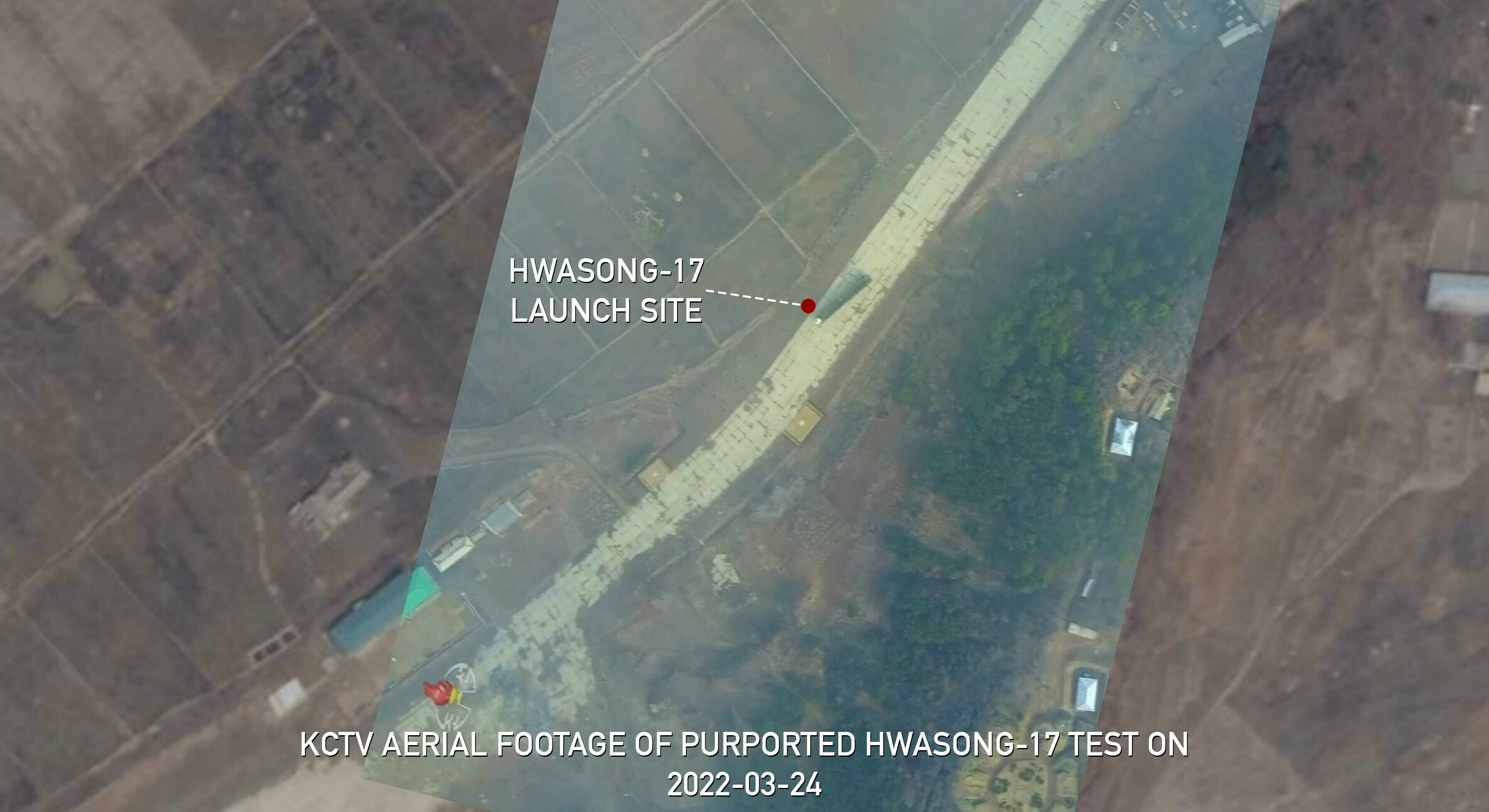 This comparison shows how the Hwasong-17 TEL was parked in the same spot as the location of burn marks that appeared in satellite imagery to be from the March 16 failed missile test | Images: Planet Labs PBH, KCTV, edited by NK Pro 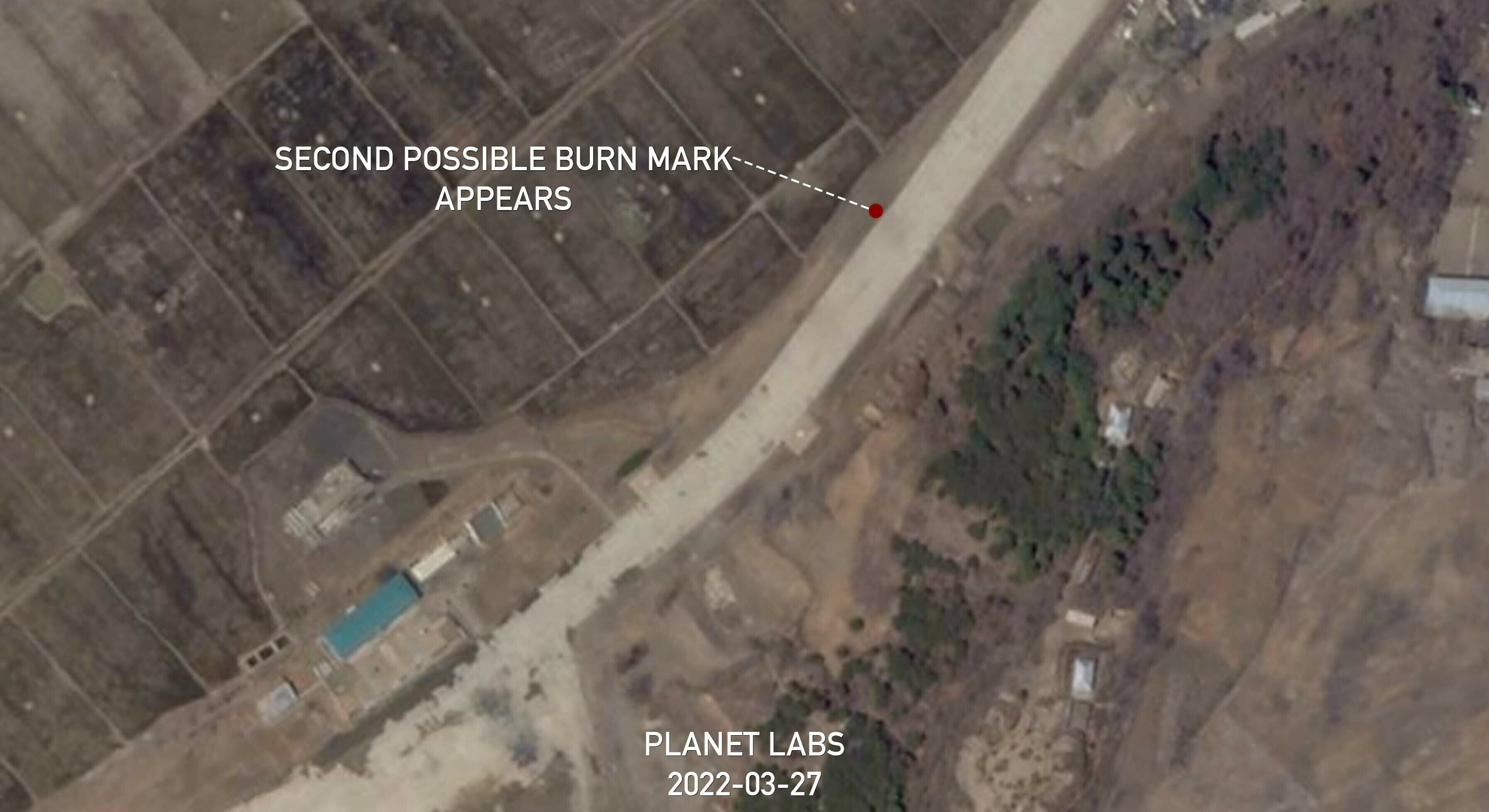 Another possible burn mark appeared between March 17 and 27, likely indicating the spot of the March 24 ICBM launch | Images: Planet Labs PBH, KCTV, edited by NK Pro  Fourth, long shadows appeared to be cast to the northwest at the moment of launch seen in the KCTV aerial footage, matching a 9:30 a.m. launch time from the failed March 16 test but not matching the 2:30 p.m. launch time of the missile tested on March 24. The sun would have cast shadows up the road toward the northeast at that time. Fifth, during the KCTV video of the launch shot from ground level looking up, the Hwasong-17 is clearly shown flying up into the sky through wispy clouds, before cutting and then showing an indiscernible missile with the wispy clouds gone from the shot. The second part of the video could be of whatever missile was fired on March 24, with the first part being footage of a Hwasong-17 launch on March 16 up until before it exploded in the sky. It also appears that the position of a set of yellow bins outside the window of Kim Jong Un’s observation bus was completely different in two separate shots that KCTV presented as being from the same March 24 missile test, suggesting one shot was from the Hwasong-17 test, possibly on March 16, and another from the successful ICBM launch on March 24.  North Korea also conducted what the U.S. claims were “ICBM-capable platform” missile tests on Feb. 27 and March 5 from the Pyongyang airport area, but never released ground-level photos or footage of the launches. NK Pro found evidence suggesting these were launched from a different part of the airport, but it is possible that state media used some images or photos from these tests on Friday as well. It also remains possible that North Korea indeed launched a Hwasong-17 on March 24, but used old footage, perhaps from a failed attempt on March 16, in its coverage of the March 24 test. This could have been necessary if cameras failed to capture certain aspects of this week’s launch that propagandists wanted to include in state media coverage. If Pyongyang is trying to pass off a failed Hwasong-17 ICBM test as a success, using footage of the failed test taken prior to its explosion in the sky and confirmed flight data of a Hwasong-15 test as cover, it would not be their first attempt at missile-related subterfuge. North Korea similarly attempted to pass off a failed Jan. 2016 submarine-launched ballistic missile (SLBM) test as a success using altered video footage, and tried to doctor out evidence of Kim Jong Un’s presence at another SLBM test in Oct. 2019. Jeongmin Kim contributed reporting to this article. Edited by Arius Derr. Updated on March 25 at 7:34 p.m. KST to include additional evidence relating to shadows seen in KCTV footage, and on March 28 at 11:35 a.m. to include new evidence from a satellite image taken on March 27. © Korea Risk Group. All rights reserved. |

September 29, 2026Sep 29, 2026

The ultimate resources for professionals working on North Korea
 SHARE
SHARE COPY LINK
 X
X MASTODON