  
News Work resumes at North Korean aerospace base after Kim Jong Un’s visit: ImageryActivity at ‘space environmental test base’ suggests DPRK pushing forward plans for military reconnaissance satellite 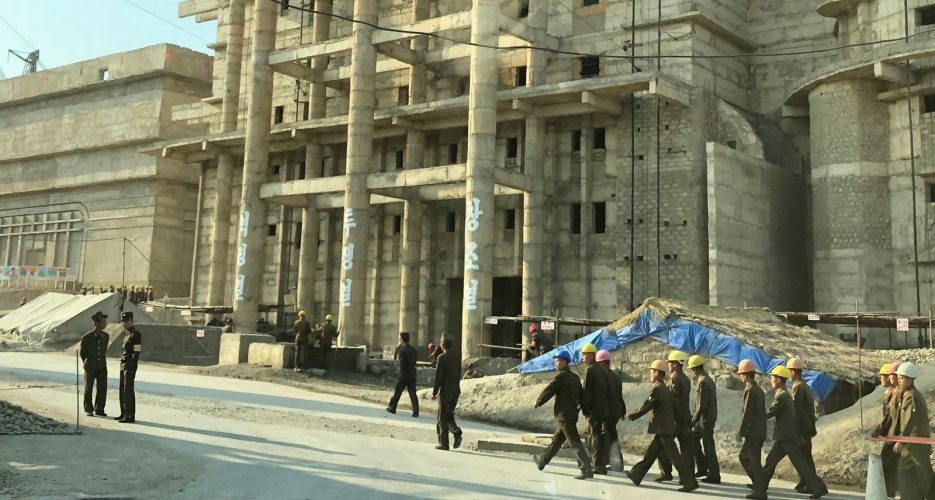 Work on North Korea’s long-planned “space environmental test base” appeared to resume in recent months following a visit by leader Kim Jong Un to Pyongyang’s Satellite Control Center (SCC) next door in March, satellite imagery shows. The renewed activity at the site is a sign that North Korea is serious about plans to improve its aerospace industry and launch multiple “military reconnaissance satellites” into space in the coming years. While the DPRK may be able to utilize reconnaissance satellite imagery from its allies in China and Russia or commercial providers, one expert said North Korea is likely pressing ahead with the project because “building a local capacity is important even if it’s a secondary target.” “You can look at Iran’s programs to see that,” Dave Schmerler, senior research associate at the James Martin Center for Nonproliferation Studies, told NK Pro. “They’ll probably still work toward a localized space capability — albeit at a different rate if they feel they don’t need to rush it.” 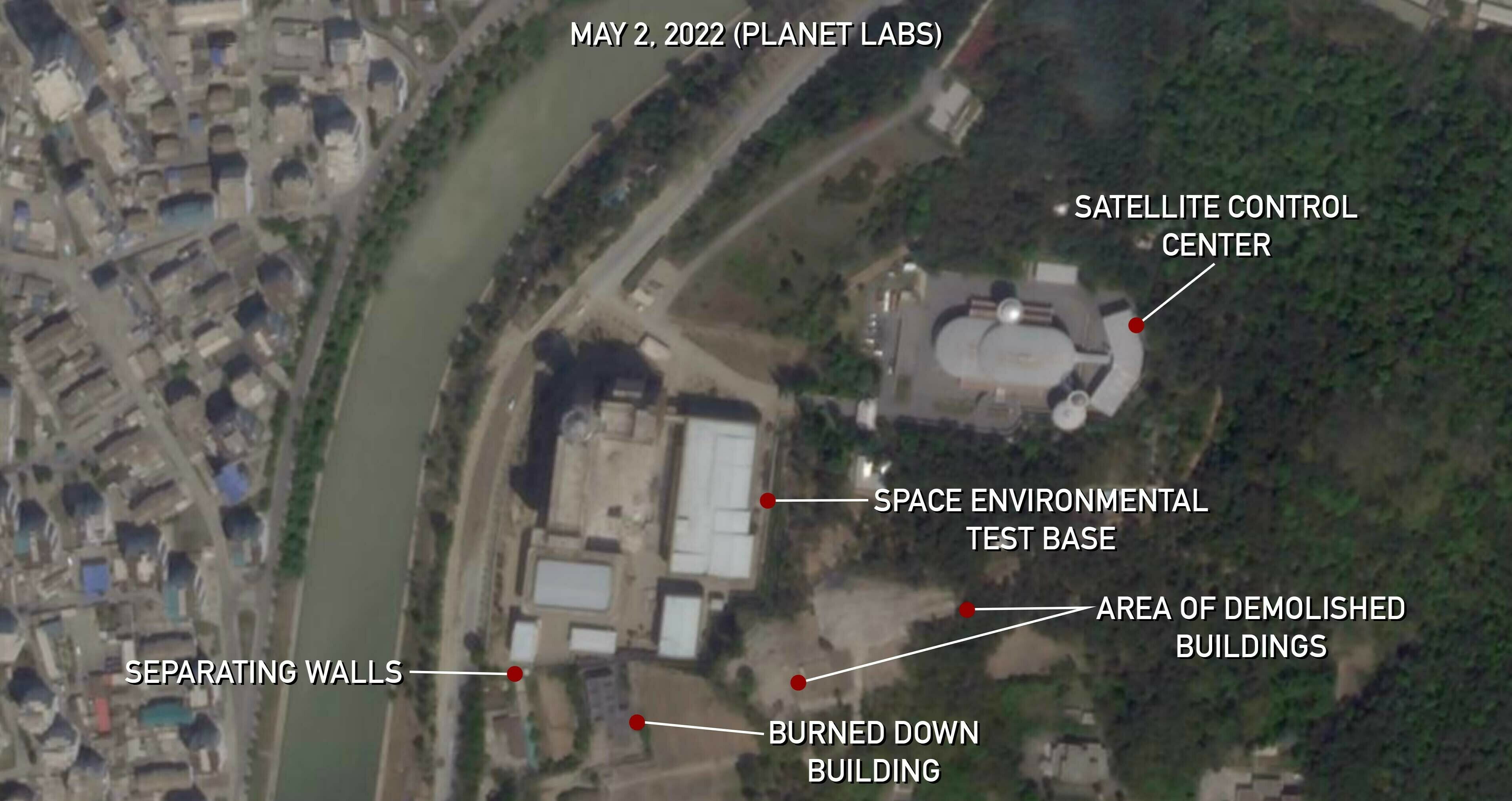 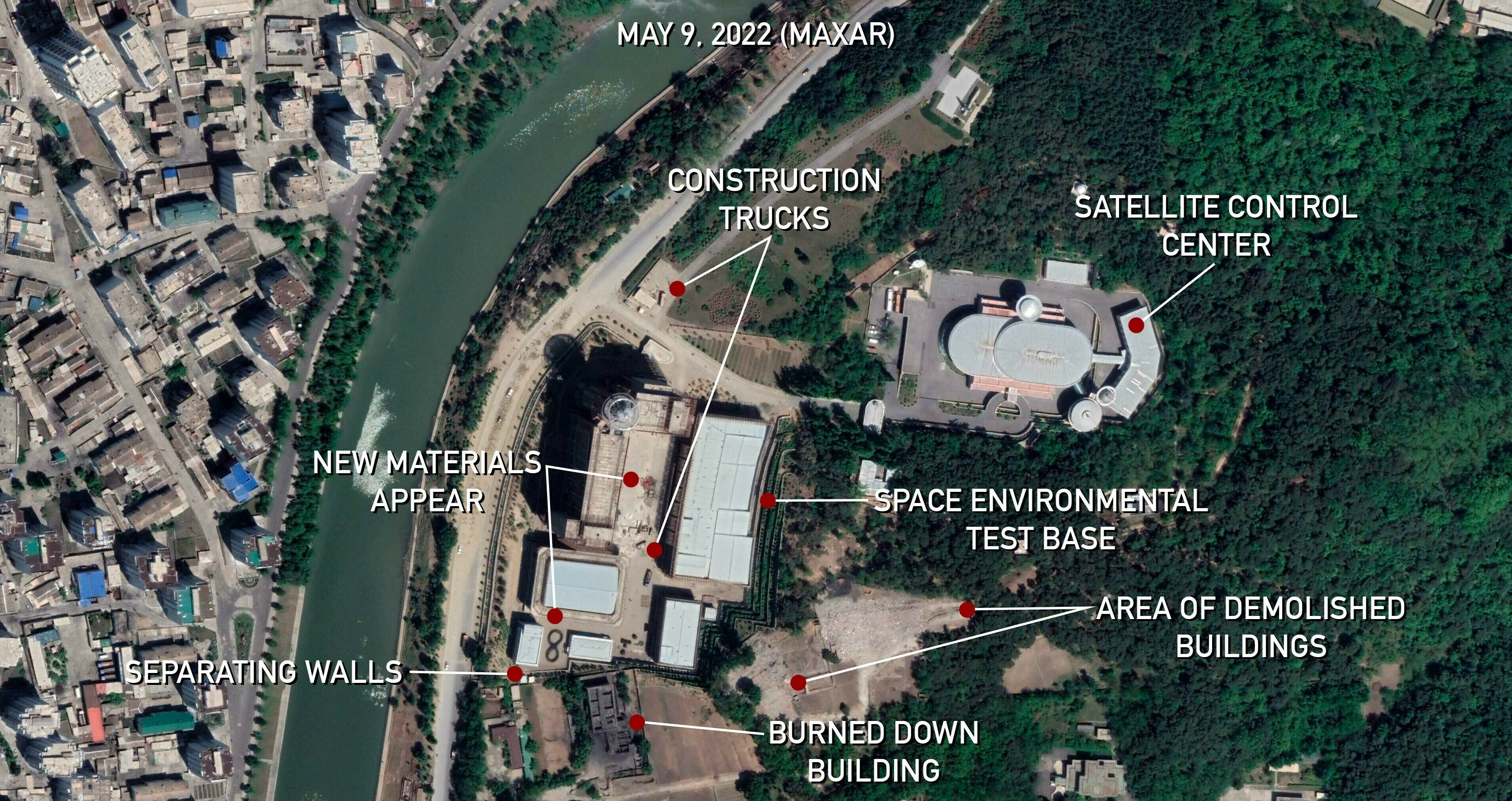 Activity at the construction site can be seen in this comparison of two satellite images taken a week apart in May 2022 | Images: Planet Labs PBH, Maxar, edited by NK Pro Construction on the advanced facilities has stalled multiple times since work began in 2017, and the recent activity has been inconsistent: Images taken in June show little activity compared to May. The latest activity appeared to begin with the establishment of a new construction worker tent camp nearby the site in Nov. 2021. The camp is located across a bridge and further away from the SCC complex than existing camps, which were established in varying sizes along the adjacent river before the first SCC buildings went up in 2014. There does not appear to be any other large-scale construction site in the area, suggesting the camp is related to the SCC. There were little signs of activity or construction at the SCC space environmental test base site in 2021, but movement of materials and trucks in the central courtyard and surrounding the space environmental test base buildings appeared to resume in April and May. 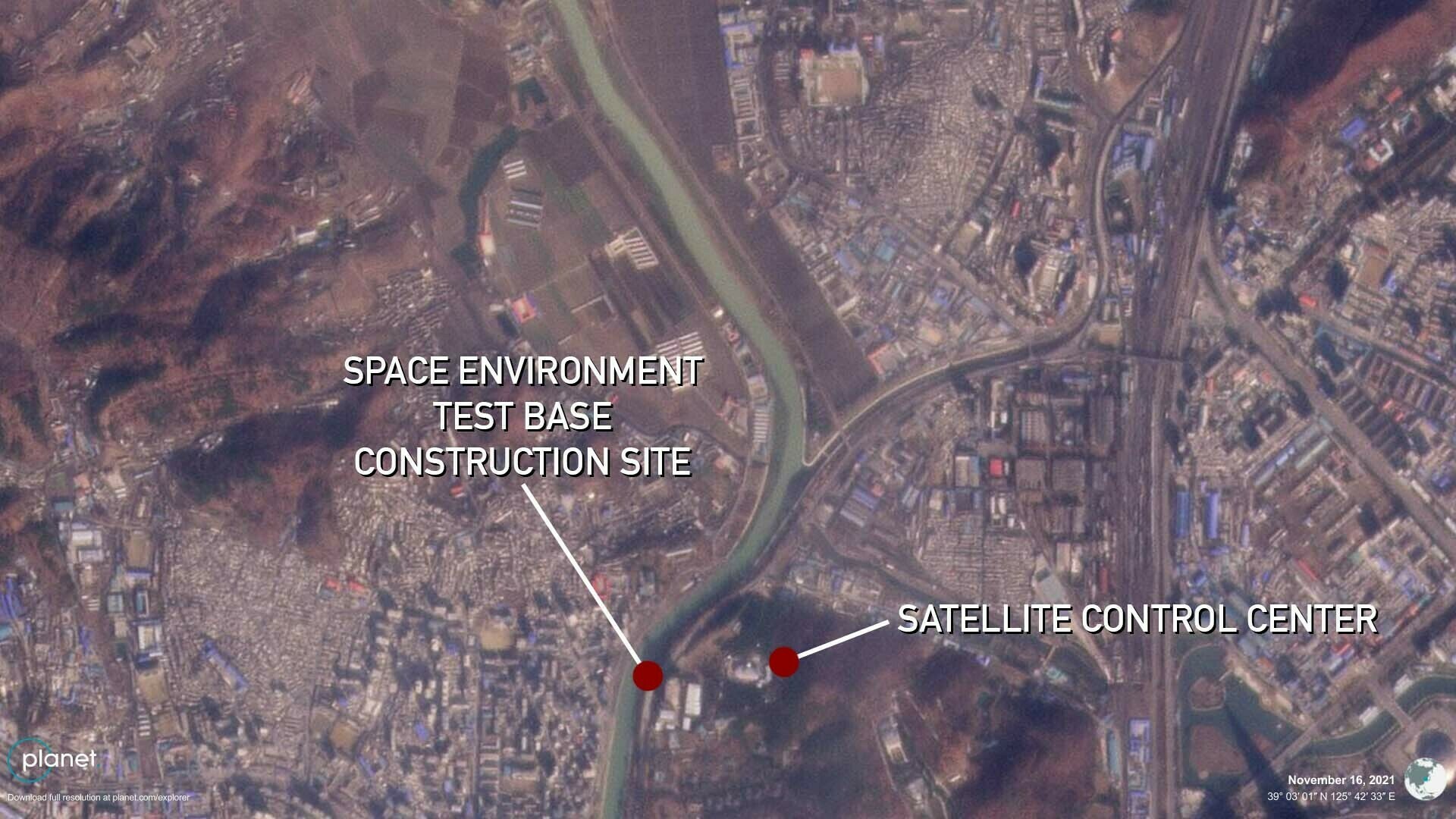 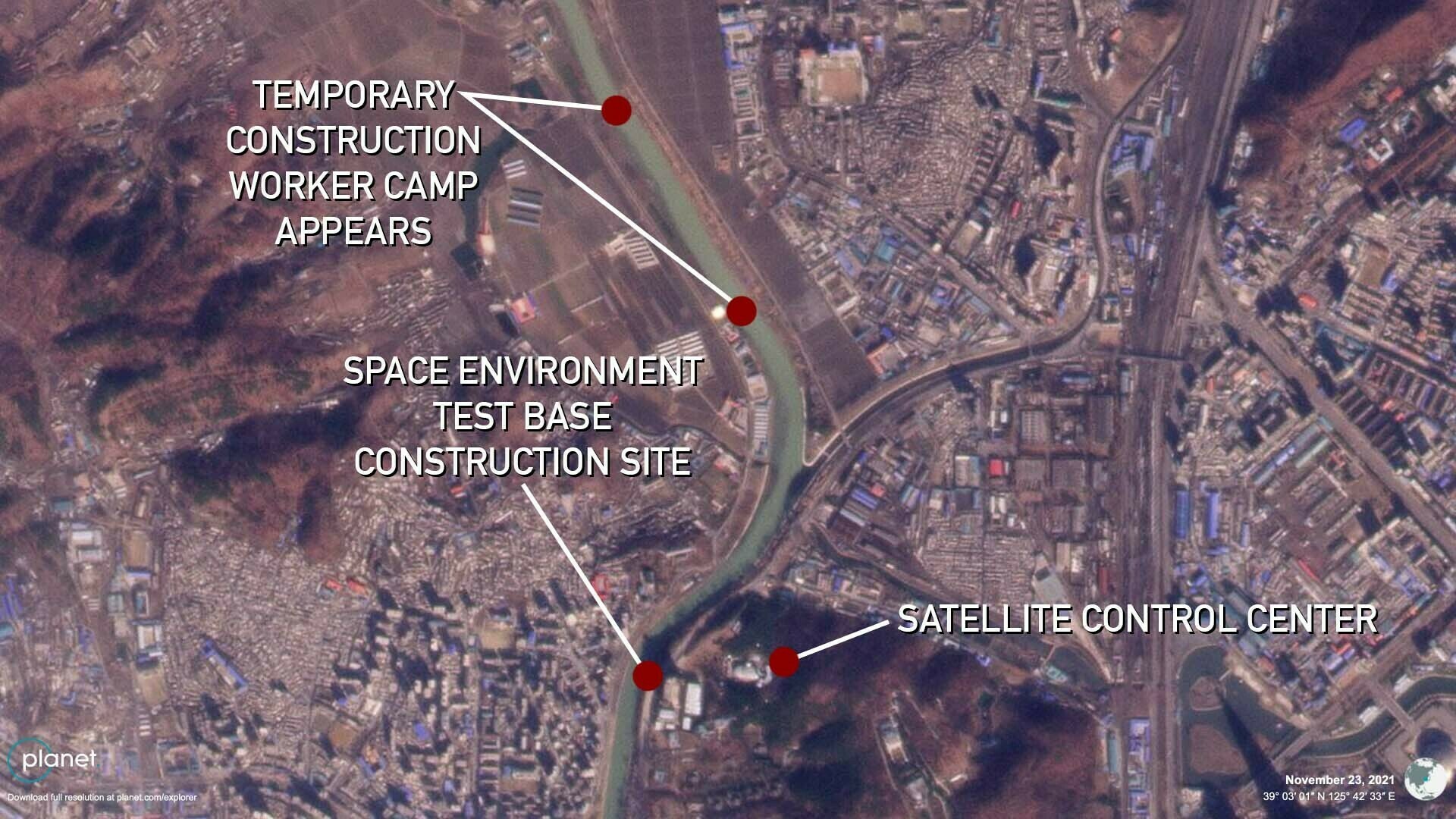 Satellite imagery shows the temporary worker camp was built starting between Nov. 17 and 19 and was fully established by Nov. 23 last year | Images: Planet Labs PBH, edited by NK Pro   High-resolution imagery taken on May 2 and 9 this year shows workers appearing to stack a pile of long, thin materials in a figure eight in the courtyard. Three large construction trucks, another vehicle and other materials newly appeared on site during that week as well. Meanwhile, satellite imagery contradicts a report from South Korea’s Yonhap News Agency that a building related to the site caught fire in early 2021. The building located next to the SCC construction site — but separated by multiple walls and with a different entrance — actually burned down between April 16 and 17 this year. While the report said it is “likely” an “important” building related to the SCC, this appears unlikely as historical Google Earth satellite imagery shows it was built before the year 2000. The SCC opened in 2015. Three other surrounding buildings were also demolished between March 27 and 30, according to Planet Labs imagery. These were also built prior to 2010, and there is no evidence they are related to the SCC, though their demolition could preface additional construction on the SCC complex. DUAL-PURPOSE TECH North Korean state media has been largely silent on the country’s aerospace development plans since Kim Jong Un publicly visited the SCC and the Sohae Satellite Launching Ground in March, which came on the heels of two “reconnaissance satellite” development tests on Feb. 27 and March 5. The U.S. determined these were actually intercontinental ballistic missile (ICBM) tests that may have provided data on components useful for deploying satellites and multiple nuclear warheads. North Korea reportedly tested another ICBM on a similarly lofted trajectory on May 25, possibly as part of more satellite-related component testing, but state media never made a statement on its purpose. An official with the DPRK’s National Aerospace Development Administration (NADA) announced detailed plans for the space environmental test base in 2016, saying it will include a vibration test room, acoustics laboratory, acceleration laboratory, electromagnetic compatibility laboratory, thermal vacuum test room, space materials laboratory, magnetic field laboratory and additional space flight and optical instrument test equipment. Schmerler of the James Martin Center wrote for NK Pro at the time that these facilities could help North Korea “develop more survivable nuclear-warheads for its missile systems” in addition to honing its satellite technology. Edited by Bryan Betts © Korea Risk Group. All rights reserved.

|

September 16, 2026Sep 16, 2026

The ultimate resources for professionals working on North Korea
 SHARE
SHARE COPY LINK
 X
X MASTODON