  Analysis Ri Son Gwon’s demotion teases major leadership changes at Party CongressIt’s becoming increasingly clear that major leadership changes will be finalized at the Jan. 2020 Eighth Party Congress 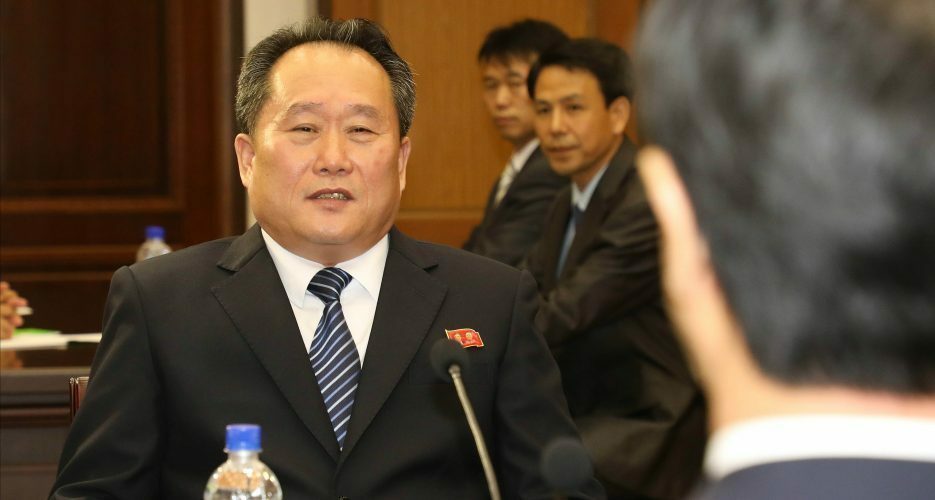 Less than six months after North Korea appointed its foreign minister to the highly-coveted Politburo, state media suggested that he had been demoted under mysterious circumstances. Foreign minister Ri Son Gwon earned the title of alternate member of the Politburo in April, but was ultimately taken off that role during the 18th Politburo meeting on Sept. 29. However, this reality only became clear about a month later, when state media excluded him from the group of Politburo officials on Oct. 22. North Korean state media is notoriously secretive about leadership developments, with demotions in particular largely going unannounced. This was also the case for Ri Son Gwon: state media’s report on the Sept. 29 politburo only said the meeting dealt with “organizational matters.” FOUR INDICATORS OF DEMOTION Thanks to strict protocols on how North Korea positions and ranks officials, North Korean media continuously supplies the world with information on their titles and membership in the main party institutions. There are exceptions on rare occasions, and sometimes the changes are purely symbolic — but over time, a clear picture always becomes visible. The first hint at Ri Son Gwon’s lower standing was in a group picture taken at the opening ceremony of a new hall in the Korean Revolutionary Museum on Oct. 3. Although he should have been ranked as first of the attending party members, since he was supposedly the sole Politburo official, Ri stood in between other members of the Central Committee. Among this group of party officials, department directors like Ri Yong Rae were all positioned to the right, suggesting that formal ranking rules were applied and that they were the highest-ranking among those in attendance. While what were presumably museum or educational and propaganda officials were also standing to the right of Ri and military officials, which is not the norm, Ri’s position away from the department directors suggests that he no longer had the same authority as he did when he was a Politburo official. Then, two days later, North Korea released footage of a Politburo meeting and Ri Song Gwon was nowhere to be seen. Absences are rather frequent for alternate Politburo members, though, and one seat at the table remained empty (although a cup, a bottle of Sindok mineral water and a notepad were prepared). It almost seemed as if Ri simply wasn’t able to make it in time due to other obligations such as tasks linked to the upcoming Oct. 10 military parade. Seats at the table with the leader are usually reserved for members of the respective body hosting the meeting, while non-members have to sit on separate chairs positioned at the walls. In retrospect, it’s now clear that the seat was left empty because there was no Politburo official to fill it.  The Oct. 10 military parade itself ended up being another important indicator that Ri was demoted. Ri was not visible in the front line next to other alternate Politburo members. As foreign minister, he would have been ranked as one of the last in this group — plus, his military background would have required him to wear his old uniform, making him easily distinguishable from the other officials in black. Politician Jo Yong Won, for example, attended the parade in a military uniform that revealed his status as a three-star general. The report on the parade did not list Ri either, despite listing other Politburo officials. The last and most explicit indicator was at Kim Jong Un’s visit to the cemetery for Chinese martyrs of the Korean War, which state media reported on Oct. 22. A sentence from the report named all the attending Politburo officials, which included Kim Hyong Jun, who heads the party’s international department but is only an alternate member. Ri Son Gwon was mentioned, but only as foreign minister after the sentence listing Politburo officials — an indirect but explicit sign that he was no longer part of this group.  WHAT IT ALL MEANS Ri Son Gwon’s removal after only serving half a year as an alternate member in the Politburo is surprising. But neither a punitive demotion nor a general decrease in power among foreign policy officials appears to explain this. North Korean media has confirmed that Ri remains North Korea’s foreign minister. Ri has also been a member of the State Affairs Commission (SAC), Kim Jong Un’s state governance body, since April. Any removal from the SAC would only be revealed in a parliamentary session, as the SPA is the only institution that can add and remove SAC members. His actual fate seems similar to Jong Kyong Thaek’s, who was also demoted from the Politburo but while staying in his position as minister — and in what appears to have been a party governance reform. Pak Thae Song – last known to be the speaker of North Korea’s parliament – also left the Politburo without much noise in August, but as a result of the reactivation of the party’s Executive Policy Council. The real reason behind Ri’s demotion might remain unclear for some time, but there is an interesting similar case in China. Chinese foreign minister Wang Yi is also not part of the Communist Party’s Politburo, but instead is a member of the State Council. Meanwhile, the head of the party’s international department Song Tao sits in the Politburo, but not the Central Committee’s secretariat. If North Korea was to implement a similar model — where the foreign minister and the party’s foreign affairs director are not a part of senior party leadership — one should expect Kim Hyong Jun to be removed from the SAC at the next parliamentary session expected in April. His seat in the party’s Executive Policy Council, however, should be saved, as it gathers considerably more members than the Chinese party secretariat. Where exactly North Korea’s political system is heading is still unclear, but it is becoming more and more certain that the Party Congress in January will be used to finalize important leadership changes. Edited by Kelly Kasulis and James Fretwell © Korea Risk Group. All rights reserved. |

October 15, 2026Oct 15, 2026

The ultimate resources for professionals working on North Korea
 SHARE
SHARE COPY LINK
 X
X MASTODON