  News North Korea imported more Russian horses amid new work on elite equestrian parks30 horses sent during construction on mansion-complex's new track, harkening back to Kim's 2019 ride up "holy" mountain 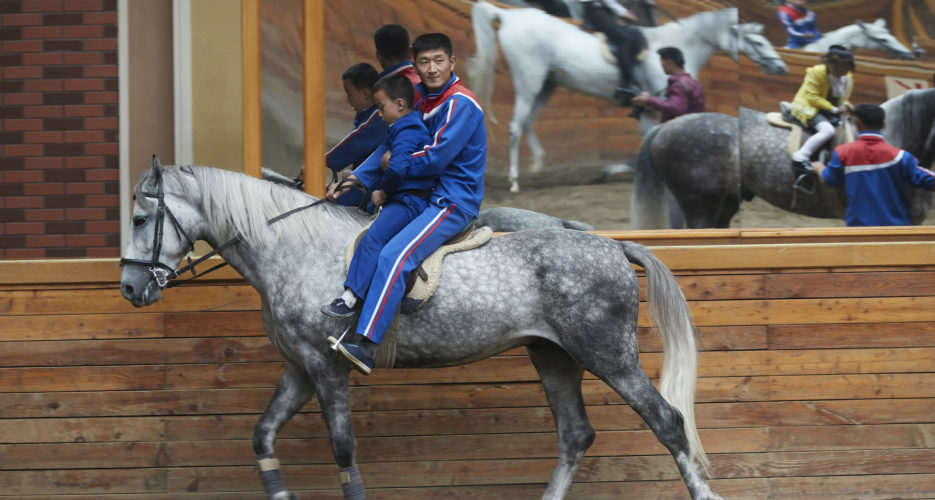 Russia exported 30 non-purebred horses to North Korea in March as Pyongyang ramped up construction at two elite equestrian parks, NK Pro analysis of satellite imagery and trade data from Russia’s Federal Customs Service shows. The construction effort and the $19,600 purchase of horses came during a difficult time for the DPRK, which closed borders over COVID-19 and suffered severe supply shortages due to plummeting trade with China. The horses may be destined for Pyongyang’s main equestrian park, which is currently being outfitted with a new arena. The horses could also end up in a new park built inside a large mansion complex that’s likely reserved for the ruling Kim family or other top personnel. But since the horses purchased were relatively cheap compared to the Russian purebreds North Korea acquired last fall — which made an appearance during Kim Jong Un’s propaganda-heavy ride up “holy” Mt. Paektu — it’s unclear whether they’d be suited for one of these new parks or other official use.  Another batch of the best? March’s trade data confirms the shipment of 30 Russian, non-purebred Orlov Trotters to the DPRK, which was reported by Primorsky Krai’s veterinary customs agency on April 8. The customs agency noted that the horses had undergone quarantine, possibly into early April, before being sent by rail over the Rajin-Khasan border. As previously reported by NK News and the Moscow Times, North Korea imported a dozen purebred equines at the cost of over $75,000 last October, which included at least one purebred Welsh pony and two Orlov Trotters bought directly from Russian stud farms. UN sanctions have restricted exports on a handful of explicitly-named “luxury goods” to North Korea — and while the idea of adding horses to the list was at one point “floated,” according to a UN source, the issue was never officially discussed. The trade of horses remains legal. The Kim family has coveted Russian-bred Orlov Trotters for generations, and has horse-sourcing logistics networks inside Russia going back at least 30 years. White horses hold great significance in North Korea as symbols within the Kim family mythos and Korean mythology, invoking the winged Chollima horse used in some East Asian folklore. White horses also harken back to founder Kim Il Sung’s warhorse, which he praised as worthy of “higher commendation than the most loyal of men.” A pure white Orlov Trotter, then, was the appropriate grandfather-channeling steed that leader Kim Jong Un selected for his ride up Mt. Paektu last October for a much-covered photo and film shoot.  While the regime was willing to pay $75,000 for just a dozen purebreds in 2019, March’s 30 non-purebred Orlov Trotters were worth only $19,600 in total. At an average of $650 a head, their cost may indicate that the horses are destined for a humbler life than the Kim family stables. The animals were exported under HS Code 010129, which specifies “Horses, Live, Other Than Purebred Breeding,” while Primorsky Krai stated the 30 horses included “14 stallions, 1 gelding, and 14 mares.” New elite equestrian facilities The destination of the 30 horses was not noted in public documents, nor disclosed by any known source farms in Russia. However, potential destinations include North Korea’s largest public equestrian park or even what NK Pro has identified as another exclusive equestrian park sprouting next to an elite mansion complex. The latter option would even reflect a similar process seen last fall, when North Korea acquired expensive Russian horses and built new horse tracks at Kim Jong Un’s mansions directly before his December Mt. Paektu trip. Located in the Ryongsong district of Pyongyang along the border with Phyongsong city to the north, the new elite track is similar to others commonly seen inside Kim family compounds across the country.  But perhaps more significantly, it also closely resembles tracks built in Wonsan and Sinchon late last year, likely in connection with that December visit. It’s unclear if Kim Jong Un has used the mansions at the site, which is not to be confused with the larger and more well-known Kim compound elsewhere in Ryongsong. But the mansions and an area of smaller villas on the other side of the water — likely reserved for use by top officials or even other political elites — have appeared active in satellite imagery in recent years. NK Pro analysis of Planet Labs medium-resolution satellite imagery shows construction began with the clearing of land between December 20-24, 2019, and then continued in snowy conditions through early January. The track’s shape began to emerge by late March and appeared mostly finished in April, as shown by high-resolution Google Earth imagery. A small building was built immediately in front of the track in April as preparations were underway on at least three other large buildings in the area. A group of small structures built in the area in 2009 and 2010 (far left of the image below) were then demolished in early June. By early July, progress had been made on the larger of the new buildings. But overall, the project still appears to be unfinished.  The latest and maybe most revealing development on the project, however, has been the carving of over 6 kilometers of trails into the adjacent mountain from early April through mid-May 2020. Kim and over a dozen other top officials were filmed riding along trails at the mythical mountain during what has been officially listed as a three-day trip starting November 30 last year. But construction of practice trails was not observed, despite the addition of new round tracks on Kim’s mansion compounds. Meanwhile, Planet imagery shows that only small upgrades were made at a track in Kim’s Kangdong mansion complex in early September ahead of the North Korean leader’s early October trip. However, the two large, brand-new tracks in Wonsan and Sinchon — built after demolishing Kim Jong Un’s private airstrips — were then finished just before a late-November Paektu trip that saw more participants and a larger overall production. The new elite track construction could thus signal plans for yet another trip for the DPRK leader and/or other officials to Mt. Paektu. It also comes as state media began promoting summertime expeditions up the mountain in June, following unprecedentedly-heavy coverage of such trips over the last winter. Timelapse of the construction on the new equestrian facilities since last November | Images: Planet Labs But another equestrian park — which is officially open to the public and mostly used by Pyongyang’s upperclass residents — provides another potential home for the newly-imported animals. Planet imagery shows that construction on new facilities at the Mirim Riding Club accelerated in mid-April after starting and stalling late last year. On April 10 of this year, North Korean state media reported that parts of the complex — one of Kim Jong Un’s first major vanity projects “for the people,” completed in 2013 — were being refurbished and that work on a new arena was also underway.  Timelapse of construction at the Mirim park since January, with major developments also visible at the military parade practice grounds to the north | Images: Planet Labs Work did not appear complete as of early July, according to Planet imagery, despite progress made in prior months on both the new arena (located in the track’s infield) and another new building outside the track. The Mirim Riding Club would be a natural fit for the new horses: It’s the largest such facility in the country, and it’s already home to dozens of other horses designated for public use (though state media announced in April that the facility closed under COVID-19 prevention measures). Whether intended for use at the new private track near the elite mansion complex, the Mirim club, or other somewhere else, North Korea’s 30 new high-priced horses are a reminder of the DPRK leadership’s long-time fascination with the famed Orlov Trotters. That fascination remains strong, even amid sanctions woes and a pandemic — and it’s perhaps a sign of more equine-themed propaganda to come. Edited by Kelly Kasulis © Korea Risk Group. All rights reserved. |

October 02, 2026Oct 02, 2026

The ultimate resources for professionals working on North Korea
 SHARE
SHARE COPY LINK
 X
X MASTODON