  News Upgrades, activity ongoing at North Korea’s satellite control center: imageryFacilities in Pyongyang under construction since mid-2017 may be planned “space environment testing base” 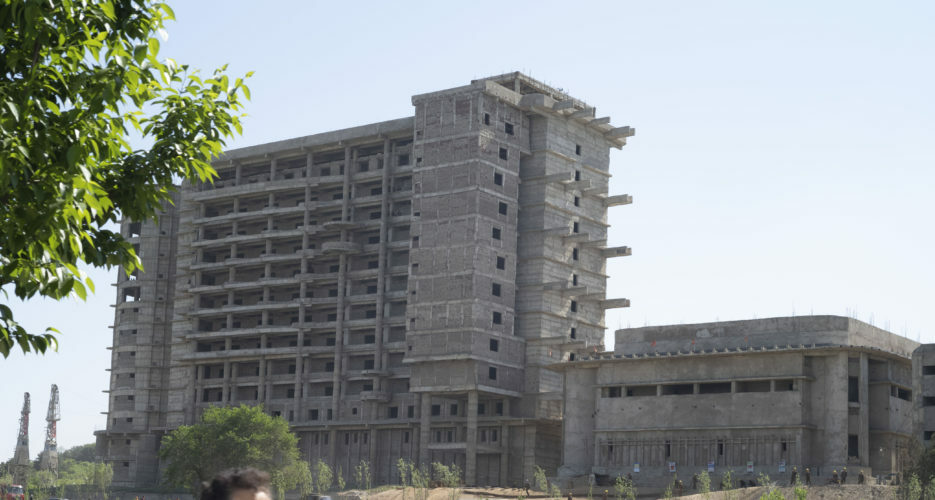 Construction of new facilities connected to Pyongyang’s General Satellite Control Center (GSCC) of the National Aerospace Development Administration (NADA) has made slight progress in recent months but does not appear ready to open, recent satellite imagery suggests. Imagery obtained by NK Pro also shows that the existing GSCC facilities which opened in 2015 continued to see regular traffic in February, despite the country’s strict coronavirus prevention measures. The ongoing construction on the new buildings — which may be a planned “space environment testing base” — as well as activity at the control center next door also comes amid renewed state media signals of interest in the national space program after going quiet since early 2018.  Lengthy build Almost three years after construction began, the basic structures of three large buildings and smaller support buildings grouped along the same entrance road as the GSCC appear to have been mostly built out as of last year, but little progress may have been made since. Comparing high-resolution satellite images taken last November and this February, it appears new roofing was installed on the large auditorium-style building, following similar roofing installed on another large building next door prior to April. Such roofing or other exterior work does not yet appear to have been completed on the 12-story L-shaped administrative or apartment building on the corner, however.  It is unclear if the finished design of this building is intended to appear with an exposed grid-like frame that remains visible in satellite imagery, though ground-level images obtained by NK Pro last summer suggest this may be the case. This makes it difficult to determine how much progress has been made since last summer in satellite images alone, though compared to the image below, it appears at least the rounded tower at the corner of the L-shaped building was completed by November.   DPRK leader Kim Jong Un, according to state media, said upon visiting the newly-opened GSCC in May 2015 that “a symbolic structure should be appropriately erected to visually make known it is the satellite control center” — possibly reflected in the skeletal frame design reminiscent of a satellite launch stand. In the images above, outer walls of rooms appear recessed behind balconies and the large vertical columns, which may explain their prominent appearance in the February 20 and 27-dated satellite imagery below.
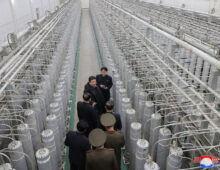
 Kim in the 2015 visit also reportedly said that “ultra-cutting-edge facilities should be further supplemented” for the GSCC and “a space environment testing base should be built so that satellite test can be conducted in the exact same environment as in outer space.” These were further described in state media in 2016 by a NADA official as including at least eight high-tech laboratories and testing rooms for a variety of materials used in the making of satellites.  While it is not possible to determine if these facilities have been equipped with the necessary machinery — much of which would likely need to be imported from abroad in violation of UN sanctions — the construction site as a whole, with unpaved and unlandscaped grounds, appeared unfinished as of late February. Temporary structures along the nearby Pothong river bank which appeared before construction began in spring 2017 are also yet to disappear, as was the case just before the opening of the GSCC in 2015, satellite imagery shows. 
 GSCC activity Extensive imagery shown on state TV for Kim’s visit to the GSCC on May 2, 2015 depicted lecture rooms, computer study rooms, and meeting rooms in addition to the large central launch control room, and the state media readout quoted Kim as saying the facilities provided “scientists and technicians with enough conditions for their research and living.” Ten satellite images of the GSCC published to Google Earth since late 2015 show cars and buses moving in and out of the parking lot and near-constant activity, which does not appear to have abated since the country instituted strict coronavirus prevention measures in late January.  Changes in bus and car presence in the parking lot across the single November 2019 and three February 2020 images (with the February 1 image only partially capturing the GSCC) in the comparative animation at the top of the article suggest that the center as of late is still active. This comes as state media last month reported that the Korea Space Association (KSA) — officially a non-government organization but believed to be closely related to NADA — was still “producing space sci-tech achievements … in the sector of manufacturing and testing satellites and applying satellite data.”
State media largely avoided promotion of NADA and national space science goals since early 2018 when North Korea was seeking to negotiate better relations with the U.S. and South Korea, but has returned to more openly suggesting continued work in the sector since last fall. Two tests believed to be those of rocket engines at the Sohae Satellite Launching Ground were also conducted and promoted in state media last December, albeit officially in connection with “defense science” goals and the country’s “reliable strategic nuclear deterrent.” North Korea last launched a satellite in early 2016, and officially presented plans in late 2017 for two more satellite types which have yet to resurface. Edited by Oliver Hotham © Korea Risk Group. All rights reserved. |

October 04, 2026Oct 04, 2026

The ultimate resources for professionals working on North Korea
 SHARE
SHARE COPY LINK
 X
X MASTODON