
  Analysis The coronavirus slowdown at North Korean ports, as seen from aboveSatellite imagery reveals relatively empty scenes at Nampho and Sinuiju ports in conjunction with quarantine measures 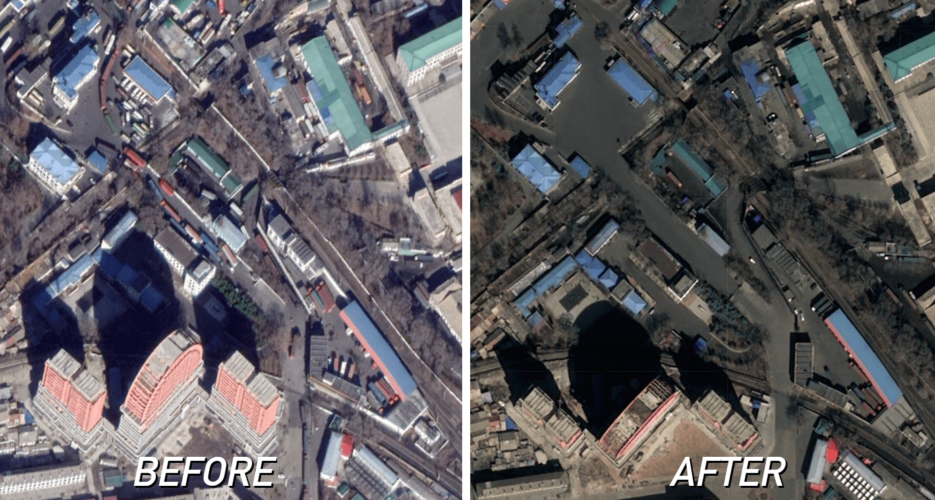 Starting in early February, North Korean state media reported on extreme measures being undertaken in order to block the spread of the novel coronavirus (COVID-19) at the country’s ports. Some of the state-led measures have included disinfecting incoming ships and vehicles and distributing extensive guides for quarantining imports from abroad, resulting ultimately in what appears to be a major slowdown in traffic to the country’s two busiest ports. This is according to NK Pro analysis of satellite imagery of Nampho port on the southwest coast and the Sinuiju land port at the northwest point bordering China, where the scene appeared almost at a standstill compared to the same time last year. Below is a look at these two ports from the beginning of January, before any coronavirus measures were taken, through February as the slowdown began, and into this week in mid-March. Dandong-Sinuiju The busiest road and rail connection between North Korea and China still crosses a single narrow bridge between Dandong (China) and Sinuiju (DPRK), as a new large bridge, built but not connected for six years, has still yet to open. But recent satellite imagery appears to show that this crossing has nearly completely closed to shipping traffic — not a declared measure by the state — in addition to incoming tourists and foreigners of any kind. Below are images of the Dandong and Sinuiju vehicle customs areas appearing with no vehicle traffic and otherwise changing very little from early February, when the strictest measures were put in place, to this Wednesday, March 11. 
These can be compared to three other days from last October and November where there was heavy freight traffic lined up on both sides of the border, and other visual changes in buses and vehicles parked in each area.   While the situation is more difficult to assess from medium-resolution satellite imagery from Planet Labs, their near-daily availability provides another useful view of the situation. In the below timelapse starting from early January, both customs areas show little to no traffic each day throughout February until March 11, where we would expect to see shifting shapes and colors each day in the open areas representing trucks and cargo.
Compared to a timelapse of the same period in 2019 below, where visible changes are continuous in both areas, it becomes apparent that this is not a seasonal change but rather it is likely due to COVID-19 prevention measures.
Nampho North Korea’s largest sea port is the west-coast city of Nampho, which boasts a container port, coal terminals, and recently-upgraded oil terminals. The container port provided the clearest signs of a significant slowdown amid the coronavirus measures, with the large open dock area seeing almost no day-to-day changes or obvious new arrivals of large shipments in satellite imagery. This is as the ruling party daily Rodong Sinmun on March 9 continued to report that Nampho customs officials were thoroughly disinfecting incoming ships, quarantining imports “for 10 days isolated from one another in their natural state,” and coming up with new ways to “disinfect people and items coming off of ships.” Referencing the NK Pro Ship Tracker tool, Martin Weiser, a researcher focusing on North Korean open-source data, said that quarantine measures have even since late January been reflected in tracking data showing that some ships have avoided returning to DPRK ports.
 The Sinwon is an example of a cargo ship that appeared to avoid North Korea in February, having headed out from the Nampho area to Dalian, China on February 10 and only broadcasting data again on March 11 showing a return towards Nampho, according to the Ship Tracker. For ships that appeared to be in Nampho during the quarantine, Weiser said some appeared to have since been released, such as the Hwa Song cargo ship which headed out towards Dalian on March 5 and was seen heading towards Nampho once again on March 11. He also said the data appears to show that ships which have no contacts with foreigners and only travel between North Korean ports, on the other hand, do not seem to be quarantined, which could account for some of the activity seen below. Below is a look at the container port dock in Planet Labs imagery from January through early March this year, showing daily changes indicative of receiving new shipments and reorganizing container storage in January (note that rain and snow create large water-stained areas that are not cargo). These can be compared to a high-resolution satellite image of the container port taken last November, where dozens of containers are stored on the dock, to be processed and moved within days. 
According to the medium-resolution imagery timelapse, it appears the container yard became mostly empty between January 29 and February 3 and stayed roughly static through the end of the month. There was some visible activity, however, as an unidentified line appears across the yard in the image from February 27 and stays through March 8, with some part of it disappearing by March 11. A ship is also seen arriving at the port between February 10-11, and another is seen parked at the dock on March 11, though these movements represent much slower traffic than seen even throughout the January imagery. NK Pro previously reported that such inactivity at the Nampho container port is rare even for a single day, let alone for weeks at a time. Compared to the same time period in 2019 as well, shown below, it is clear that state coronavirus prevention measures have resulted in significantly fewer incoming shipments.
Just to the west at the coal terminals, such a slowdown throughout February and early March was less obvious. The image below provides a high-quality look at both the rail-linked shipment terminals and the coal terminals in February 2019.  In the below timelapse of the port from January through March 2020, there were frequent changes in the ships parked in each terminal throughout January. While the frequency may have slowed in February at some terminals, activity still continued during the quarantine period.
At the rail-linked terminal in the center of the image, two-to-three new ships appear to be arriving and departing in February and early March. Large vessels also appear to come and go at the coal terminal towards the right of the image in February and early March. Below is a look at the same period in 2019 for comparison, where there appeared to be slightly more turnover at the coal and other terminals.
Meanwhile at the Nampho oil terminal further to the west, there also appeared to be some stalled movement throughout February likely related to coronavirus quarantine measures. This terminal saw capacity upgrades through the middle of last year, and is said to be a hotspot for ships returning from conducting UN-sanctioned ship-to-ship transfers.
At the end of the docks jutting out in the center of the image, it appeared that the same ships remained in place from February 8-23 before some departed between then and the 27th. All docks have remained vacant throughout the imagery since March 2. And while this may have been due to the ships being quarantined, it is also not abnormal for ships to stay at the port for long periods of time, as seen in the January imagery and across the same period in 2019 shown below.
Conclusions The above imagery provides a clear view of what appears to be a slowdown at some of North Korea’s primary terminals in Sinuiju and Nampho under state-led COVID-19 prevention measures. North Korean state media has, after all, not been shy about promoting extreme measures to block the coronavirus, maintaining that no cases have been detected in the country but that nonetheless it is willing to risk “huge economic loss” in cutting off travel and slowing the imports process with quarantines. But in revealing the relative infrequency of shipments at these points of entry over the last five to six weeks, it appears that such stringent measures have also scared away or otherwise prevented a large chunk of imports that would otherwise be visible in the form of heavier traffic seen in the same period last year. If North Korea is truly preparing to lift more strict measures, as state media signaled on Friday that the country is gaining confidence the situation is under control, a corresponding return to busier ports should also become apparent in satellite imagery. Edited by James Fretwell © Korea Risk Group. All rights reserved. |

October 24, 2026Oct 24, 2026

The ultimate resources for professionals working on North Korea
 SHARE
SHARE COPY LINK
 X
X MASTODON