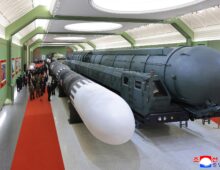
  Analysis Ready for liftoff? Satellite imagery shows progress of DPRK’s space programNK Pro analysis reveals construction status of key infrastructure, as North Korea telegraphs future satellite launch 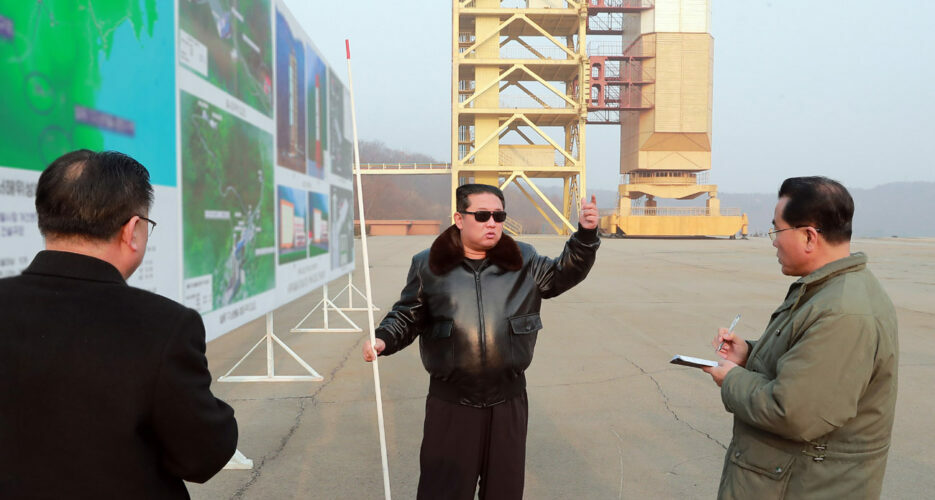 North Korea has made strides in building infrastructure for its budding space program but some key sites remain unfinished, according to NK Pro analysis of satellite imagery, after a string of recent developments that have focused attention on the country’s efforts to launch reconnaissance satellites. Pyongyang reportedly tested components of its largest intercontinental ballistic missile (ICBM) twice in recent weeks as part of a military spy satellites project, and Kim Jong Un visited two of the country’s main satellite launch facilities to announce plans to expand activities. The following analysis delves into recent activities at facilities connected to Pyongyang’s space program and its recent missile launches, as it appears work has yet to begin on new construction plans. SOHAE — THE LAUNCH PAD North Korea demonstrated that it didn’t need a dedicated launch pad to kick off its latest satellite development tests, after the U.S. suggested that the DPRK recently launched the first stage of the Hwasong-17 ICBM first revealed at a military parade in late 2020 to test satellite cameras or maneuver control systems in low earth orbit. But any attempt to put a satellite in orbit will likely require the use of the Sohae Satellite Launching Ground. State media reported on Kim Jong Un’s plans for “expanding and modernizing” the Sohae facilities on Friday in order to launch a spy satellite and “other multi-purpose satellites by diverse carrier rockets,” detailing the following upgrades:
  State media partially blurred blueprints and 3D renders of construction plans behind Kim in shots of his visit, but the images reveal a mix of minor facelifts to existing structures and plans to build new structures. North Korea could still use the existing facilities to launch something in the near future, especially as anticipation mounts for a military parade and other big events around the April 15 holiday celebrating the 110th birthday of founding leader Kim Il Sung. However, Kim appeared to suggest the extensive changes outlined above will need to be made before launching a rocket capable of deploying multiple satellites at once — a technology experts say could also be used to deploy multiple nuclear warheads from an ICBM. Sohae last saw significant construction in early 2019.  RECENT TEST LAUNCH SITE AND MISSILE BASE The South Korean military pinpointed the location of North Korea’s Feb. 27 and March 5 military reconnaissance satellite tests (as part of apparent ICBM platform tests) to the Sunan area of Pyongyang, likely referring to the international airport that has long served as a favorite spot for missile tests. Satellite imagery also supports this, with what are likely two separate burn marks close to each other on the airport runway on the morning of the respective tests.  There is also what experts have identified as a large missile program-related facility in the Sil-li area just south of the airport built since 2017. Satellite imagery shows this facility has been active in recent months and may have been involved in the recent test launches conducted nearby. Planet Labs imagery shows activity in an empty lot between the site’s underground facilities and main buildings throughout the month of October — coinciding with an exhibition in Pyongyang of the country’s largest weapons — but there are few signs of major activity in the past few weeks. A housing complex attached to the site has also remained unfinished for years, and a rail line leading into the main facilities still appeared unfinished as of March 10, but missiles or related equipment could still be transported to and from the facility by road. PYONGYANG — THE TESTING LAB During his visit to the Pyongyang Satellite Control Center (SCC) of the National Aerospace Development Administration (NADA) earlier this week, Kim Jong Un reportedly talked to officials on site about ongoing “issues” with building a “space environmental test base (우주환경시험기지)” next door. This is because those facilities, which North Korea started to build five years ago in 2017, still appear unfinished, according to Planet Labs imagery. Pyongyang originally planned to include the following elements at the test base:
Analyst Dave Schmerler wrote for NK Pro at the time that these facilities could help North Korea “develop more survivable nuclear-warheads for its missile systems” in addition to honing its satellite technology. According to the latest imagery, workers appeared to move items around the construction site in recent months, but a multi-story administrative building with ornate aerospace-themed design elements looked unfinished as of early March.  MYSTERY RESEARCH INSTITUTE IN CENTRAL PYONGYANG? North Korea has apparently made strides in recent years developing its ICBM and satellite technologies, and that may be due in part to workers of a “space science institute (우주과학연구원),” which the state media report on Kim’s visit to the SCC mentioned for the first time. The institute’s location is unknown, but one possible match is a large campus built next to Pyongyang’s prestigious Kim Il Sung University starting in 2017. While state media has never acknowledged the site and actively seeks to hide it, the campus has appeared active with buses frequently in its parking lots. The campus contains 20 multi-story buildings likely housing hundreds of classrooms for thousands of students. The buildings are arranged in the shape of a ringed planet — one clue of its potential connection to the aerospace industry. There are also around a dozen other buildings, a large gym, football field, auditorium and what may be a library.  Kim Jong Un has a penchant for thematically designed mega projects, so it would make sense for the campus to at least be focused on scientific research of some kind. This potential library building is the largest on campus, and features what appears to be a golden logo of a planet with orbital rings around it on the building’s side. This is similar to the NADA logo — the second clue that the campus could be the space science institute in question. The campus also features a large platform for Kim Il Sung and/or Kim Jong Il statues, and covered walkways between most buildings, something seen at other schools related to national security such as the Kim Jong Il Military Postgraduate Institute across town. However, some newer construction on the campus starting in 2020 remains unfinished, and no statues have been installed, indicating authorities are not yet ready to announce its existence to the public.  That may be due to sensitivities about angering the U.S., which believes North Korea’s space program is intimately tied to its ICBM program. Such concerns previously led state media to hide a national aerospace symposium held in 2018. Such sensitivity has surely been dropped with Kim’s latest promotional tour of space program sites and state media reports on recent satellite technology tests, but North Korea still appears timid about publicizing its latest ICBM developments as state media apparently omitted that aspect from its recent coverage. MYSTERY RESEARCH INSTITUTE IN MISSILE DISTRICT? There’s another mysterious new campus north of Pyongyang that may be related to aerospace or missile development projects. This site, never before revealed, is located inside a secured district that houses the Sanum-dong missile/rocket fabrication center, nearby Kim Jong Un National Defense University.  Planet Labs imagery shows that authorities originally assigned high priority to the project given quick progress from April to May 2020 that included the demolition of old structures and construction of a large structure with a high bay ceiling, often associated with the missile-related facilities. This came amid construction stoppages elsewhere as the country entered its COVID-19 pandemic lockdown. However, construction stalled from summer 2020 until Nov. 2021, when workers finally installed a roof on the main building and built another new building closer to the main road, before appearing to complete a soccer field in the center of the grounds earlier this month. Its location near other missile-related facilities is enough to suggest it is at least related to the country’s rocket research or development, but its precise purpose is not yet known. It is much smaller than the campus in central Pyongyang, containing only three large buildings and the soccer field. Updated with additional imagery of Sohae on March 11 at 11:18 p.m. KST Edited by Bryan Betts © Korea Risk Group. All rights reserved. |

October 17, 2026Oct 17, 2026

The ultimate resources for professionals working on North Korea
 SHARE
SHARE COPY LINK
 X
X MASTODON