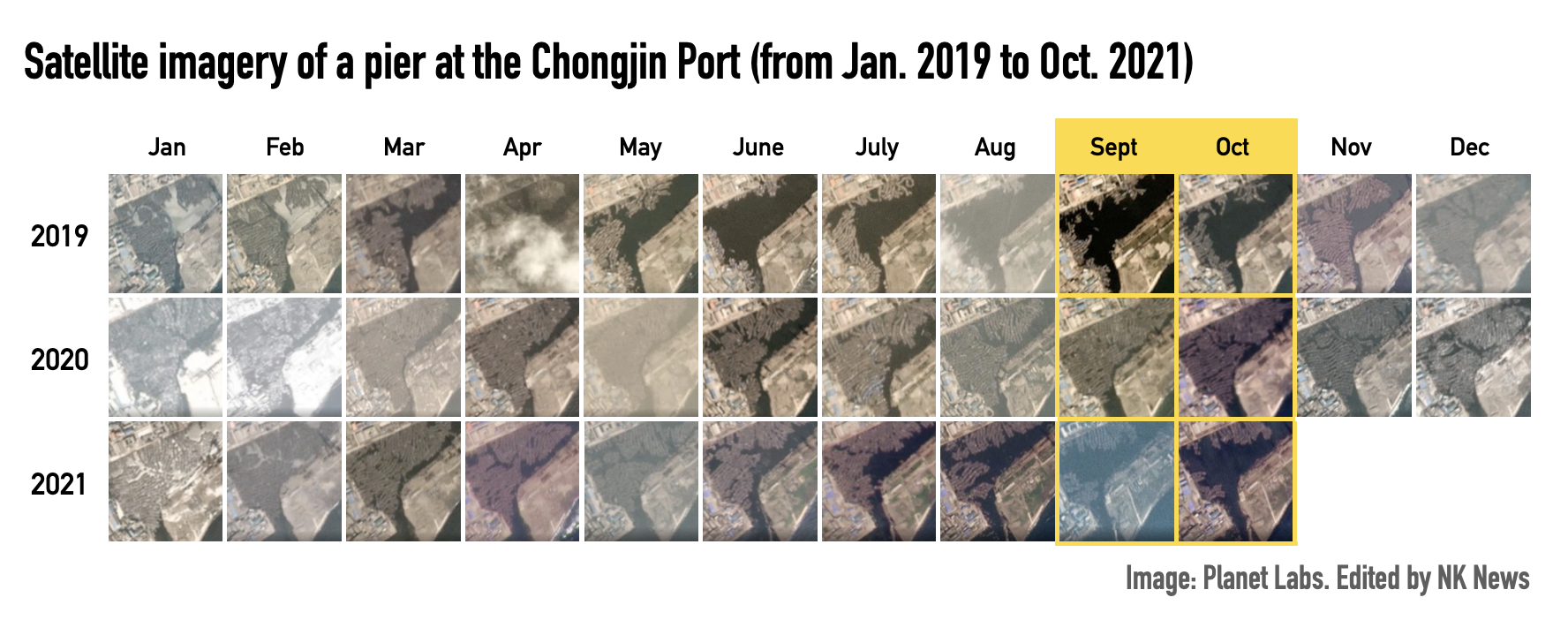
  News North Korean fishing boats may be resuming greater activity in East Sea: ImageryAppearance of fewer vessels at key port suggests fishing is resuming after COVID-19 restrictions 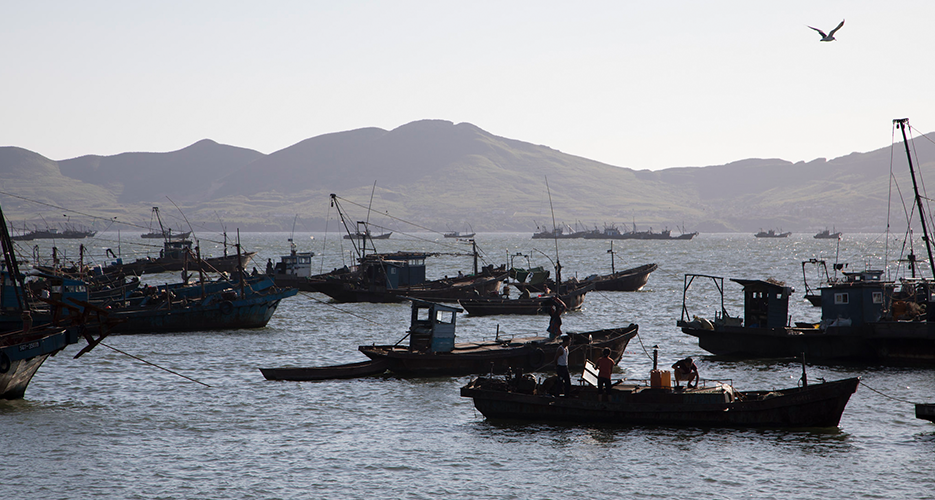 North Korean fishing activities in the East Sea may be returning to some form of normalcy, as satellite imagery suggests more vessels are leaving a major port on the East Coast to head out to sea. The development comes after a port at Chongjin appeared tightly packed with fleets of small-sized fishing vessels until early this year, amid reports that the country’s stringent COVID-19 quarantine rules were limiting commercial fishing. A three-year comparison of satellite imagery of a port in Chongjin — one of North Korea’s major fishing centers — suggests that the number of vessels docked at the port’s piers in September and October this year has declined closer to pre-pandemic levels as ships appear to return to sea.
Satellite images of the Chongjin shipyard from Jan. to Dec. 2019 show fluctuations in the number of fishing vessels docked there throughout the year. During North Korea’s squid harvesting season — roughly between June and October — the pier used to be relatively empty. The other pier at the port also showed a similar seasonal pattern, with fewer fishing vessels docked between summer and fall. But in 2020, satellite images showed the two piers at the Chongjin port packed with small-sized boats almost over the entire length of the year. Last November, North Korea’s state-run Korean Central News Agency reported that authorities are establishing a “more strict sea entry order in the coastal areas.” South Korea’s National Intelligence Service (NIS) also told lawmakers late last year in a closed-door briefing that Pyongyang banned fishing and salt production due to concerns that seawater may be contaminated with COVID-19. 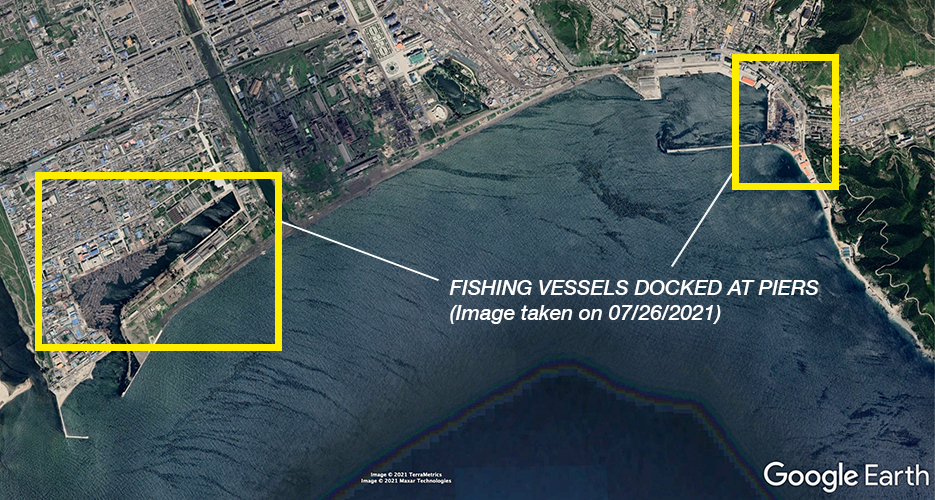 Earlier this year, Voice of America reported on the impact of pandemic measures on the fishing industry at Chongjin, citing a lack of fuel and quarantine measures as possible explanations behind the apparent inactivity of fishing vessels there. The images taken in September and October this year suggest a return to more normal fishing activities. Imagery from Aug. to Oct. 2021 more closely resembles imagery captured in 2019 — before the pandemic — than in 2020, with far fewer vessels docked at the piers in Chongjin. The boat activity also aligns with recent state media reports. On Thursday, North Korea’s party-run Rodong Sinmun reported that “fishing industry units” in the East Sea area “all together entered into fishing.” The article states that the decision was made in accordance with a policy guideline to catch more fish through “intensive fishing combat.” This likely refers to the North Korean leader Kim Jong Un’s policy speech in late September, when he reportedly urged the country to invest in its fishing industry to catch more fish and produce fish products to “enrich people’s diets.” SEAFOOD FOR THE PEOPLE? The development of infrastructure, such as refrigeration facilities, has made seafood available across the country at similar prices, according to Joung Eunlee, a research fellow at the Korea Institute for National Unification (KINU). “One of the biggest characteristics of the Kim Jong Un era is that North Korea has a nationwide distribution network that can get goods delivered, so you can see various seafood at marketplaces regardless of the region,” Joung told NK News. “In other words, as long as you can afford it, the [infrastructure] exists to buy and eat seafood in North Korea.” Joung said demand from neighboring countries like China historically drove North Korea’s fishing industry. Snow crab, for example, used to be a primary seafood export from North Korea to Japan, said Jin Huikwon, a senior researcher at the Korea Maritime Institute (KMI). But following nuclear and ballistic missile tests in 2006, Tokyo slapped economic sanctions on Pyongyang, including a total trade ban on goods from North Korea. South Korea also used to be a destination for North Korean seafood exports, Jin noted. But Seoul’s May 24 measures imposed after North Korea’s attack on the ROKS Cheonan in 2010 put a blanket ban on inter-Korean trade. North Korea again saw its trade channels shrink after it tested intercontinental ballistic missiles in 2017. The U.N. Security Council responded to the test with Resolution 2371, banning the DPRK from selling or transferring seafood — among many other goods — to other countries.  Peter Ward, a researcher on the DPRK economy and a contributing analyst to NK Pro, says that while the fishing industry’s standing has waned, unofficial seafood trade still plays a significant role in the DPRK’s economy. The fishing industry “used to be pretty important in the country’s export earnings. Nowadays, less so because obviously mining has become more important,” he said. “But it’s still very important.” Meanwhile, the United Nations’ panel of experts report shows that North Korea has sold fishing rights to third-country entities. Obtaining these rights for up to five months at a time reportedly costs anywhere from about $30,000 to $46,000. Last year, Pyongyang’s COVID-19 measures reportedly extended to Chinese fishing boats operating in North Korean waters, requiring vessels and their crew members to go through “some form of COVID-19 disinfection measures” and operate under “the strict surveillance of the DPRK authorities” at designated areas. Joung of KINU said it’s likely that domestic consumption of seafood may, to some degree, cushion the impact of the pandemic and sanctions on the industry. “[But] they will pose constraints on new investment,” she said. “It will hit the cities like Chongjin with fishing industries and the people who rely on it … but anyways the industry will maintain its current status quo.” Edited by Arius Derr © Korea Risk Group. All rights reserved. |

October 23, 2026Oct 23, 2026

The ultimate resources for professionals working on North Korea
 SHARE
SHARE COPY LINK
 X
X MASTODON