  Analysis North Korean disinfection zone still not operating despite activity: imageryReports previously suggested the zone would open in August to help kick-start trade with China 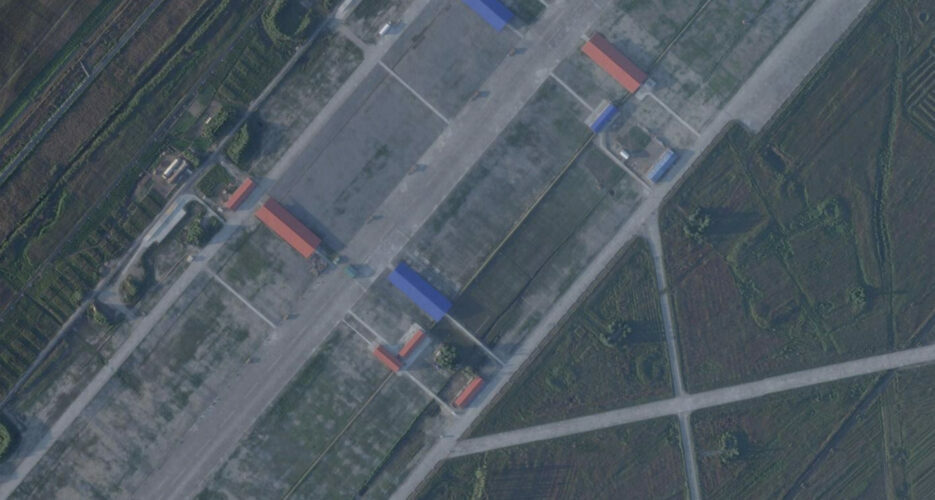 This article is based on a presentation for the NK Pro briefing “Why satellite imagery plays a critical role in DPRK research.” North Korea’s new large-scale import disinfection zone built earlier this year near the border with China still appears to be non-operational despite activity at the site, NK Pro analysis of recent satellite imagery reveals, after earlier reports of a potential opening and trade revival in August. The apparent delay comes amid self-imposed trade restrictions in place since Jan. 2020 to keep out COVID-19. State media has in recent months asked the population to work harder to overcome unprecedented economic “trials and difficulties.” While still appearing closed, consistent activity at the new import disinfection zone in recent months suggests preparations for opening are still underway. The complex was built rapidly between Feb. and April 2021 at the Uiju military-civilian airport across from China’s Dandong. Its initial failure to open in spring was related to a problem with the military’s construction or management of the zone, according to South Korea’s National Intelligence Service, which reportedly tied the problem to what Kim Jong Un publicly described as a ”grave” COVID-19 incident in June. In July, NK Pro reported on new construction activity, and a “South Korean government source” told Reuters that North Korea appeared to be “aiming to restart trade with China in August.”  IMPORT ZONE ACTIVITY Near-daily Planet Labs satellite images of the Uiju disinfection center taken in recent months have not yet revealed signs that indicate the center is operational, such as train traffic inside the zone or vehicle activity around apparent storage warehouses. Cranes or other equipment likely needed to unload high volumes of goods from train cars have also yet to be installed at any of the five new train platforms that run along the new railway built parallel to the airport runway. But workers still appear to be active inside the zone. A high-resolution image taken on Sept. 17 shows dozens of large items along the edge of the main runway, but this activity appears related to either harvesting crops or clearing land. Prior to the airport’s conversion this year, the military appeared to use almost all land in between roads and runways for agriculture. At least eight new small structures have also been built since June, including what appears to be a roadside checkpoint at the south end of the outer security perimeter and buildings at both north and south ends of the runway. Some of these buildings surround the inner containment zone where ten football field-length warehouses likely to house and disinfect goods are located, and may be related to managing how items are taken out. Disinfected items could either be moved back to the west side to be loaded onto trains again — the most practical method for transporting items to Pyongyang and the rest of the country — or to the east side to be loaded on trucks for transport by road. The full text of North Korea’s official disinfection process, codified in the “Law on Disinfection of Imports” passed in March, is not yet publicly available.  INCREASING TRADE? Even if the new Uiju disinfection center opens, North Korea’s international trade is unlikely to rebound right away to pre-pandemic levels due to a bottleneck from quarantine and disinfection processes. In the meantime, trade with China has steadily risen in small amounts over the past few months, according to official Chinese trade data. Much of this is likely coming through increasingly busy seaports at Nampho on North Korea’s southwest coast, which have traditionally seen a higher volume of trade than the Dandong-Sinuiju border crossing. 38 North recently reported an uptick in activity at the Nampho container port next to a new large building that may be part of COVID-19 disinfection procedures. It was built over last winter around the same time as the Uiju disinfection center. Just to the west of the container port in Nampho is another import-export staging area near a seaport and railroad tracks, where activity has ramped up since May. Shipping analyst Leo Byrne has written about North Korea’s recent use of barges to transport potentially sanctioned goods to this port in Nampho and another near Sinuiju. Like at the Nampho container port, items arriving at the nearby staging area have appeared to remain in place for two to three weeks before moving, suggesting authorities are still enforcing quarantine measures. Meanwhile, potential new disinfection facilities built last winter in the northeast of the country at the Chongjin seaport and near the Russia-DPRK border crossing have also yet to show heavy traffic in Planet Labs satellite imagery that would suggest they have started operating. Edited by Arius Derr © Korea Risk Group. All rights reserved. |

October 14, 2026Oct 14, 2026

The ultimate resources for professionals working on North Korea
 SHARE
SHARE COPY LINK
 X
X MASTODON