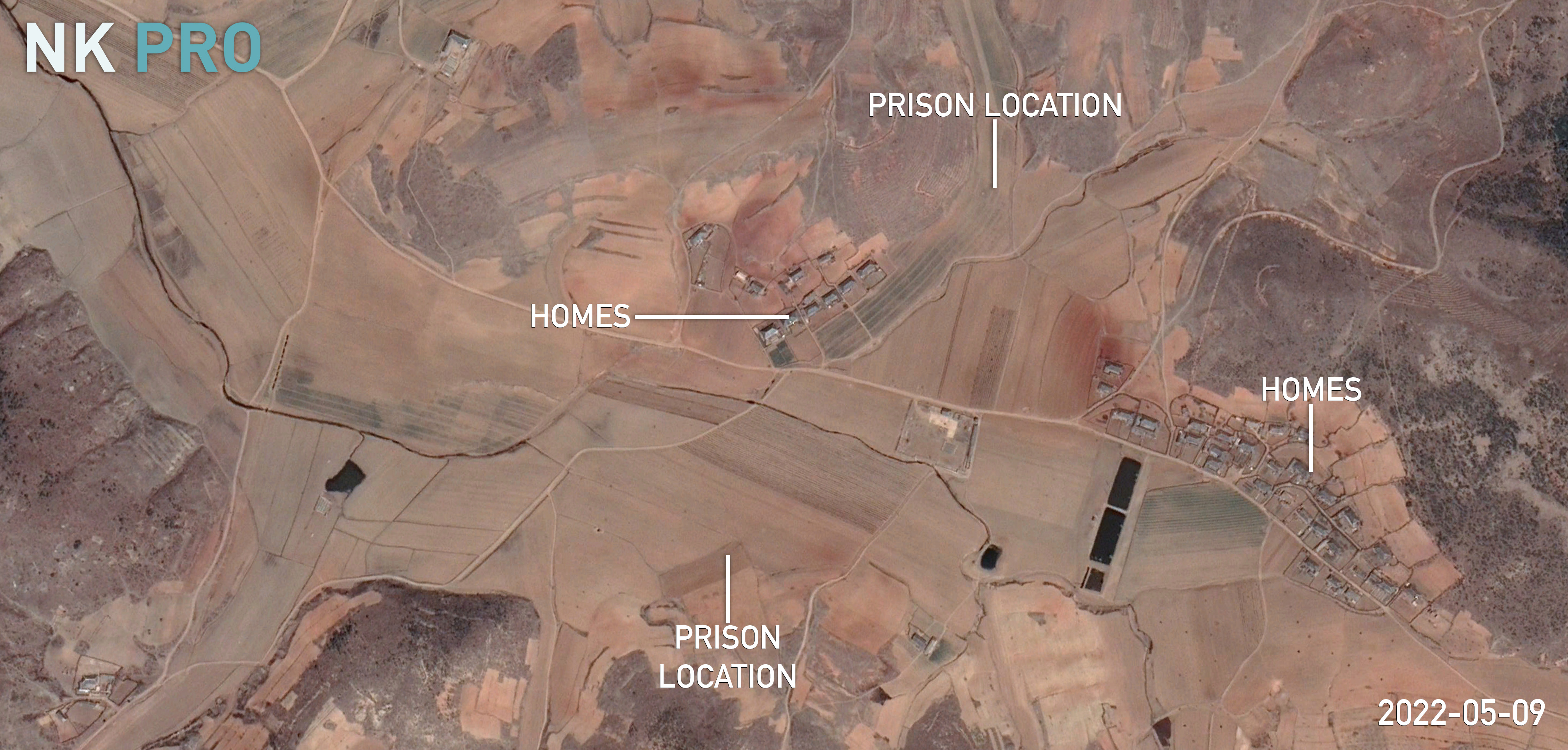
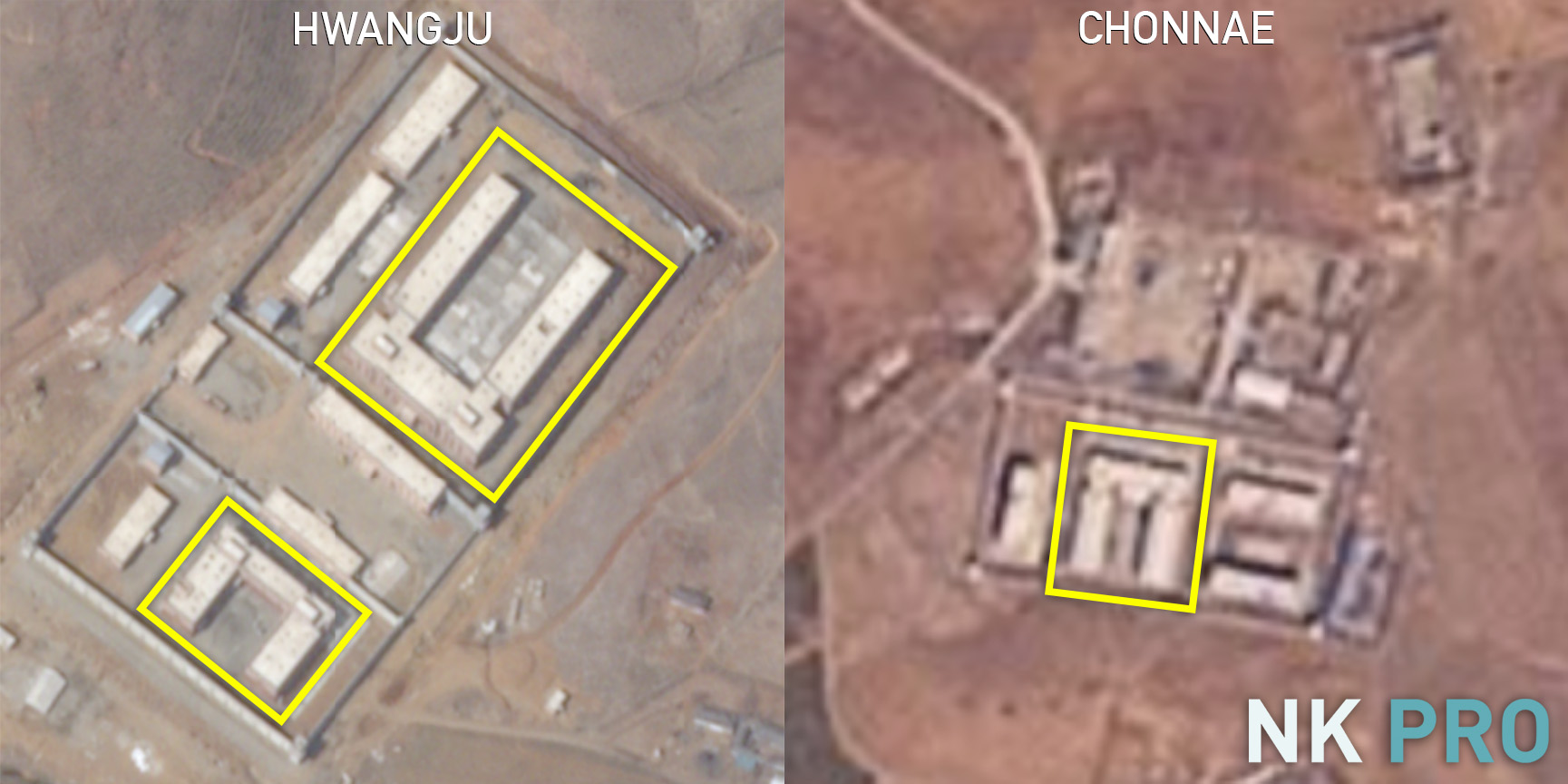
  Investigations North Korea building first new large prison in decades in sign of rising ‘crime’Exclusive NK Pro analysis finds new construction is part of at least five major prison projects ongoing around country 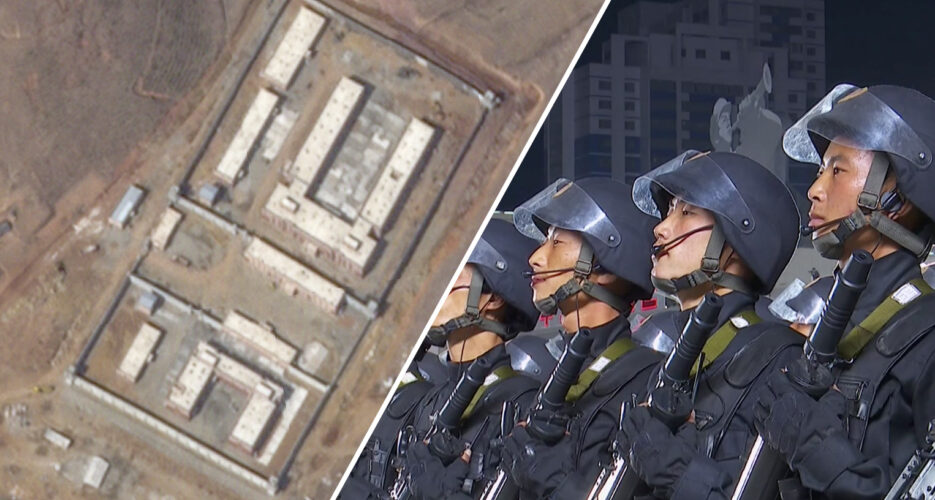 North Korea is building a large new prison in a likely sign of increasing crackdowns by authorities on acts considered crimes in the country, according to exclusive NK Pro analysis of satellite imagery. NK Pro has identified the new walled prison south of the capital in Hwangju — the first such brand new facility to be identified in the country in decades. Planet Labs imagery shows construction started around March 2023 and that it is nearing completion. Efforts to rebuild and expand three other prisons around the country in Sinuiju, Sariwon and Chonnae then began at the end of 2023, NK Pro previously reported, while upgrades started at a fourth prison in Hamhung earlier this year. PURPOSE OF NEW PRISON The newest prison in Hwangju features buildings that appear similar to the recently expanded “kyohwaso” facility in Chonnae on the east coast. This suggests Hwangju will also be a kyohwaso, often referred to as an “ordinary prison camp.” Extensive defector testimony over recent decades indicates that North Korean authorities commonly use kyohwaso prisons to detain people for economic crimes like theft or black market activities, drug use and trafficking, violent crimes and even what may be considered political crimes like attempting to leave the country. 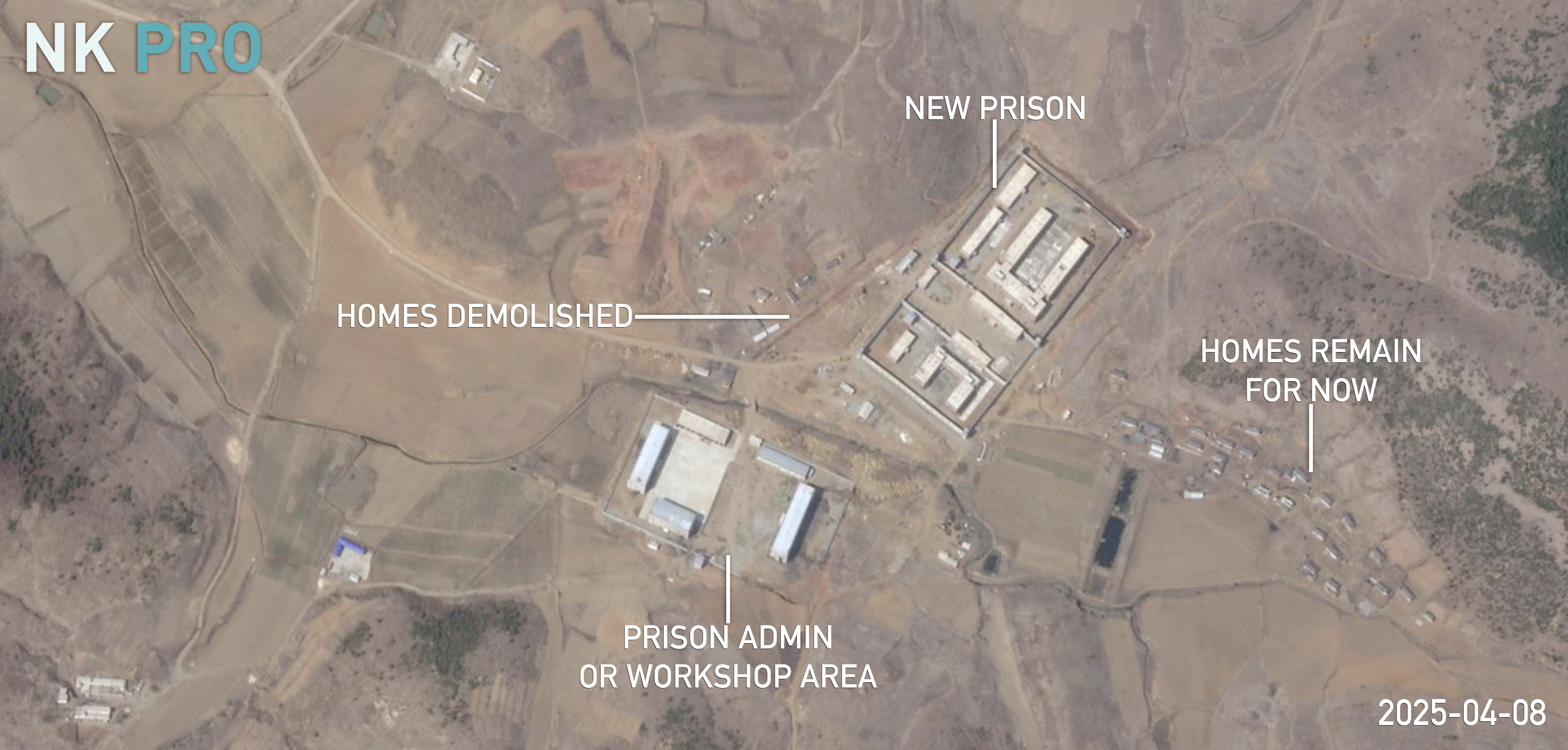
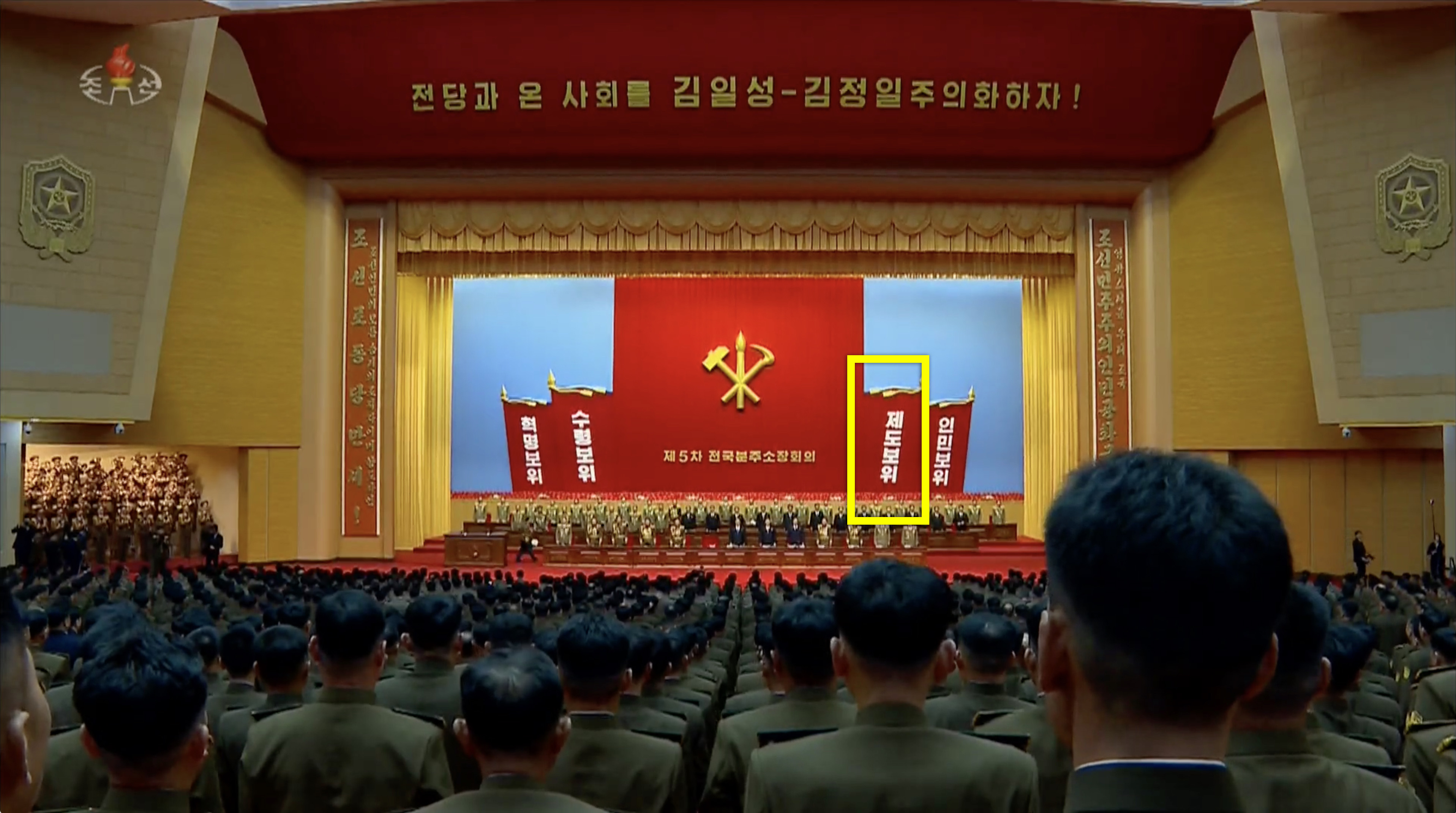
 If the new Hwangju prison is indeed a kyohwaso, this would suggest North Korea is seeing a rise in such crimes, or that authorities are strengthening enforcement efforts. Given Kim Jong Un’s recent crackdowns, it also can’t be ruled out that both the new Hwangju prison and upgraded kyohwaso facilities will operate under different policies from the past and thus house more political prisoners. Authorities have historically used separate political prison camps to put citizens through ideological reeducation or permanently put people away who are deemed a threat to the ruling Kim family dictatorship. An official from the regime made a rare public admission at the U.N. last year about Kim’s efforts and even the use of public executions, saying new laws have been established to “protect national sovereignty and our socialist system from all sorts of maneuvers from the hostile forces including the ideological and cultural poisoning.” Regarding common crimes, North Korea does not publish statistics or related dedicated news stories, but state media has subtly mentioned problems in recent years like “selling state-provided farm supplies on the black market.” Decrees warning of the death penalty for illegal market activity were also posted in public during the COVID-19 pandemic. In addition to increasing inmate capacities, establishing new cell blocks for prisoners at the five known recent prison construction projects will result in relatively better living conditions, after poor conditions were reportedly responsible for rampant inmate deaths in the past. This could simply be part of efforts to make the DPRK prison system operate more efficiently and under more formal systems comparable to a country like China. It could also be part of future plans to push back against international reporting on North Korean prisons by showing off or even inviting foreigners to visit model facilities. One recent piece of evidence suggestive of North Korea opening up about or formalizing its prison system is that the rebuilt facility in Sinuiju near the Chinese border now displays the slogan “Protect the System” (제도보위) in large letters on a lawn outside its walls, intended for reading from the air or via satellite imagery. This is a formal slogan displayed at a police conference in Pyongyang last year that focused on cracking down on “anti-socialist” elements of society. 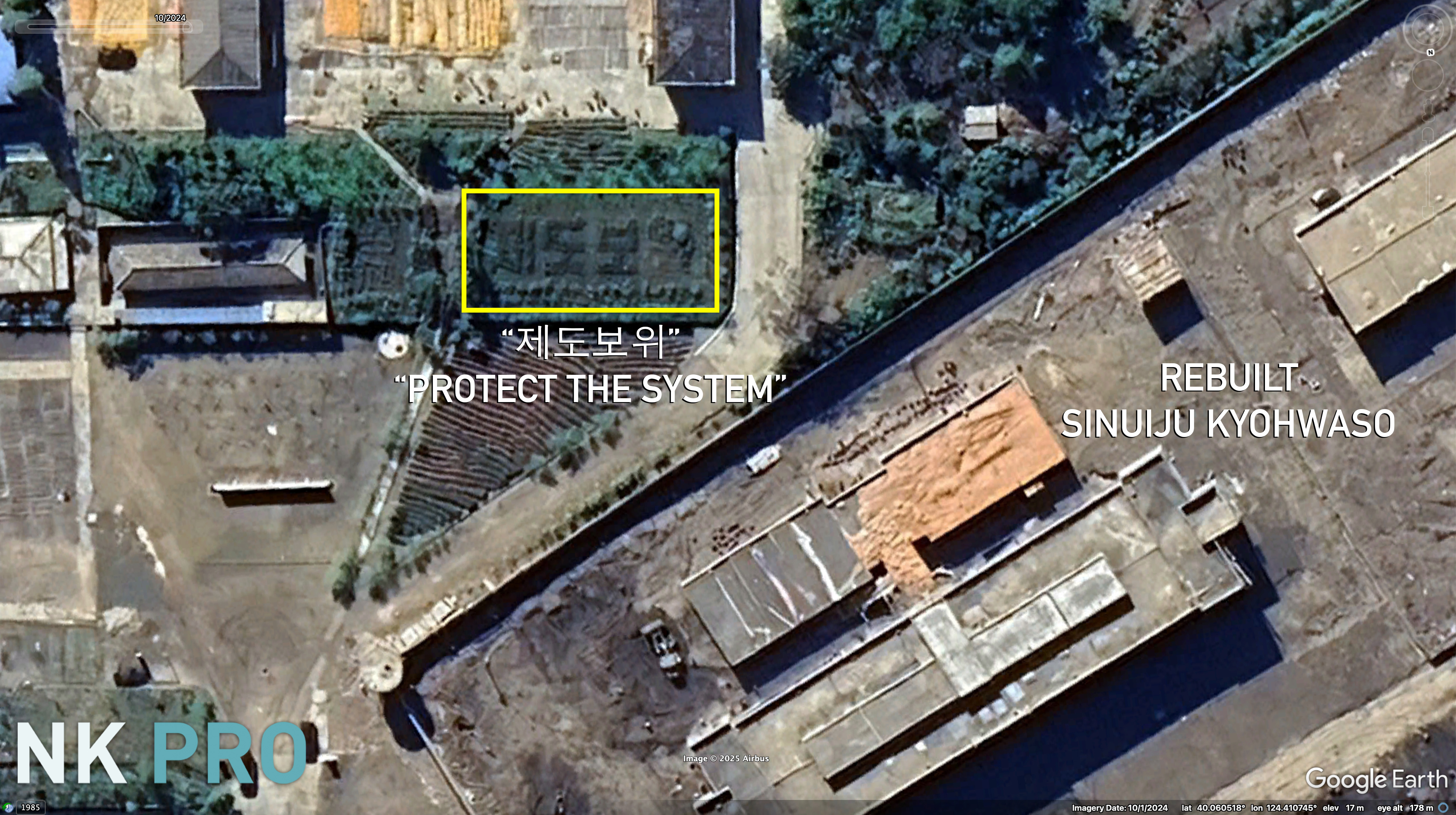
HWANGJU PRISON DETAILS The Hwangju prison features six guard towers along a rectangular perimeter wall, enclosing three separate partitions inside a 2.6-hectare area (6.4 acres). The largest section covers around 1.4 hectares (3.4 acres) and features what appears to be a U-shaped group of three-story cell block buildings, each measuring around 55 by 12 meters (180 by 40 feet). Two other similarly sized buildings are in this section as well, possibly housing a cafeteria or workshops for prisoners. This section features guard towers at all four corners. 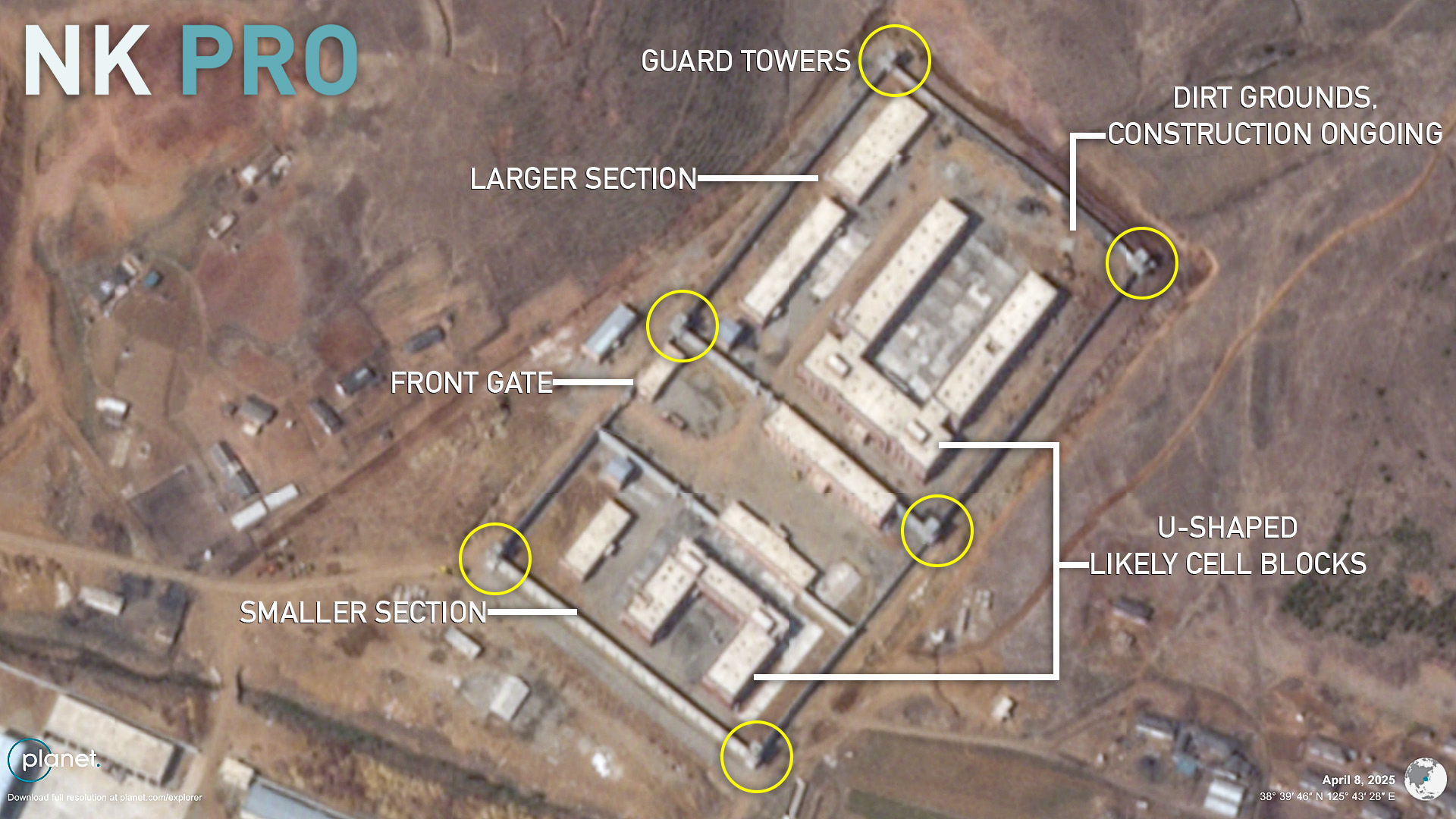 There is then what appears to be an administrative section in the middle of the grounds, where the entrance gate is located, separating the larger section from a smaller one covering 0.65 hectares (1.6 acres) with a smaller U-shaped group of likely cell block buildings. Unlike the larger section, its inner partition wall corners do not feature guard towers. The larger and smaller cell block sections may split prisoners by gender or type of offense. Across the road to the south is a separate group of buildings inside a rectangular perimeter wall, though without guard towers, suggesting it is either another administrative area or prisoner workshop area. The new prison is located 1.5 km (just under a mile) to the east of the Pyongyang-Kaesong highway, near a section of the road used for major missile tests in 2016, and 4.5 km (2.8 miles) to the west of Hwangju Airbase. 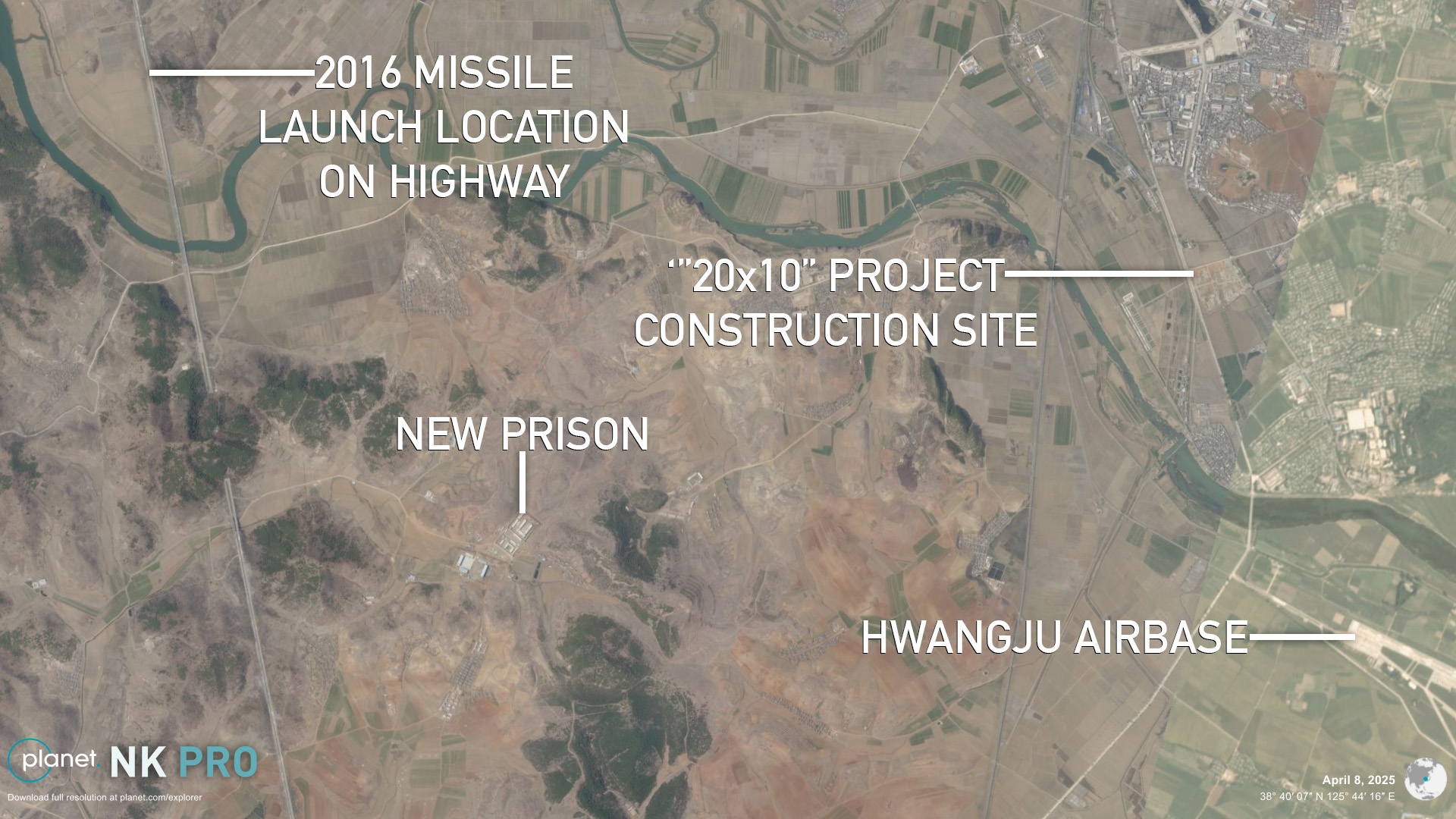 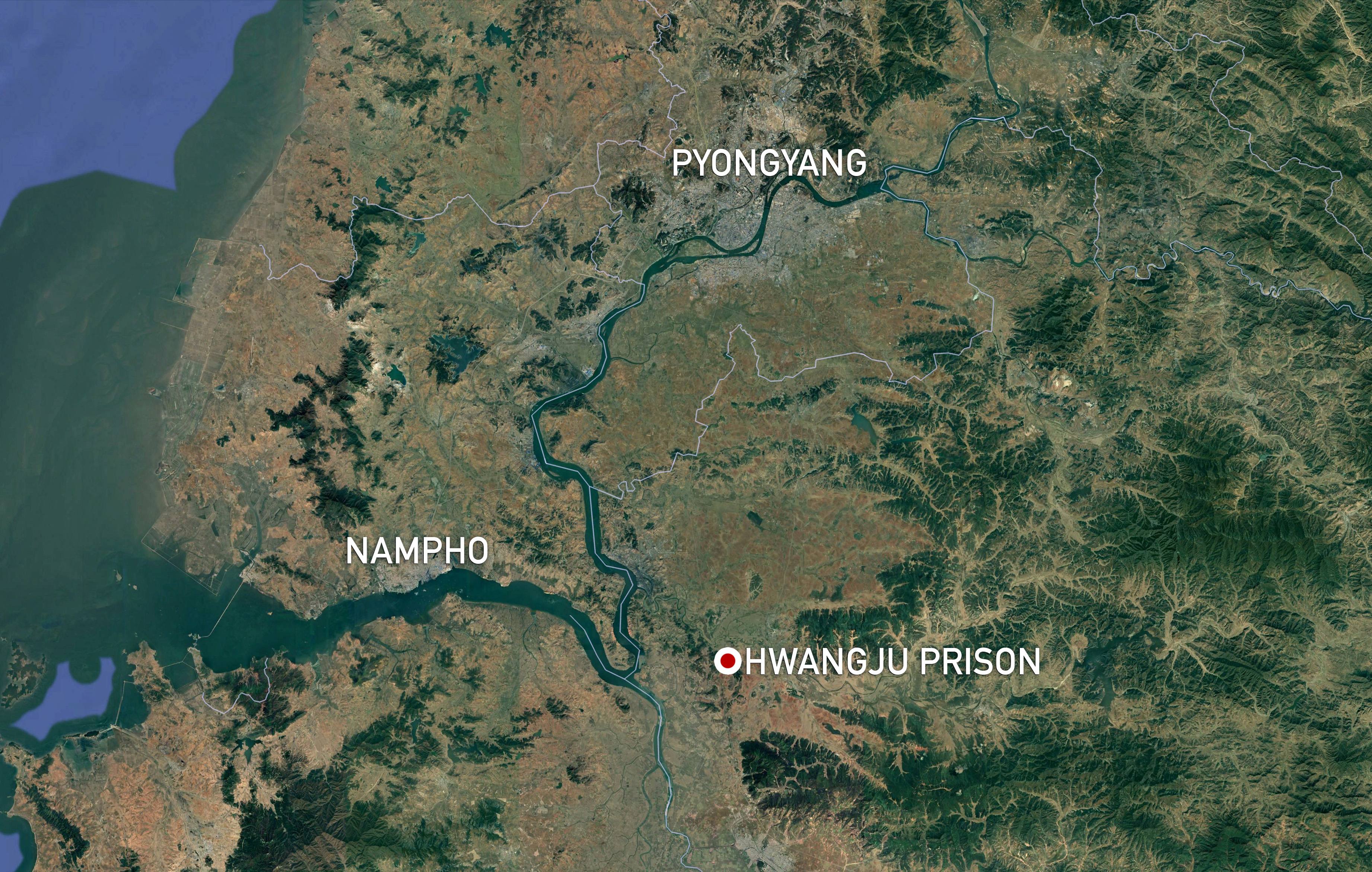 Hwangju of North Hwanghae Province is an important county to the Kim family, hosting a missile test last month, housing multiple military bases including the “undeclared” missile base at Sakkanmol to the east, as well as the new Kwangchon Chicken Farm which Kim Jong Un gave a proportionally high level of attention compared to other economic projects since the pandemic. Construction also started near the airbase this year on new light industry factories under the “20×10” rural development policy. Given that NK Pro has identified active prison construction in five locations across the country in the last two years, it is likely that upgrades are planned at more existing facilities. It’s also possible that there are additional completely new prisons now under construction in locations not yet identified. Edited by Alannah Hill © Korea Risk Group. All rights reserved. |

October 17, 2026Oct 17, 2026

The ultimate resources for professionals working on North Korea
 SHARE
SHARE COPY LINK
 X
X MASTODON