


North Korea and China carry out cross-border construction at oil pipeline
Repairs to the Dandong-Sinuiju pipeline may be underway, or a new pipeline may be taking shape
 SHARE
SHARE COPY LINK
 X
X MASTODON
A key oil pipeline at the North Korea-China border recently appeared to undergo repairs or possibly an expansion, NK Pro has found, as North Korea faces continuing economic difficulties from their prolonged pandemic lockdown and mismanaged natural disasters.
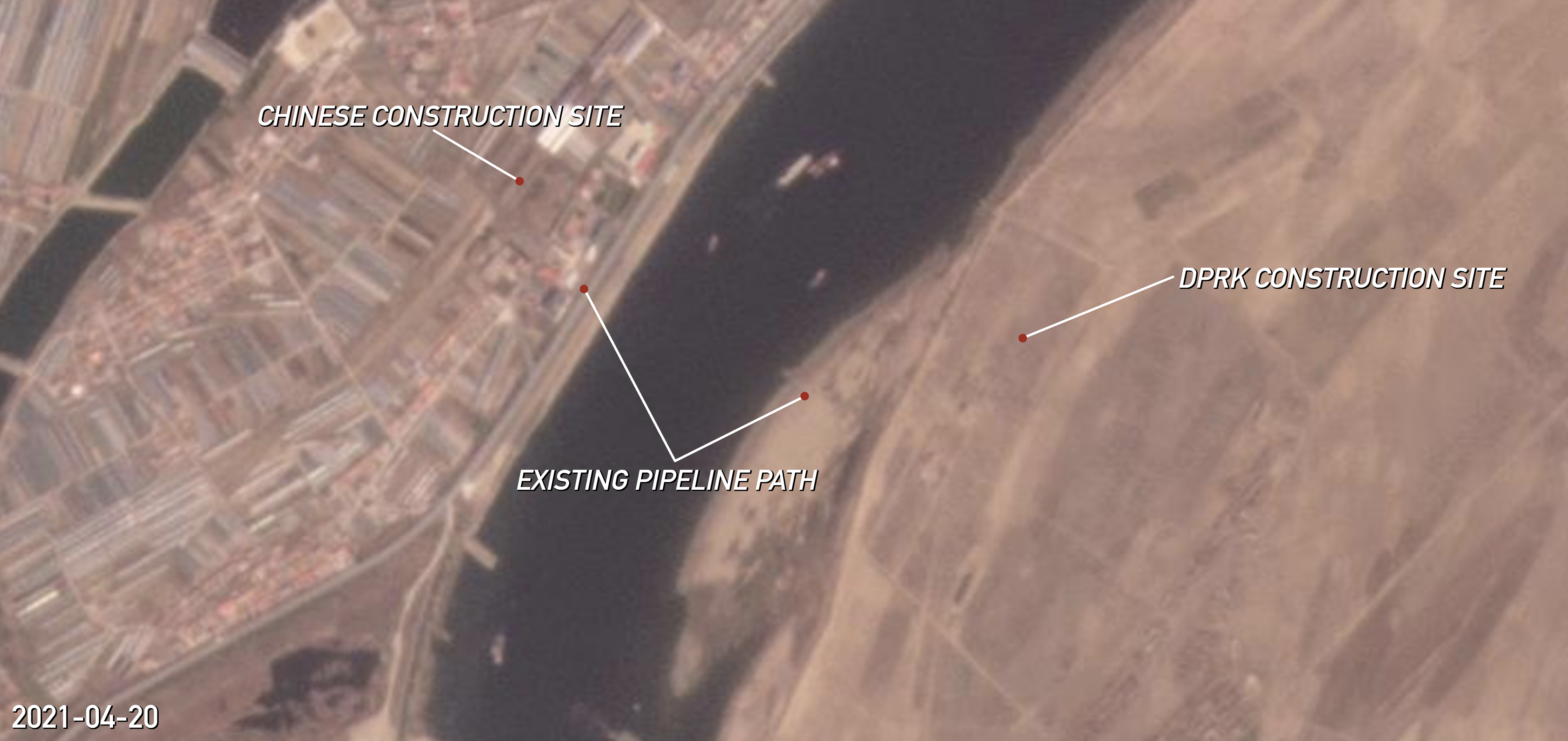
According to NK Pro analysis of recent satellite imagery, construction work began in April both at China Petroleum Pipeline Engineering Co. facilities on the edge of the Yalu River and across the water on North Korean territory.
The coinciding construction and images of boats on the DPRK shore suggest the two sides have been coordinating and perhaps jointly working on a new project surrounding the 47-year-old Dandong-Sinuiju pipeline.
China has taken charge of pipeline maintenance on the North Korean side in the past, but as of early August it’s unclear what the excavation work is meant for on either side of the DPRK-China border.

WHAT’S HAPPENING ON THE GROUND
Medium-resolution Planet Labs satellite images reveal that construction crews began to clear an empty patch of land on China Petroleum Pipeline Engineering Co. (CPP, 中国石油管道公司) property starting around April 18 this year, next to their Dandong Training Base (丹东培训基地) and Yalu River Oil Transport Station (鸭绿江输油站) located on the river across from North Korea.
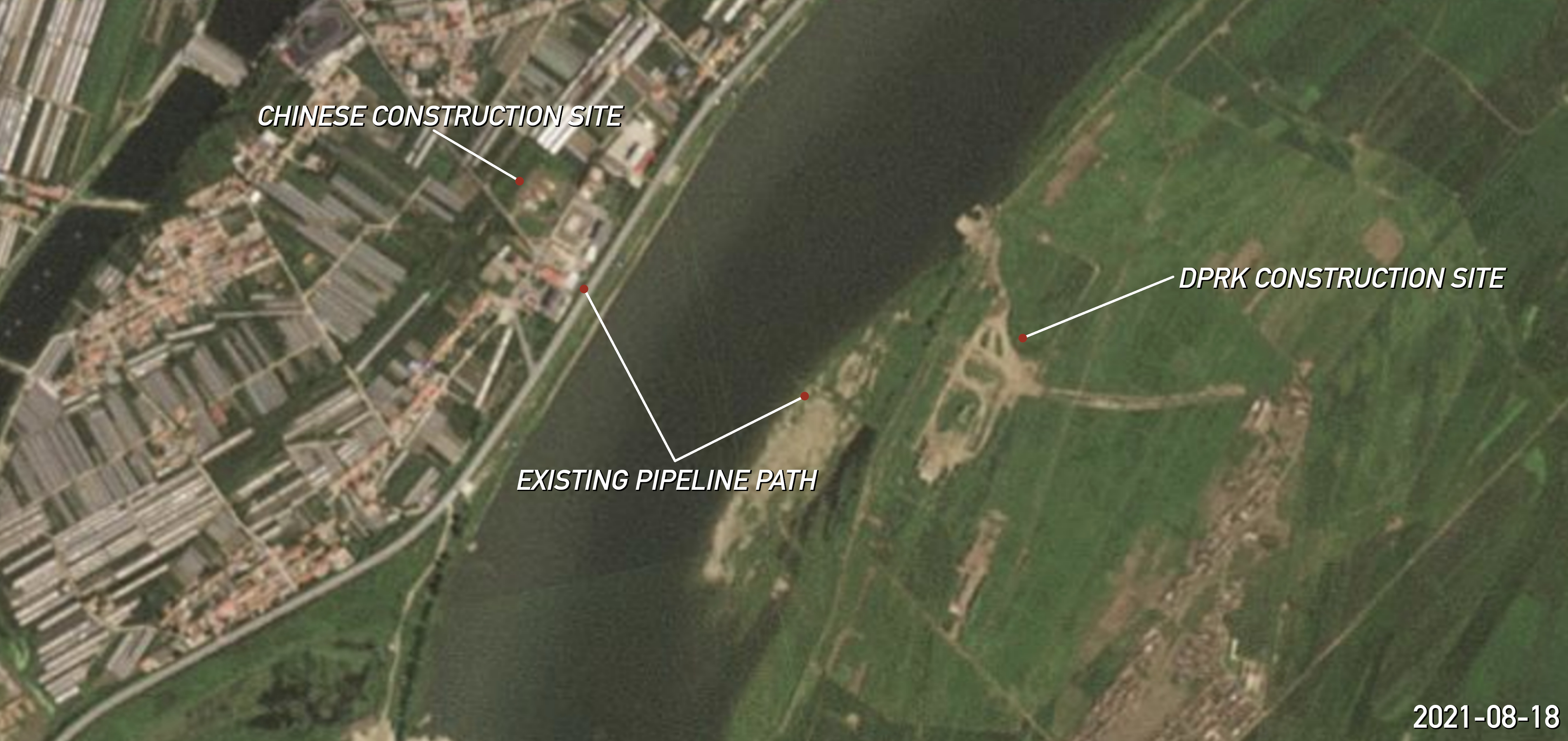
Seoul-based Daily NK reported last week that excavators, vehicles and construction materials were parked inside the new fenced-off area in July but that no new construction had appeared there yet. It is possible this was used as a staging area for the new project.
Simultaneously in mid-April, large dredging ships began to congregate in the middle of the Yalu River where they remained in daily satellite imagery until the middle of July, just upstream from where the existing oil pipeline is believed to cross under the riverbed.

Between April 25 and 29, a temporary dirt landing dock appeared on the North Korean side next to the dredgers and upstream from the pipeline. Small boats, possibly coming from the Chinese side, appeared to dock there throughout May and June.
Perhaps most significantly (and mysteriously), excavation work began on the North Korea side in early May with dirt paths stretching down from the landing dock to the riverside oil pipeline pump station and in a long, curved line stretching 380 meters (1,245 feet) to the northeast — away from the direction of the existing pipeline’s destination at the Ponghwa Chemical Factory (봉화화학공장) oil refinery about 13 kilometers (8 miles) to the southeast.
The wide excavated line on the DPRK side, located about 100 meters (330 feet) north of the existing pipeline, lines up with the construction site on the Chinese side. Satellite images also show discoloration of the water, indicative of kicked-up sediment, stretching precisely across this line — possibly as part of work on a detour pipe to temporarily or permanently replace the existing one, or work on a new kind of pipeline entirely.
But a stream of sediment appeared to be flowing down from the dredgers anchored a bit further upstream in many of the images, suggesting the work may have also been intended to clear debris or protect the existing pipeline.
The CPP wrote on its website that a refined petroleum pipeline was built in 1975 at the same time as and directly next to the crude oil pipeline, but that it was blocked off and discontinued in 1981, and no other information is available on other existing pipelines in the same vicinity.
Further indicating the importance of the recent construction and likely relation to the oil pipeline, new North Korean double-layer security fencing recently being built all along the border appeared to be diverted around the entire area where the pipeline pump station and new construction site are located, according to a high-resolution Planet Labs Skysat image taken on May 17.
The CPP and their parent company, the state-owned China National Petroleum Corporation (CNPC), did not immediately respond to NK Pro requests for comment on the nature of the recent construction.
Obvious changes at the construction sites and boat activity in the river appeared to stop simultaneously in early July, but it is unclear if the project was finished, delayed or is ongoing.
PAST ACTIVITY AT PIPELINE CROSSING
Demonstrating the unique nature of the recent project, no similar large-scale excavation work had appeared on the North Korean side of the oil pipeline area in daily Planet Labs imagery since 2016 or occasional Google Earth imagery since the early 2000s.
This is even as Chinese inspectors have reportedly conducted thorough maintenance on the pipeline on North Korean territory as recently as Aug. 2019.
On the other hand, some aspects of the recent work do have precedent, such as the CPP’s reported maintenance on and replacement of corroded pipeline on the Chinese side. Historical satellite imagery has also revealed the presence of dredgers anchoring upstream from the pipeline for weeks on end — activities reflected in official CPP reports on clearing blockages in other parts of the river in the past.
The Chinese military has additionally conducted drills at the beach near the pipeline crossing point for decades, and the CPP has a security agreement with the local police and People’s Liberation Army (PLA).
Since at least 2002, satellite images and reports have shown PLA training courses going on for months each spring, where they practice building floating pontoon bridges across the Yalu River. Some images, such as one available on Google Earth taken in June 2014, show that the bridges get close to the North Korean shore, but the extent of DPRK military involvement is unclear beyond their giving obvious clearances to cross the midline of the river.
The pontoon bridge sections last appeared along the Chinese beach adjacent to the CPP Yalu River Oil Transport Station between April and July 2020, according to Planet Labs imagery, suggesting the recent construction work prevented the annual training from being conducted this year.

OIL LIFELINE
When the U.N. Security Council passed its toughest sanctions on North Korea in 2017, China apparently argued for a tailored exception to a ban on crude oil exports to the DPRK.
Resolution 2397 allowed delivery of up to 525,000 tons of crude — just over the precise amount the CPP declared in 2015 was the pipeline’s regularly maintained “transport capacity” of 520,000 tons per year.
The CPP also said that the pipeline was originally designed to handle a capacity of 3 million tons per year, meaning a physical expansion might not be necessary to increase the volume of crude exports to North Korea.
The sanctions exemption kept the oil flowing through the Dandong-Sinuiju pipeline, and while China is required under the resolution to report crude oil deliveries every 90 days, the panel in charge of managing the U.N. sanctions has only released Chinese totals once, revealing that China delivered precisely their entire allowance during the first year under the new sanctions.
It is likely that China has continued to send crude oil through the pipeline, however, since the Dandong Public Security Bureau reported as recently as Jan. 2021 that they were still carrying out proactive security inspections with the CPP around the riverside pipeline facility to ensure against any disruption.
Fuel prices have also remained relatively stable despite North Korea’s economic difficulties, suggesting the Ponghwa factory is still refining crude in addition to Pyongyang receiving shipments of refined petroleum products at its seaports.
Further analysis of images of the construction site will be required in the coming months to determine the true nature of the work and possible changes to the Dandong-Sinuiju oil pipeline scheme.
Meanwhile, fresh construction began in late June at the new but unfinished import disinfection center located just south of the oil pipeline crossing point.
Though the site is in the underground pipeline’s likely path inland, there does not appear to be any indication that it is related to the new pipeline area construction. However, both projects appear to be part of Pyongyang’s efforts to maintain and soon increase bilateral trade long stalled by the pandemic.
Edited by Arius Derr