  
Border Controls North Korea turns airport into COVID-19 disinfection center to boost tradeSatellite imagery shows construction at airfield near the Chinese border — possibly to tackle extreme drop in imports 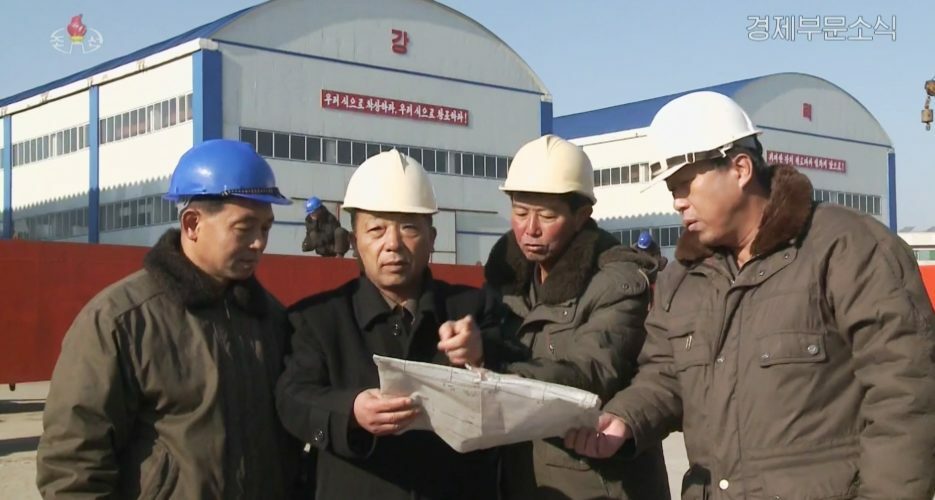 North Korea recently transformed an airport near the Chinese border into an apparent disinfection center for goods — possibly to restart high volumes of trade after a significant dropoff in the COVID-19 era, according to NK Pro analysis of Planet Labs satellite imagery. There’s also evidence of other disinfection facilities undergoing construction at key ports and border crossings in the DPRK. Last month, North Korea passed the Law on Disinfection of Imports, which is meant to create a “system and order of disinfecting imports at border-passing spots” to “reliably protect” citizens’ lives, as state media put it. In general, North Korea has shown substantial fear over COVID-19, closing its borders to most international travel starting in Jan. 2020 and putting a near-stop to trade with Moscow and Beijing for much of last year, which caused shortages in an array of goods. “It’s an interesting development and it looks like it will hasten the reopening of the border to some extent [and] allow the country to be resupplied with things it’s not been able to get,” said Peter Ward, a researcher on the North Korean economy and a contributing analyst to NK Pro.  FROM AIRPORT TO RAIL PORT Planet Labs satellite imagery shows that North Korea built two new railway sections starting in late Feb. 2021, connecting the rail bridge between China’s Dandong, North Korea’s city of Sinuiju — the busiest overland trade link before the pandemic — and the transformed Uiju airfield, located around eight miles (13 kilometers) to the northeast. Parking areas for North Korean military aircraft were destroyed inside the military-and-civilian-use Uiju airfield to make way for more than two dozen new buildings and multiple rail stations around the runway, satellite imagery shows. Homes were demolished and a new perimeter appears to have been built surrounding the airport, indicating heightened security around the operation. The images support a report from Radio Free Asia (RFA) on Tuesday, which stated that a new rail line was built from the Sino-Korean Friendship Bridge towards a new disinfection center somewhere in Uiju. However, it does not look as though an entire new rail line was built, as RFA’s sources reported. Instead, it looks like North Korea built new sections of railway that connect to an existing line in order to allow southbound trains from China to turn directly east towards the airport, then into a new line inside the Uiju airport. 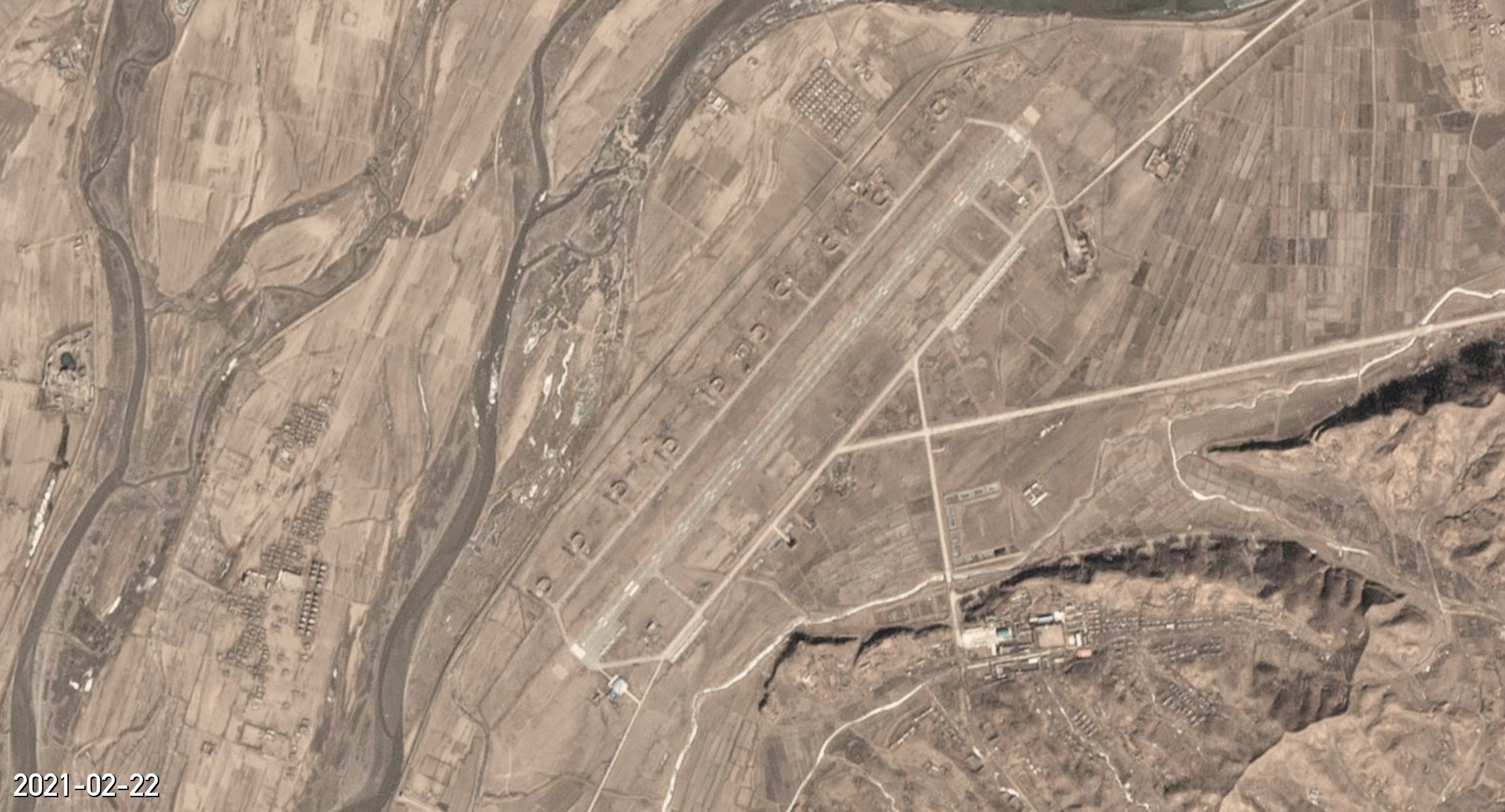 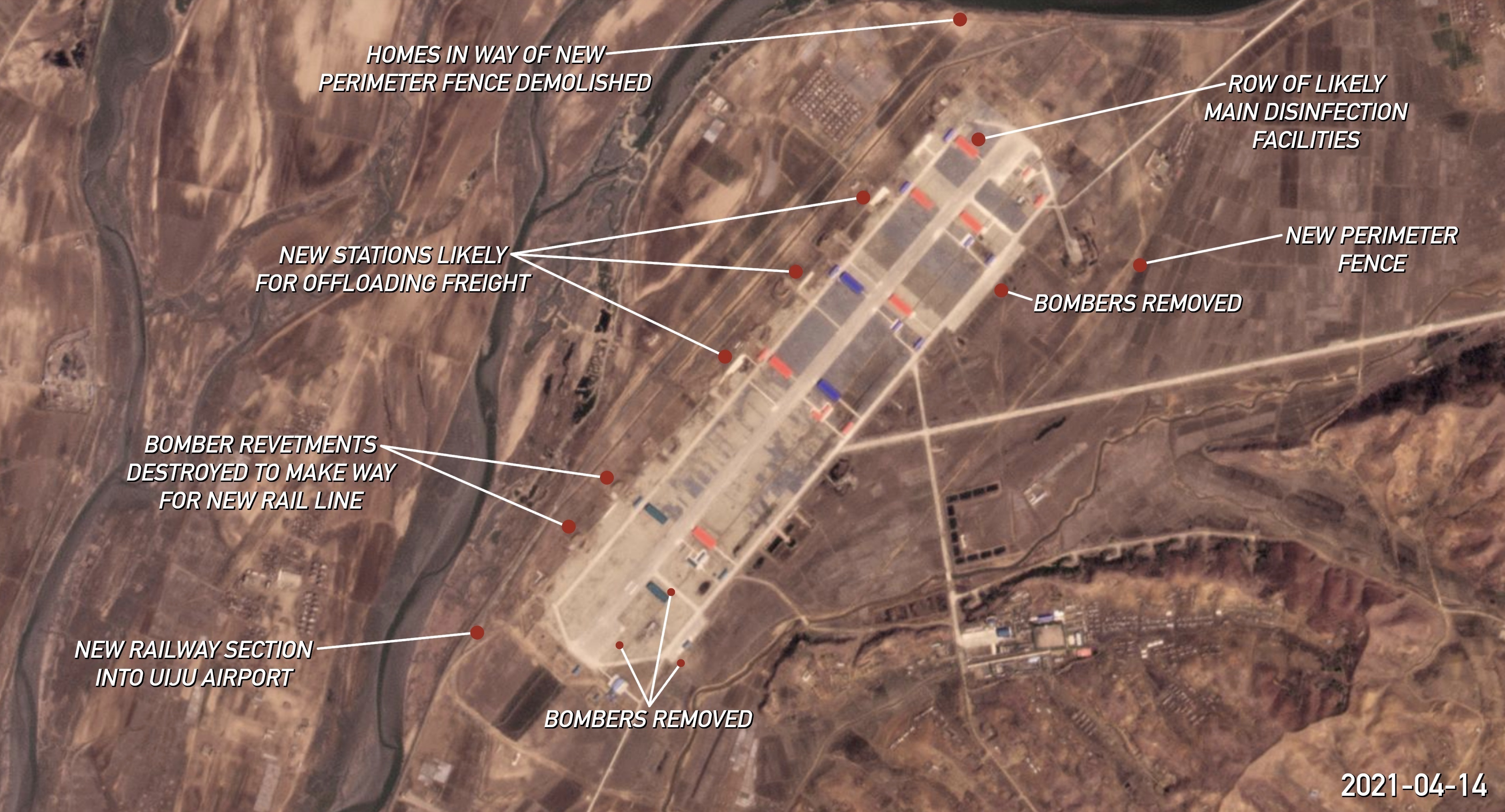 According to satellite imagery, trains carrying cargo from China will likely enter the airfield from the southwest corner and stop along a row of stations next to five new buildings, each measuring 100 x 40 meters (330 x 130 feet) parallel to the runway. Five more buildings of the same dimensions were also built along the south edge of the runway, along with 18 smaller support buildings throughout the airport. The construction began around the middle of February and appeared mostly finished by the end of March, according to Planet Labs imagery, but the facility did not look complete or open as of April 15. RFA reported that the imported freight will continue south to Pyongyang after passing disinfection in Uiju. It is unclear if North Korean cargo planes will also be used to pick up priority goods, but the 2,500-meter-long (1.5 miles) runway appeared to remain unimpeded and available for use.  Speaking from Pyongyang this week, Russian Ambassador Alexander Matsegora said he thinks “freight transport may resume in the near future,” allowing Pyongyang to resume importing “construction materials and equipment” for its latest state-led projects. Ward also said the new disinfection center will help restart imports of “food they can’t produce internally, spare parts for imported machinery and medicines.” “I think food prices are going to come down, corn prices are probably going to come down — corn’s gone up a lot — and the value of the won will decline,” he said. But while the transformed airfield will help solve shortages of goods, it could also have negative implications for North Korea’s military readiness, according to Scott LaFoy, program manager for national security and intelligence at Exiger Federal Solutions. The above timelapse of changes at the Uiju airfield show work starting in late Feb. 2021 and mostly finishing by late March. Some areas appeared incomplete as of mid-April (coordinates: 40.154472°, 124.500933°). | Images: © 2021 Planet Labs Inc. All Rights Reserved, reprinted by permission. Edited by NK Pro. “They clearly tore a ton of bomber infrastructure out,” LaFoy told NK Pro. “It has probably reduced any readiness at the base.” North Korea has based a large fleet of Soviet-made Ilyushin Il-28 and Chinese-made H-5 bombers at the Uiju airport, as well as what LaFoy wrote last year was likely the DPRK’s relatively unknown air-launched cruise missile (ALCM) program. But the bombers were all removed from the airport grounds during the course of the recent construction, and they no longer appear outside a suspected underground storage area for planes nearby. “They could still test ALCMs, but it seems silly right now due to the importance of that facility for the COVID response,” LaFoy said. “They could’ve moved the ALCMs southward and still tested them [from Nampho] last month, but we also see so little out of the ALCM program that it is super speculative.” NETWORK OF DISINFECTION CENTERS? The new facilities at the Uiju airfield appear to be North Korea’s largest new disinfection complex for imported goods, but there are also instances of new construction at other major ports in recent months that could give the DPRK more avenues to restart trade. For example, a single building similar in size to the 10 new buildings at Uiju airfield is under construction at the country’s busiest seaport, the Nampho container port on the west coast. 38 North reported that this construction began last October, and recent satellite imagery indicates it may have been nearing completion as of mid-April. Its purpose, however, remains unknown.  A freight storage facility near the border with Russia was apparently upgraded in early April 2021 (coordinates: 42.418360°, 130.620384°). Images: © 2021 Planet Labs Inc. All Rights Reserved, reprinted by permission. Edited by NK Pro. Satellite imagery shows that North Korea also upgraded a container storage rail station immediately to the south of the country’s border with Russia, connected to the cross-border rail bridge nearby, in the first week of April 2021. In February, Ambassador Matsegora also said that an import disinfection center was being built in the region. North Korea’s busiest east-coast sea port — located in Chongjin — was also outfitted with two new buildings starting in Nov. 2020, according to satellite imagery. New orange roofing was also installed on an existing 80-by-30-meter (260-by-100-feet) warehouse next door, in March 2021.  Edited by Kelly Kasulis © Korea Risk Group. All rights reserved.

|

September 22, 2026Sep 22, 2026

The ultimate resources for professionals working on North Korea
 SHARE
SHARE COPY LINK
 X
X MASTODON