
North Korea’s Answer to Club Med?

beach-scene

Tad Farrell, NKnews.org

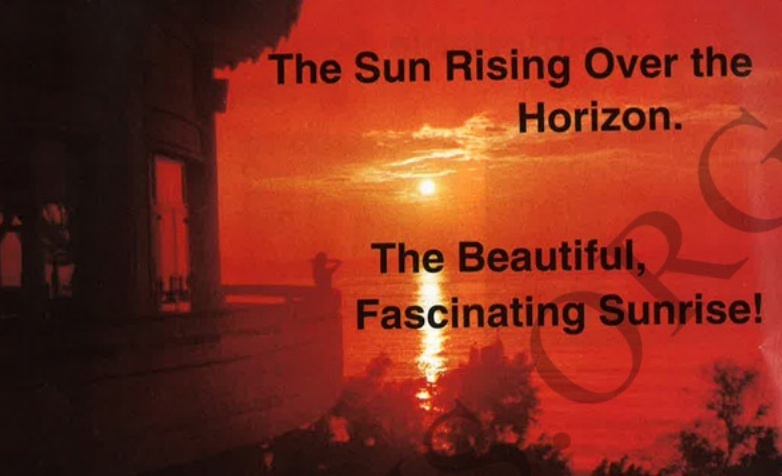
“The Sandy Beach Covered with Flowers and Green Foliage.
The Gulls Flying over the Gentle Waves.
The Fishing Boats Appear on the Horizon Fluttering the Flags
of Heavy Catch – the Beautiful Sea of Majon Gives you a New Hope.”
Download the Majon Beach Resort Brochure (PDF)

A picturesque scene, to be sure.  Wording you might have once found in a Club Med- brochure, describing a balmy resort, hidden somewhere deep in the Asia-Pacific – Bali, Malaysia, or Thailand.   And while the standards described at the Majon Beach Resort may sound familiar, their location will not.  For this destination is located in the Democratic People’s Republic of Korea, or as the brochure details more precisely, in the “suburbs of Hamhung – an Industrial City”.

According to the brochure, visitors to the Majon Beach Resort can take advantage of a relaxing summer sojourn in one of twenty villas, each equipped with TV, air-conditioning and kitchenette. The whole family is welcome to enjoy the 1200m long sandy beach, or to explore the local forest, sporting some 4,000 trees.  Parents can leave their children at the nearby Soho Children’s Bathing Resort for the day to take advantage of the on-site beauty parlour, hire a boat to go fishing with locals, or even visit local factories such as the Hungnam Fertilizer Complex and February 8 Vinalon Complex.

Accommodation at Majon, as depicted in the brochure

Located in the environs of North Korea’s second largest city, the brochure explains that the resort is a five-hour drive from Pyongyang, or eight hours if taking the train.  To make the journey, suggested transport options include taking a taxi, renting a coach, or even chartering a plane.  But quite how this fits with North Korea’s notoriously restrictive concept of tourism is left unexplained.

Today, visitors to the DPRK must be accompanied by guides of the state run Korea International Travel Company (KITC), at all times.  Trips must be planned weeks in advance, with detailed itineraries that oblige patrons to keep on the move as much as possible.  Freedom of movement and personal time is highly limited, helping reduce the risk that overly inquisitive visitors might cause problems.  Quite who the intended audience of the Majon Beach brochure is, or perhaps more accurately, was, is thus, unclear.

With references to the German Mark and photos of a distinctly 1980s hue, this brochure was most probably mass published at a time when the Communist bloc was still standing strong.  At a time when for allies, lazy holidays on the shores of socialist North Korea a distinctively attractive possibility.  When, it was perhaps even feasible for foreign Communists to explore Pyongyang by taxi and metro, un-escorted – practically impossible for tourists today.  But while times have of course changed, interestingly the Majon Beach Resort brochure has not – still being distributed as of 2010 to tourists in the DPRK.

Sunrise at Majon

Sunrise at Majon

Thanks to the recent decision of KITC, travel to the Majon Beach Resort is now possible for Westerners – with the first group having arrived there in early 2010.  Although still well cared for, the resort today unfortunately fails to live up to the de-luxe standards described within its aged promotional material.  Running water no longer fills the pipes, the three restaurants lie for the most part empty, and NGO staff make up the majority of the guests. One wonders when the last time the disco or cinema was last used for any form of entertainment purpose.  Travel to the resort is currently an extremely arduous affair, with roads among the least developed tourists will ever see in North Korea, and a train track that is reported to take far longer to traverse than the eight hours quoted from Pyongyang.

Majon Beach Resort in 2010

Perhaps this dilapidation is what motivated North Korea to open its ‘Modern Majon Hotel’ in the same area, last July.  Promoted extensively in a recent issue of the quarterly Foreign Trade journal, the new resort apparently boasts ultra-modern features that include a “bathing resort, shower stalls, beach volleyball court and a pavilion on a rocky islet”.  North Korea’s state news outlet KCNA described the hotel as a “product of General Secretary Kim Jong Il’s love for the people.”  Unfortunately, most of them will never get an opportunity to enjoy its facilities.  And quite how the building of such an opulent resort in such a remote and inaccessible location can hope to make any form of financial sense for North Korea is hard to understand.  But then again, it is also hard to understand why it made sense to embark on the building of a 3,000 room, 105 floor hotel in Pyongyang during the twilight of the Communist bloc (The Ryugyong, in case you are wondering).  Perhaps this time, North Korea will be more fortunate – a two-lane road linking Hamhung to Wonson is currently being rebuilt, perhaps a sign that there are big plans for the new hotel.

The luxurious "Modern Majon Hotel"

Today, Hamhung remains a city of paradoxes.  It is most famous for its February 8 Vinalon complex, which produces low quality synthetic fibre that there no longer exists an export market for – better quality fabrics can be imported from China for the same price.  Its celebrated Hungnam Fertilizer Complex was built to supply the nation with much needed farming resources, but being connected to the rest of the country via dirt tracks and a train track that is in dire need of attention, one wonders how effective its distribution has ever been.  And while The Majon Beach Resort may have once attracted tourists from across the world, for the most part it today lies empty.  Whether or not its successor stands any chance of giving Hamhung some much needed rejuvenation remains to be seen.

Download the Majon Beach Resort Brochure (PDF)

About the author

Tad founded NK News in 2010 following frustration at the lack of a central hub for North Korea related news and information. He wrote his MA thesis on the DPRK's nuclear weapons programme, studying at Kings College London. He now works in Washington DC. Email him at news@nknews.org
  • Joe S

    Interesting article, how did you obtain the leaflet?

  • Ray Cunningham

    I stayed at this resort in August. The roads getting there were difficult to say the least. I was in a beach house and indeed there was no running water. It was the first time we lived like Koreans. The beach was deserted and there were European NGO people staying at one of the beach houses. The entire complex was underused (as they all are) and little had been done to keep it up.

    My photos of this complex are at: http://www.flickr.com/photos/zaruka/sets/72157624896579416/

  • http://www.nknews.org admin

    Thanks for the pictures and feedback Ray!

  • http://aidanfc.net Aidan Foster-Carter

    Fascinating stuff. I take it the brochure is undated?

    Given that they began almost a quarter century ago – I was on the first UK tourist trip, back in 1986 – I often wonder why they haven’t tried a bit harder to increase tourist numbers, which remain very low.

    To produce a brochure like this in English, indeed to develop the resort, suggests someone had plans and ambitions, once. You wonder what then happened, or didn’t, and why.

    And it got a big makeover in 2009:
    http://english.chosun.com/site/data/html_dir/2009/07/29/2009072900272.html

    Thanks again,
    Aidan

  • admin

    Hi Aidan,

    Yes its interesting so much effort was put in! The makeover you refer to is actually a side project though – there are now two resorts within about 500m of each other in Hamhung, the new one and the one in this brochure!

    The luxury one is very opulent, and bizarre that it is not being offered on any itineraries yet for foreigners.

    Tad.

  • admin

    By the way Aidan, the brochure is undated unfortunately.

  • Jim Hoare

    I stayed there a couple of times in 2001-02, and I too have a brochure. There was running water then, ondol floors in the cool weather and sometimes even hot water. It was not unlike some of the places we stayed in South Korea in the early 1980s.The setting is beautiful. I suspect tourism fell away because of the hard years of the 1990s, though there were groups of Chinese in some scenic areas when I lived there.

  • http://www.llukasz.com/North_Korea.htm llukasz

    Hi !
    I was two times in DPRK and I spent one day/night at the Majon Beach Resort at the begining of October 2010 (…unfortunately during a rainy day…).
    However it was a really good experience…. I swam in the East Sea, we played tennis table with the staff of the hotel… food was delicious… but there was no running water… I hope to have the opportunity to come back to this place in the future… (this time during summer !!)

    There are some photos of the resort in my personal website dedicated to DPRK.
    http://www.llukasz.com/Hamhung.htm

  • http://www.nknews.org admin

    Thanks for linking to you pics, they are good.

  • Robert

    How old is this brochure? They talk about exchange of currencies like US Dollar, Pound (Brittish I presume?) and Mark. Is that Deutsche Mark? We have the euro for over 11 years now!

    • http://twitter.com/nknewsorg nknews

      It was apparently printed in the late 1990s I have now been told!